
Publications & Resources
Our faculty, students and researchers work together everyday to contribute to a better world by grappling with urgent problems we are facing in India. We conduct rigorous work to produce high quality learning resources and publications to contribute to public discourse and social change. Here, we feature a sample from our work for everyone to access. You can explore featured resources, policies, and the latest publications from the University.
To explore all the work of our University, please visit our publications repository.
List of Publications & Resources

- Published
- Authors
Links

- Published
- Authors
Abstract
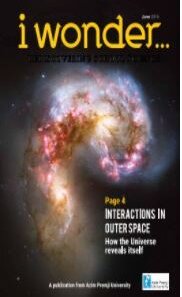
In ‘Interactions’ & ‘Emerging Trends in Biology’, explore articles on chemical ecology, the common cold, fundamental forces, gut microbes in health & disease, & memory. In ‘The Science Lab’, discover simple classroom activities to teach photosynthesis & daytime astronomy. In ‘Annals of History’, trace the journey of microscopy from the simple magnifying glass to the powerful electron microscopes & easy-to-assemble foldscopes available today. Discover the writer & physician Oliver Sacks through his fascination for the human brain, bikes and stories in ‘Biography of a Scientist’. Enjoy our pull-out poster on ‘Ten things you didn’t know about – Bones’ & nature-based activity sheets – ‘Chirp Chirp’, ‘Hibiscus Tales’, ‘Bark Bites’ & ‘All about Ants’! Or browse through our pocket-size pictorial guide to common butterflies!
Links
What we ate then and what we eat now : a grandmother’s tale
in Azim Premji University


- Published
- Authors
Abstract
Malnutrition levels in India remain a major public health challenge. According to the fourth round of the District Level Household Survey (DLHS‑4, 2012 – 13), almost 30 percent of all children under the age of 5 are underweight in most states. This is a serious cause for concern for several reasons: low weight-for-age has been associated with a range of disadvantages, including a higher risk of dying due to several disease conditions among young children; changes in the autonomic nervous system; higher risk of hypertension and insulinresistance in adulthood; adverse impacts on brain development, cognitive ability and school achievement; and behavioural problems such as anxiety and hostility later in life.
Links

- Published
- Authors
Links
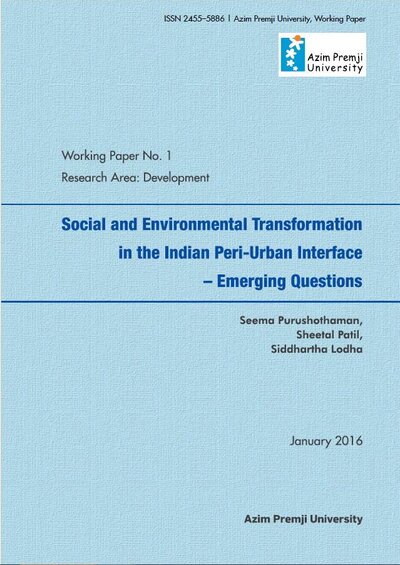
Social and Environmental Transformation in the Indian Peri-Urban Interface – Emerging Questions
in Azim Premji University

- Published
- Authors
Abstract
Urban spaces emerging as nodes and drivers of global capital are recognized as centres of economic growth; while the rest of the geography is consigned to the residual category commonly referred to as ‘rural’. Diversity and increasing numbers of urban centres do not seem to alter this dichotomous perception of urban-rural landscapes and this dichotomy extends to policies and institutions. Nevertheless, the diversity in expansion and extraction pattern of the urban core is reflected in the way it transforms and interacts with its peripheries, fostering types of interfaces that depict urban and rural characteristics and processes to various extents.
Links

- Published
- Authors
Abstract
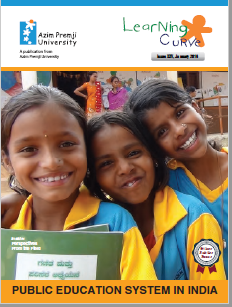
The theme of public education is one that affects every society across the globe. All over, there has been fundamental dissatisfaction with the systems, though the idea itself is intimately linked with a democratic society: one in which the individual is taught her place in the larger society. In India there has been disaffection with both public and private schooling, especially in urban centres, where private schooling flourishes at exorbitant cost, many times with inadequate space, facilities and less than adequate teaching. Every single person in the country is crucially involved in what form education takes, since it matters to us what the future of our society is going to be. It reveals too the tremendous hope that we all have that there are solutions, elusive perhaps, but they exist and it is for us, and others who follow, to find these solutions. This hope is all the more attenuated when we hear stories, as we do, of our public schools in the remotest of places, where teachers are doing a wonderful job, coming to school braving the weather, working under very challenging circumstances, their enthusiasm unabated.
Links

- Published
- Authors
Abstract
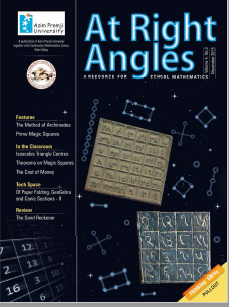
Volume 4 Issue 3: Two themes dominate this issue of AtRiA: Archimedes & Magic Squares — an unlikely combination! Both are exceedingly rich topics to write about, with histories that go far back in time. Who can’t be both charmed and thrilled by the story of Archimedes?
Links

- Published
- Authors
Abstract
Explore ‘Inter-disciplinary Science’ with 5 articles that connect knowledge, methods, & perspectives from across the natural sciences. Trace the exciting history of familiar science concepts in ‘Serendipity’ & ‘Annals of History’. Enjoy reading about the quirky & brilliant J.B.S Haldane in ‘Biography of a Scientist’. Re-discover the wonders of the world within us (Macrophages) & in outer space (Mars Orbiter Mission) in our section ‘In here/Out there’. Prepare to be surprised by the colourful life of the humble fly in the section on ‘Nature in your Backyard’. Check out our ‘Science Online’ section for a step-by-step introduction to an open access software tool for understanding Time. Also enjoy our pull-out posters on ‘Experiments with Water’ & ‘Ten things you didn’t know about – Blood’!
Links

- Published
- Authors
Links

- Published
- Authors
Abstract
The starting point of this Issue is Mahatma Gandhi’s Nai Talim which he envisaged over many years and made available in 1937. Children learn by making and doing, and it is by relating these two to the larger context that the understanding of the whole picture emerges. It is this larger picture that this issue has attempted to present. This issue also explores the relevance of Nai Talim in the India of today. The explorations are on the idea of Nai Talim and the overall visions of a ‘good society’, rethinking Nai Talim in the light of the NCF of 2005, as well as in the present context.
Links

- Published
- Authors
Abstract
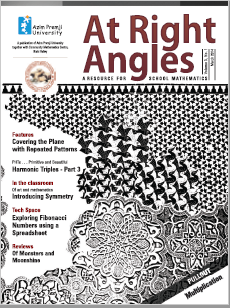
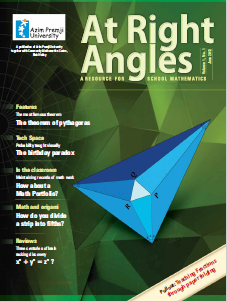
Volume 4 Issue 1: The lead feature in the March 2015 issue of AtRiA is based on the theme Proof Without Words. In the Review section, Mark Kleiner discusses Edward Frenkel’s Love and Math — the Heart of Hidden Reality. Thomas Lingefjard, in his article Learning Math with a DGE system, addresses a pressing need of teachers using technology in the classroom. This issue features a new author Ali Hussen whose article weaves in algebra, geometry and arithmetic. It also introduces a new series on Low Floor High Ceiling activities.The pullout continues on the Teaching of Geometry (part ii).
Links

- Published
- Authors
Links

- Published
- Authors
Abstract
Learning Curve decided to devote this issue to Inclusive Education as a theme. In this issue, readers will find articles on literature for children particularly emphasizing inclusion, on gender stereotyping and an article on RTE and inclusion in schooling, among others. The issue also has an article on teaching language to include, caste as a barrier to education and upward social mobility and, finally, teacher preparedness in curriculum development.
Links

- Published
- Authors
Links

- Published
- Authors
Abstract
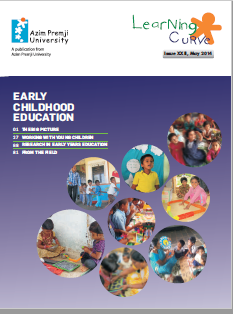
This issue of the Learning Curve focuses on one of the most important periods in any individual’s life — early childhood. Whatever differences there may be on any other aspect of education, this is one area on which everyone agrees: that the years between birth and eight are the most significant and can make or break a life. So universal is this that it is equally true in all cultures. You will find focus articles by some of the most well-known and much respected educationists in the country, followed by very practical and hands-on approaches to Early Childhood Education (ECE).
Links

- Published
- Authors
Links
- Published
- Authors
Abstract
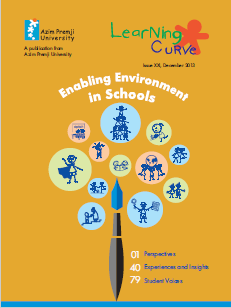
The dictionary defines the word “enable” as, to make able, to give power, means or ability; to make competent, authorise, to make possible or easy. The word “enabling” when used as an indicator in school education can be defined as a comprehensive, multi-faceted series of empowering activities required to address the needs of youngsters facing barriers in the acquisition of both academic and life skills. In this Issue, we have tried to bring together articles recounting the experiences of practicing teachers, educators and students across India even one from a school at an altitude of 12,000 feet from distant Leh! — who have all been part of this process. We have articles that enlarge on the theme of empowerment through responsible citizenry by involving the community in the process, of methods used to facilitate collaborative learning by getting students and teachers to jointly examine their problems and concerns, of attitudinal changes enabled through dialogue.
Links


- Published
- Authors
Links

- Published
- Authors
Abstract
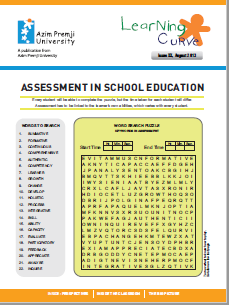
In this issue, we have a range of articles recounting personal experiences of teaching with the goal of inclusive learning rather than a random attempt at throwing information at a mixed ability group, only some of whom could lick the system with others falling by the wayside. Readers will find that diverse aspects of assessment have been thoughtfully tried and objectivity is a key theme. Another important aspect of assessment, namely, reflectively constructed rubrics have been given a place in this issue.
Links

- Published
- Authors
Links

- Published
- Authors
Abstract
This issue of Learning Curve focuses on ‘Innovative teaching-learning practices’ — recipes that have been tried and tested and found to be efficacious, not methods recommended by textbooks. They are practical and completely doable in the most ordinary circumstances, as most classrooms in India find themselves in. No special equipment is required to try out these ways of teaching and the common thread running through them is just the desire to make a difference.
Links

- Published
- Authors

- Published
- Authors
Links
- Published
- Authors
Abstract
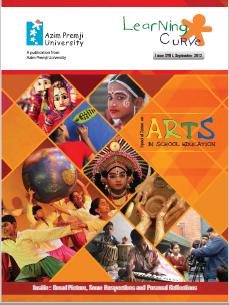
The latest issue of Learning Curve focuses on ‘arts in school education’. The burthen of the collective message of this issue is: in the life of our children, Art is as essential as any other subject. Art sharpens perceptions of the world around us, it increases awareness and sensitivity. It also enhances human relationships as we discover the similarities of the artistic experience. There is a general recognition of the fact that the word ‘art’ encapsulates within itself a wealth of meaning, as witness phrases such as the art of writing, of communication, of social and political exchange.
Links

- Published
- Authors
Links

- Published
- Authors
Abstract
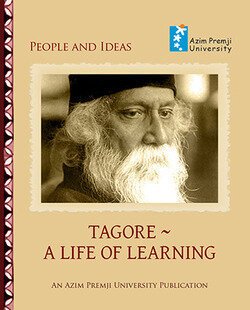
Azim Premji University attempts to explore ideas, lives and work of many social reformers, writers, thinkers and philosophers who have influenced us deeply, and fundamentally shaped our vision and philosophy. This graphic novel is on Rabindranath Tagore’s ideas and philosophy of education. Tagore is an educator for all times and his ideas are as relevant today, as they were when he lived. Tagore expresses in all his writings, that he experienced no joy while being taught by a series of teachers, or shifting from one conventional school to another. His approach to teaching grew from his life experiences. The school he set up in Santiniketan was ‘conceived to free the students’ minds and lead them to a state of creative unity where they would respect human beings, irrespective of caste or creed’. Tagore tried to inculcate the joy of learning among his students by integrating the classroom with nature. The myriad celebrations at Visva Bharati were envisaged to educate his students about the natural and human world around them, about collective action and community involvement. The dream was to foster complete human development where the unique potential of each child could flower in a happy and secure environment.
Note: Best viewed as two pages with the cover separate

- Published
- Authors
Abstract
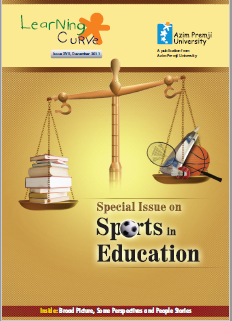
This issue of Learning Curve focuses on ‘sports in education’ which explores topics ranging from the interpersonal and collaborative influences that sports have on children to the skills it develops, from the harsh realities about why people don’t take up sporting careers to the challenges parents face while bringing up sporting kids, from questioning notions of competition in sports to detailing the power of a sporting mind, from examining the contribution of the RTE to revealing the NCF’s take on sports education.
Links

- Published
- Authors
Abstract
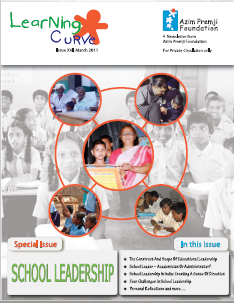
This issue of Learning Curve centres attention on the subject of ‘school leadership’. It defines the construct and scope of educational leadership, ruminates on whether a school leader ought to be an academician or an administrator, reflects on the challenges of school leadership and explores the forms of school leadership in India.
Links

- Published
- Authors
Abstract
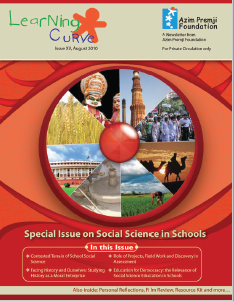
This issue of Learning Curve deliberates on the the purpose of social science in society, what the National Curriculum Framework says about the subject, the many moral conflicts while teaching it, pedagogic dilemmas, and a look at social science education across the world. The effort has been to give our readers an honest and comprehensive view of the nature of social science as a subject.
Links

- Published
- Authors
Abstract
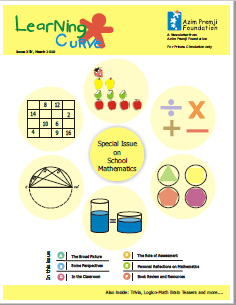
This issue of Learning Curve is cantered on the subject of Mathematics. While one article discusses the very nature of Mathematics, the other traces the history of the subject; similarly while one describes the pedagogy of the subject the other shares insights and the practical perspective of the teacher.
Links