
Publications & Resources
Our faculty, students and researchers work together everyday to contribute to a better world by grappling with urgent problems we are facing in India. We conduct rigorous work to produce high quality learning resources and publications to contribute to public discourse and social change. Here, we feature a sample from our work for everyone to access. You can explore featured resources, policies, and the latest publications from the University.
To explore all the work of our University, please visit our publications repository.
List of Publications & Resources
India’s Economy in the last decade: a view through the Flow of Funds
in Azim Premji University

- Published
- Authors
Abstract
Using the RBI’s Flow of Funds data, this paper examines changes in India’s sectoral balance sheets between FY2011-12 and FY2023-24. It confirms two longstanding features: households remain the dominant creditor and government the dominant borrower. It identifies a break in the historical stability of household asset portfolios, with savings increasingly moving into mutual funds, insurance, and pension products, though deposits remain the largest asset class. It further finds that deleveraging has left corporate balance sheets healthier, and that non-banking financial institutions have displaced banks as the dominant holders of government debt. The paper then draws out four macroeconomic insights: personal consumption appears increasingly supported by credit; private investment remains tepid on weak demand, despite repaired balance sheets; non-banking intermediation has deepened capital markets while raising exposure to market and regulatory dynamics; and persistent current account deficits leave India’s growth dependent on mobile foreign capital.
Authors:
Links
Second-Stage Stratification in India’s Labour Force Surveys: A Simulation Study∗
in Azim Premji University

- Published
- Authors
Abstract
In this paper, we examine the utility of second-stage stratification within the first-stage units (FSUs) of large-scale sample surveys, focusing on India’s official labour force surveys, namely the NSSO Employment-Unemployment Survey 2011-12, the Labour Bureau Employment-Unemployment Survey 2013 – 14, and the Periodic Labour Force Survey 2022 – 23. These three surveys stratify households within the FSU in different ways, and we examine the implications of these choices for the statistical precision of the resulting estimates. Using Monte Carlo simulations on FSUs constructed from PLFS 2022 – 23 unitlevel data, we estimate the variance of each design across three labour market outcomes: labour force participation rate (LFPR), unemployment rate (UR), and labour income. Our primary finding is that the household-level stratification designs employed in these surveys do not necessarily improve precision. For labour force participation and unemployment, simple random sampling outperforms stratification in most FSUs. In general, gains depend critically on the correlation between the stratification variable and the outcome of interest. We propose an alternative education-based scheme that combines lower secondary (10th pass) and graduate attainment. This design raises the median efficiency gain over the PLFS by about 14% for unemployment and 17% for income. We conclude with some reflections on the factors that are relevant to the choice of stratification design.
*We thank Anmol Somanchi and Prof G.C. Manna for helpful discussions. Views are authors’ and do not necessarily represent those of their institutions
Authors:
Pratyush Priyadarshi, Anand Shrivastava, & Amit Basole
Links
- Published
- Authors
Abstract
This paper documents that despite relatively robust output growth, India has experienced a marked and puzzling slowdown in labour productivity over the last decade. This we argue, is partly because of a intensification in dualism. While employment rates have risen, across most kinds of occupations, there is a proportionately greater shift toward self-employment and informal activities (especially among women), which are lower productivity sectors. Overall we document a sustained reversal in labour reallocation toward lower-productivity sectors, especially towards agriculture. We show that this pattern is unusual in international perspective. Sectoral, household, and gender-based evidence indicates that rising per capita incomes have been sustained through labour intensification despite stagnant or declining earnings per worker. An additional and puzzling fact is that there has been a decline in labour productivity growth even in larger firms. Taken together, the findings point to an intensification of dualism-with some growth in formal higher value added activity being offset by much larger growth in activity in lower value added sectors.
Authors:
Links
Creche Attendance and Child Anthropometric Outcomes: Evidence from a Multi-State Early Childhood Programme
in Azim Premji University

- Published
- Authors
Abstract
This paper examines whether attendance in full-day community creches is associated with improved nutritional outcomes among young children in rural India. Drawing on Monitoring and Information System data from creches supported by the Azim Premji Foundation in Bihar, Jharkhand, Odisha and Chhattisgarh, we analyse longitudinal weight and height records for ~11,000 children aged six months to three years. We exploit variation in age at entry and duration of exposure to trace weight-for-age and weight for-height trajectories for children enrolled in these creches. At admission, children are substantially lighter and thinner than both WHO growth standards and children of the same age in the National Family Health Survey, 2019 – 21 (NFHS‑5) from the same districts of APF creches. Fixed-effects regressions show that longer exposure is systematically associated with higher final weight with stronger associations for children who enter at younger ages. We find evidence of catch-up growth as well, with the median child gaining more than 300 grams in weight for each month spent in the creche.
Authors:
Ashutosh Kumar, Dipa Sinha, and Arjun Jayadev
Links
The composition and affordability of Indian diets: Analysis of household consumption expenditure data
in Azim Premji University
- Published
- Authors
Abstract
India exhibits high and persistent rates of undernutrition and a growing prevalence of micronutrient deficiencies — particularly anemia — as well as overweight and obesity. Addressing this triple burden requires diverse, nutritious diets, yet Indian diets remain limited in diversity and nutritional quality, characterized by heavy reliance on cereals and cereal-based foods. Previous studies have shown that diets consistent with India’s food-based dietary guidelines are unaffordable for a large proportion of the population. Using data from the 2023 – 24 Household Consumption Expenditure Survey, we characterize dietary composition and food expenditure in India. We then use derived commodity-level prices to provide updated and representative estimates of the cost and affordability of vegetarian and nonvegetarian diets that meet India’s food-based dietary guidelines. We find that Indian diets are high in visible fat consumption and that most protein is derived from low-quality sources, such as cereals, while consumption of nutrient-dense or high-protein foods remains limited even for the richest deciles. We estimate the daily cost of a healthy vegetarian diet at INR 63.6 per consumer unit and a non-vegetarian diet at INR 73.1 at the all-India level. An estimated 31.2% of urban and 56.6% of the rural population would need to increase their current food expenditure to meet the cost of a healthy diet. If instead we compare our costs against the threshold defined by the State of Food Security and Nutrition in the World (SOFI) 2025 report, we find that 8.3% of urban and 32.6% of rural populations cannot afford a nutritionally adequate diet. While social safety nets subsidize cereals, thereby increasing affordability for the poorest, additional items such as spices and cooking fuel raise total costs. We assess these extensions and discuss policy implications.
Authors:
Kalyani Raghunathan, Anshuman Singh, Dipa Sinha
Links
Rural growth and distribution. Two narratives from the PLFS 2017 – 2023
in Azim Premji University
- Published
- Authors
Abstract
This paper investigates a striking puzzle in recent rural India: individual real wages have shown weak or stagnant growth for large segments of the labour force, while house hold per-capita incomes have risen materially and, in many cases, faster among lower deciles. Using microdata from the Periodic Labor Force Survey(PLFS)2017 – 2023, wedocu mentthese contrasting patterns and reconcile them. First we undertake a simple decompo sition that separates (i) average real wage per earner, (ii) the number of earners per house hold, and (iii) household size. Our empirical analysis shows that demographic and labour supply adjustments — chiefly an increase in earners per household driven by rising labour force participation and expanded non-farm employment — accountforthebulkofobserved gains in household per-capita income even as individual real wages remain subdued. Dis tributional analysis reveals that percentage growth has been relatively progressive (lower deciles recording larger proportional gains), but absolute level gaps persist and, in many cases, widen. We further disaggregate decile income by occupational category and find that lower deciles have seen significant shifts from casual work to self-employed status. Since the latter category provides, on average, higher incomes, this can partially explain muchof the observed progressivity of household income growth.
Authors:
Links
Growth, Employment, Productivity and Demographics in Indian States: Lessons from an Accounting Decomposition
in Azim Premji University
- Published
- Authors
Abstract
This paper examines the interaction between demographic change, employment absorption, and productivity growth across Indian states using a transparent accounting decomposition. Methodologically, we extend standard demographic dividend accounting by explicitly incorporating labor-market absorption, decomposing per capita Net State Domestic Product (NSDP) growth into output per employed worker, the employment-to-working-age population ratio, and the working-age share of the population. This employment-adjusted framework separates the mechanical contribution of age structure — the arithmetic demographic dividend — from labor-market dynamics and productivity performance. Using state-level data spanning 1994 – 2023, we document substantial heterogeneity in demographic transitions and growth experiences across Indian states. Declining dependency ratios provided a positive mechanical contribution to per capita growth in almost all states. However, this potential dividend was frequently muted — and in several cases fully offset — by falling employment-to-working-age ratios, particularly during the high-growth period from 2004 to 2017. At the same time, several better performing states, sustained high growth in output per working-age adult over long periods. A three-period decomposition (1994 – 2004, 2004 – 2017, and 2017 – 2023) reveals a marked shift in the composition of growth. While earlier phases were characterized by strong productivity growth alongside weak employment absorption, the post-2017 period exhibits a partial recovery in employment ratios accompanied by a broad-based slowdown in productivity per employed worker. We use the historical bounds implied by these decompositions to construct counterfactual growth trajectories, highlighting the limits of demographic advantage in the absence of employment-intensive productivity growth.
Links
Rural Transformation in India: What can we learn from village studies?
in Azim Premji University
- Published
- Authors
Abstract
This article examines rural transformation in India through a review of longitudinal village studies conducted over the past three decades. It argues that rural India is not undergoing structural transformation in the classical sense. While labour is steadily moving out of agriculture, this shift has not led to higher productivity in agriculture or the development of a robust rural nonfarm economy. Instead, what unfolds is a process of deagrarianisation, driven by out-migration of male workers to cities where they engage in informal nonfarm employment. This transition is uneven and remains deeply embedded in existing hierarchies of caste, class, and gender, which shape both access to opportunities and outcomes. By identifying common patterns across diverse regional contexts, the article shows how village studies provides a grounded perspective on the nature of rural change.
Author:
C.R. YaduLinks
Social norms and women’s employment in India: A district level analysis
in Azim Premji University

- Published
- Authors
Abstract
Reducing gender disparities in workforce participation is an important policy goal in several developing countries. India, in particular, has historically had low levels of women’s workforce participation as compared to men and as compared to peer economies. Prior research has identified both supply and demand-side explanations for low levels of women’s participation in paid work. On the supply side, social norms constraining women’s mobility and autonomy are commonly invoked as one explanation. We test the relevance of such norms in explaining heterogeneity in women’s employment using district-level data from the National Family Health Survey (NFHS) 2015 – 16 and the Sixth Economic Census (2013). Norms indices are constructed using Principal Components Analysis for 640 districts of India. The findings indicate that less restrictive norms related to decision-making, mobility, and asset ownership are positively correlated with higher levels of women’s employment.
Authors:
Subhapriya Chakraborty and Amit Basole
Links
- Published
- Authors
Abstract
Unemployment is one of the key macroeconomic variables used to assess the performance of an economy. However, there is a bias towards conceptualizing unemployment solely through its predominant measure of rates. Considering that rates alone do not reflect labor market conditions, especially in developing countries, it is crucial to include unemployment duration in analyzing labor market efficacy and the larger economy. This paper utilizes longitudinal data from CMIE to understand the determinants of unemployment duration through an OLS linear regression and survival analysis. It finds that the groups that experience longer spells of unemployment are young and old individuals, the highly educated, and upper caste individuals. Nonparametric survival analysis is also employed to account for censoring through the hazard and survival function. This model also finds that duration dependence is non-monotonic with individuals experiencing high initial re-employment probabilities before experiencing a decline in their hazard rates. However, analysis of re-employmentwages and occupation indicates a positive association with unemployment duration which indicates potential benefits to extended job search.
Author:
Roshan Kannan
Links
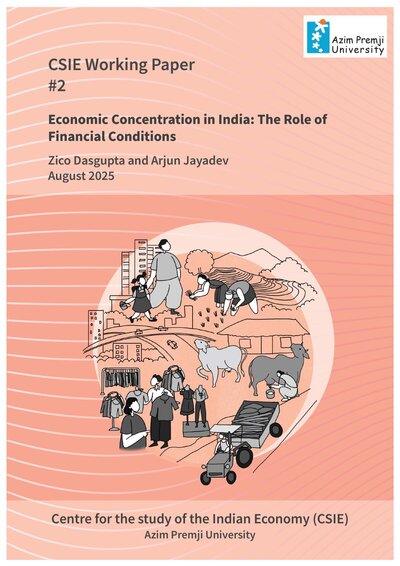
Economic concentration in India: The role of financial conditions
in Azim Premji University
- Published
- Authors
Abstract
This paper examines recent trends in corporate concentration in India’s non-financial sector, with a focus on developments since 2015. Using firm-level data from the CMIE Prowess database we document changes in asset and income distribution across firms. We find that while the overall decline in the public sector’s share of assets and income contributed to a reduction in measured concentration in earlier years, this was accompanied by a steady increase in the share held by large private business groups. By 2023 – 24, the top five business groups — Reliance, Tata, Adani, Aditya Birla, and Bharti — accounted for approximately 24(%) of total assets and 16(%) of total income in the non-financial corporate sector.
Authors:
Links
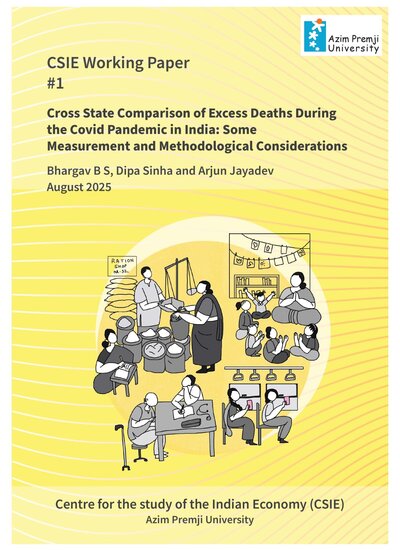
Cross state comparison of excess deaths during the covid pandemic in India: Some measurement and methodological considerations
in Azim Premji University
- Published
- Authors
Abstract
This paper assesses excess mortality in India during the COVID-19 pandemic, focusing on the year 2021 when the country experienced a substantial surge in deaths. Drawing on newly released official data from the Civil Registration System (CRS) and the Sample Registration System (SRS), and supplemented with estimates based on the National Family Health Survey (NFHS‑5), we construct a range of mortality estimates using multiple baseline comparisons. Excess deaths are calculated in absolute terms, per 1,000 population, and using age-standardised death rates to facilitate cross-state and international comparisons. Particular attention is paid to persistent challenges in India’s mortality data landscape, including regional disparities in death registration completeness, limitations in cause-of-death certification, and inconsistencies between administrative and survey-based sources. The analysis includes alternative projections that adjust for estimated registration completeness, underscoring the sensitivity of mortality estimates to underlying data assumptions. By applying standard demographic techniques such as age standardisation, we attempt to mitigate the effects of India’s heterogeneous age structure and registration coverage. The findings suggest a substantial mortality impact from the pandemic, exceeding officially reported figures, and raise broader questions about the capacity of statistical systems to support real-time health surveillance. We identify correlates in terms of state capacity.These results have implications for public health preparedness, intergovernmental coordination, and the long-term strengthening of civil registration and vital statistics systems in India.
Authors:
B S Bhargav, Dipa Sinha and Arjun Jayadev
Links
And the search goes on: Job search and job-finding rates in urban India
in Azim Premji University
- Published
- Authors
Abstract
The cross-sectional nature of Indian employment surveys limits a true understanding of labour market dynamics. Using innovations in official national-level labour surveys that track urban individuals across four quarters, we study transitions from unemployment to employment — defined as the job-finding rate — to understand whether those seeking employment are able to find suitable work in urban India. Our analysis reveals significant weaknesses in the urban Indian economy over the period 2017 to 2023. On an average, only 17 per cent of unemployed individuals in any quarter find a job in the next quarter. Job-finding rates are the lowest for women, the young and the highly educated. Hazard-rate analyses reveals that the same cohorts take the longest time to find jobs, with a majority remaining unemployed even after four quarters of job search. We demonstrate the impact of the pandemic on urban labour markets in two ways. Not only are job-finding rates significantly lower in the post-lockdown period relative to pre-lockdown, there has also been a shift in the nature of jobs created, with casual work rising and regular wage and self-employment falling post-lockdown. Our analysis has important policy implications for understanding labour market dynamics and for the design of urban employment schemes.
Authors:
Rahul Menon & Paaritosh Nath
Links
The Prospects of Employment Opportunities in India: A Medium — term Sectoral Analysis
in Azim Premji University

- Published
- Authors
Abstract
Employment projection, particularly at the micro or sectoral level, is considered as a useful tool for economic planners and policymakers to have a better understanding of future trends and growth, and accordingly, the policies and planning could be designed for the supply side of the labour market.
This study finds that there is a lack of literature in the recent past on the above issue in the context of India, hence in this paper, we have tried to estimate employment numbers for seven broad economic sectors for the period 2024 – 25 to 2030 – 31. The study uses the “Top-down” approach to estimate and project the employment numbers by using the employment-output elasticities and forecasted values of growth rates of gross value added (GVA) at the sectoral level.
Three broad conclusions have been drawn from the employment estimates. First, the agriculture and allied sector continued to be the dominant force in creating employment opportunities till 2030 – 31, however, a surge of employment in the sector in recent years may unlikely continue in the future. Second, the slowing down of economic activities in services sector is expected to dent high employment growth prospects in the sector. Third, a phenomenal rise of employment in industry particularly in manufacturing sector in recent years augurs well for the economy which is expected to remain buoyant in the medium term as well
Links
Regressive income shocks during COVID-19: Evidence from India
in Azim Premji University

- Published
- Authors
Abstract
Studies based on the Consumer Pyramids Household Survey (CPHS) in India have shown that the impact of the Covid-19 lockdown on household incomes was progressive in nature — richer households suffered more. But several media reports as well as purposive surveys carried out during the pandemic suggest that the poor suffered more than the rich. We use nationally representative panel data for urban India from the official Periodic Labour Force Survey (PLFS) to show that households that were relatively richer prior to the start of the pandemic suffered relatively less during the lockdown compared to households that were poorer. That is, the shock was regressive in nature. We also confirm that, as per CPHS, richer households did indeed experience higher drops in income than poorer ones. But we show that this progressivity is much less than what prevailed prior to the pandemic. Thus the pandemic either disrupted ongoing progressive income changes or was outright regressive in its impacts.
Authors:
Amit Basole, Anand Shrivastava, Jay Kulkarni and Akshit Arora
Links
Association between Caste and Class in India- Evolution of Caste-Class Dynamics during Economic Growth
in Azim Premji University
- Published
- Authors
Abstract
Caste and class are two major markers of social and economic stratification in India. They play a crucial role in sustaining and strengthening the process of social exclusion. It has been often expected that the process of economic growth and modernization may weaken the congruence between caste and class structures and induce social and economic mobility, thereby bringing about a change in the socio-economic environment. In this paper, we focus on the celebrated period of high economic growth in India during the previous decade to study the evolution of caste-class dynamics, to analyse the pattern of association between caste and class positions, and examine whether this association/congruence has weakened during this period. The analysis is based on four rounds of employment-unemployment surveys of the National Sample Survey Organization covering the period 1999 – 2012. We construct a matrix of caste and class positions of repeated cross-sections of individuals that shows whether different caste groups are over- or under-represented in different class positions and how these representations have changed over time. We then use a multinomial logistic regression framework to capture the role of caste in explaining the conditional probability of an individual to belong to a particular class position, after controlling for other critical explanatory variables. We further examine how the explanatory role of caste has changed over time. Additionally, we explore the role of education, a crucial channel for socioeconomic mobility, in explaining the class positions of individuals belonging to different caste groups over time. Finally, we examine the impact of high economic growth in determining the class position of an individual in general, as well as for different caste groups over time. The analysis shows that caste has continued to remain an important factor in explaining class locations of individuals during the period of high economic growth. Further, the caste-class associations have continued to persist across different categories of education over time. While there has been a partial weakening of certain associations during the period, particularly for the Other Backward Castes and in some parts of the rural sector, the overall picture is more of continuity than change, with further strengthening and reinforcement of caste-class congruence along several axes. This calls into question the expectations about social mobility with economic growth as well as the nature of economic growth in India.
Author:
Vaishali Kohli
Links
The Unhappy Marriage of Women’s Work and Spousal Violence in India
in Azim Premji University
- Published
- Authors
Links
Telephone surveys for data collection – some reflections
in Azim Premji University
- Published
- Authors
Abstract
The last few years have seen an upheaval in practices of data collection and survey methods. Even before the pandemic, several data collection endeavors had begun the transition to digital, computer-assisted, and tablet-based surveys. India’s labor force surveys themselves had moved away from traditional paper- based surveys to computer-assisted PI techniques. The Covid-19 pandemic imposed a massive shock to these practices. Across several countries, ongoing surveys had to be prematurely terminated or put on hold in the interest of the safety of enumerators and interviewers.
Authors:
- Rosa Abraham
- Mridhula Mohan
Links
What did they say- Respondent identity, question framing and the measurement of employment
in Azim Premji University
- Published
- Authors
Abstract
In developing countries, a precise approach to measuring women’s employment remains elu- sive. Emerging evidence underscores the pivotal role of survey methodology, encompassing respondent selection and question framing, in shaping the assessment of women’s employ- ment. Drawing from two labor market experiments in rural India, this study offers insights on the influence of survey design on the measurement of women’s employment. The first ex- periment contrasts self-reported women’s and men’s employment figures with proxy-reported data from spouses. Women’s self-reported workforce participation surpasses proxy-reported estimates by six percentage points, while men’s estimates exhibit negligible differences. There are significant differences in the type of employment activities reported by self and proxy for both women and men. These divergences emanate from asymmetric measurement errors, stemming from gender-based norm disparities between spouses, and divergent interpretations of employment. Additionally, information asymmetry between spouses concerning women’s marginal activities and disparities in spousal characteristics contribute to these self-proxy differences. The second experiment investigates if framing of questions and recall period has an impact on reporting of labor market outcomes. We find that employing multiple ques- tions to capture weekly employment status yields a 10-percentage-point increase in reported women’s workforce participation, but men’s participation rate decreases by six percentage points. Furthermore, when a distinct employment query is directed at each day of the pre- ceding week as opposed to a single query for the entire week, reported women’s workforce participation increases by seven percentage points, and men’s by four percentage points.
Authors:
- Rosa Abraham
- Nishat Anjum
- Rahul Lahoti
- Hema Swaminathan
Links
Jobless growth and structural transformation- Some theoretical considerations and empirical evidence from India
in Azim Premji University
- Published
- Authors
Links
Tracking workers across generations – a cohort-based analysis
in Azim Premji University
- Published
- Authors
Abstract
Alongside rapid economic growth, India also saw steady de-agrarianisation of its economy in terms of contribution to GDP. In terms of employment, however, the movement out of agriculture was slower, and when they did exit, it was often a withdrawal from the workforce entirely. In general, more of the workforce are in salaried employment, however, these have filtered differently by gender, caste and religion. While cross-sectional data gives us a sense of how these structural changes affect workers at any given point in time, it cannot tell us how these play out for workers over their lifetime as well as how different generations or cohorts of workers have been affected. Here, we use seven rounds of nationally representative official data to construct cohorts who are tracked over these periods to observe employment participation and the patterns over time. We find that younger generations of women systematically less likely to be in paid employment whereas for men, after a certain age, generations look similar in terms of employment rate. Similarly, when examined from the perspective of cohorts, we find that access to salaried employment has changed by gender and caste, and increase in earnings over time over their lifecycle has slowed for certain groups.
Author:
- Rosa Abraham
Links
Estimating the productivity gap between organised and unorganised small-scale units in India’s manufacturing sector
in Azim Premji University
- Published
- Authors
- Amit Basole
- Dimple Chopde
- Paaritosh Nath
Abstract
Small manufacturing firms are considered to be engines of growth and job creation. While most research on small firms focuses on formal sector units, in India informal sector units far outnumber the formal. This is true even for manufacturing units employing 5 to 49 workers, which constitute only 5% of all unorganised units, but in absolute numbers are nine times more numerous than organised units in the same size class. Such firms have the potential to contribute to structural transformation but their capacities vis-a-vis formal firms are not well understood. To address this, the researchers create a unit-level dataset combining Annual Survey of Industries data for organised (formal) units with the National Sample Survey data on unorganised (informal) units. They also discuss problems involved in this exercise and some ways to deal with them. They find that matching organised and unorganised units on observable characteristics reduces the labour productivity differences between them to around 25 percent. The researchers discuss some policy implications of their results.
Authors:
- Amit Basole
- Dimple Chopde
- Paaritosh Nath
Links
Labour market flows and gender differentials in urban unemployment over the pandemic
in Azim Premji University
- Published
- Authors
- Paaritosh Nath
- Rahul Menon
Abstract
Utilising data from the Periodic Labour Force Survey, the researchers estimate quarterly changes in urban labour market flow over the period 2018 to 2022 and the impact on unemployment rates for men and women. Their analysis provides non-intuitive explanations for established findings as well as points out important questions for further study. Both men’s and women’s unemployment rates have reduced in 2022 compared to 2018, showing rapid reductions following the high levels reached during the lockdown. Women’s unemployment rates have consistently been higher than men’s throughout this period. The gap between men’s and women’s unemployment rates reduced during the lockdown, but has shown signs of increasing since 2021, even as unemployment rates have fallen. For women, flows from the labour force to non-participation play a larger role in explaining changes in unemployment rates as compared to men. Flows from the labour force to non-participation, however, have reduced since the pandemic, providing an explanation as to why labour force participation rates have increased, namely, women staying for longer in the labour force rather than more women entering it. Despite rising labour force participation rates, the gender gap in unemployment rates has risen, in contrast to developed economies.
Authors:
- Paaritosh Nath
- Rahul Menon
Links
Who was Impacted and How? | COVID-19 Pandemic and the Long Uneven Recovery in India
in Azim Premji University
- Published
- Authors
Abstract
We investigate the impact of the COVID-19 pandemic on income levels, poverty, and inequality in both the immediate aftermath and during the long uneven recovery till December 2021 using high-frequency household survey data from India. We find that the average all-India household income dropped between 30 to 38 percent during the months of the nationwide lockdown of April and May 2020. The subsequent recovery remained incomplete and was unevenly spread over the population even twenty-one months after the start of the pandemic. Households, on average, continued to make 16 to 19 percent lower cumulative income in the post-lockdown period, but have mostly recovered after the second wave in the second half of 2021. Poverty more than doubled during the lockdown and was 50 to 80 percent higher in the post-lockdown period in comparison to the pre-pandemic levels. In the post-second-wave phase, poverty was still slightly higher than in the pre-pandemic period, and any progress in poverty reduction that would have been achieved under normal circumstances over the two years was lost. Inequality too spiked during the lockdown, but returned back to the pre-pandemic levels. Using an event study model we find that the initial shock of the lockdown was more severe for the bottom of the income distribution, but the bottom also experienced a faster recovery. On the other hand, the top end of the distribution experienced smaller declines during the lockdown but they have been slow to recover. The bottom deciles in any period typically constituted households working in contact-intensive, informal, less secure occupations that were hit the hardest during the lockdown, but were quick to recover when the economy opened up. The upper end of the distribution constituted households working in less contact-intensive, formal, secure occupations that were shielded from the sudden shock but were slow to recover.
Authors:
- Mrinalini Jha
- Rahul Lahoti
Links
Did the nation-wide implementation of e‑FMS in MGNREGS result in reduced expenditures? A re-examination of the evidence
in Azim Premji University
- Published
- Authors
Abstract
This paper revisits a part of the analysis by Banerjee et al. (2020), in which they examine the consequences of the nation-wide scale up of reforms to the funds management system (e‑FMS) in India’s national workfare programme, using a two-way fixed effects specification. They report a substantial 19 percent reduction in labour expenditures. We exploit the recent literature that highlights the limitations of the TWFE estimator in the presence of staggered roll out and effect a Goodman-Bacon decomposition of the TWFE coefficient, to pinpoint sources of identifying variation. We undertake a detailed examination of subsamples of six constituent and valid DiDs based on timing of treatment that are averaged into the TWFE coefficient to identify heterogeneity in treatment effects. This disaggregated subsample analysis does not support the conclusion of any reductions in MGNREGS labour expenditures, suggesting that the TWFE coefficient based on the full sample is indeed biased.
Authors:
- Deepti Goel
- J.V. Meenakshi
- Zaeen De Souza
Links
Loss, recovery and the long road ahead: Tracking India’s informal workers through the pandemic
in Azim Premji University
- Published
- Authors
Abstract
Drawing on results from a panel of 2778 workers interviewed during and after the 68-day hard lockdown imposed in India, the following study examines the livelihood impact of the pandemic and the extent of subsequent recovery or lack thereof. Focussing specifically on workers located in the informal economy, the study is a useful addition to the burgeoning body of work on the economic impacts of Covid-19 by providing an insight into the employment and earnings recovery of those located at the margins. These findings are spliced across socio-economic groups to showcase the differential impact of the pandemic on different demographics within the informal sector.
Authors:
- Paaritosh Nath
- Nelson Mandela S
- Aishwarya Gawali
Links
Labour incomes in India- A comparison of PLFS and CMIE-CPHS data
in Azim Premji University
- Published
- Authors
Abstract
The Covid-19 pandemic has created a need for high frequency employment and income data to gauge the nature and extent of shock and recovery from month to month. Lack of such high frequency household-level data from official sources has forced researchers to rely almost entirely on the Consumer Pyramids Household Survey (CPHS) conducted by the Centre for Monitoring the Indian Economy (CMIE). Recently, the CPHS has been criticised for missing poor and vulnerable households in its sample. In this context, it becomes important to develop a detailed understanding of how comparable CPHS estimates are to other more familiar sources. We examine the comparability of monthly labour income estimates for the pre-pandemic year (2018−19) for CPHS and the Periodic Labour Force Survey (PLFS). Across different methods and assumptions, as well as rural/urban locations, CPHS mean monthly labour earnings are anywhere between 5 percent to 50 percent higher than corresponding PLFS estimates. In addition to the sampling concerns raised in the literature, we point to differences in the way employment and income are captured in the two surveys as possible causes of these differences. While CPHS estimates are always higher, it should also be emphasized that the two surveys agree on some stylized facts regarding the Indian workforce. An individual earning INR 50,000 per month lies in the top 5 percent of the income distribution in India as per both surveys. Second, both PLFS and CPHS show that half the Indian workforce earns below the recommended National Minimum Wage.
Authors:
- Mrinalini Jha
- Amit Basole
Links
How Comparable are India’s Labour Market Surveys?
in Azim Premji University
- Published
- Authors
Abstract
The Centre for Monitoring Indian Economy’s (CMIE) Consumer Pyramid Household surveys have emerged as an important source of regular labour market data for India. Given the differences in methods in data collection between the CMIE and official employment sources, it becomes exceedingly important to establish some comparability between the government and the CMIE datasets. With the release of the official labour surveys, Periodic Labour Force Surveys for 2017 – 18, we now have an overlap between the official datasets and CMIE datasets. In this paper, we examine the extent of comparability of labour force estimates from these two datasets. We find that employment estimates for men are broadly comparable. However, for women, there is a consistent divergence with CMIE estimates of women’s workforce participation lower than that of NSS-PLFS. We explore the points of divergence in the measurement of women’s work and hypothesise some potential reasons for this difference. We find that irrespective of the reference period used in the PLFS estimation of employment statuses, there is no convergence with the CMIE employment estimate for women’s employment. Moreover, the mismatch in CMIE-PLFS estimates occurs across all types of women’s employment and irrespective of what reference period of employment (in official data) is used.
Authors:
- Rosa Abraham
- Anand Shrivastava
Links
Financing Fiscal Support under Alternative Policy Frameworks
in Azim Premji University
- Published
- Authors
Links
Improving Survey Quality using Para Data- Lessons from the India Working Survey
in Azim Premji University
- Published
- Authors
Abstract
The efficacy of survey-based policy recommendations is primarily dictated by the quality of data collected in the first place. Is the survey truly representative of the population it claims to characterise? Are respondents voicing their true opinions or are they playing to the gallery? Did enumerator bias creep into the data? These are questions that most users of surveys have, but are typically brushed aside in the race to get the analyses out. While there are no foolproof measures to ensure that survey data are authentic, certain steps can be taken to improve their dependability. One such is the use of what is called ‘para data’ (data about the process of data collection), to streamline enumerator practices, and thereby improve the reliability of the data being collected. This report details our experience of using para data to improve the quality of the India Working Survey (IWS).
Authors:
- Deepti Goel
- Rosa Abraham
- Rahul Lahoti
Links