
Publications & Resources
Our faculty, students and researchers work together everyday to contribute to a better world by grappling with urgent problems we are facing in India. We conduct rigorous work to produce high quality learning resources and publications to contribute to public discourse and social change. Here, we feature a sample from our work for everyone to access. You can explore featured resources, policies, and the latest publications from the University.
To explore all the work of our University, please visit our publications repository.
List of Publications & Resources
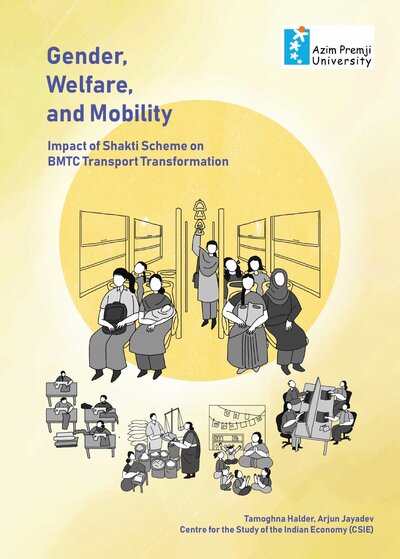
Gender, Welfare, and Mobility: Impact of Shakti Scheme on BMTC Transport Transformation
in Azim Premji University

- Published
- Authors
Abstract
The Shakti scheme, launched by the Government of Karnataka in June 2023, represents one of the most ambitious efforts in India to reimagine welfare by providing free public transport for women. Unlike welfare programmes based on targeted cash transfers, this scheme redefines inclusion through the provision of a universal, non-cash public service mobility. This report is an assessment of the evolution of the scheme with specific regard to the BMTC’s experience. In the period studied– January 2023 to March 2025, covering both pre- and post-implementation phases – the scheme generated a significant surge in bus usage across the state. With more than 2.89 crore trips recorded, a striking transformation in mobility patterns was observed. Importantly, women riders quickly outnumbered men on many of the busiest routes– especially in the Central Business District, reflecting a major shift in access to and usage of public transport. The ridership gains were particularly sharp in the first six months following the scheme’s launch and have since stabilised, indicating a sustained and regular usage pattern among women. The report is divided into three sections. In the first, the researchers discuss state-level free travel schemes. They address certain questions about Karnataka’s experience within wider debates about universalism versus targeting in social policy. In the second, they discuss the report, its methods and findings. In the final section, they discuss some potential paths forward.
Ownership, Accumulation, and the Land Question: Insights from a Village Survey in Central India
in Economic and Political Weekly
Article
- Published
- Authors
Abstract
The consolidation of agricultural lands by dominant socio-economic groups is discussed in the context of contemporary debate on the land question by foregrounding market-led land transfers as a driver of accumulation in rural India. Empirically rooted in central India, the paper studies the commodification and increasing concentration of land as an outcome of the processes of agrarian change at work.
Links
Delivering Affordable Nutrition Security through Fish: Evidence from a Rural Village in Telangana
in Indian Journal of Agricultural Economics
Article
- Published
- Authors
- School of Development
Abstract
The study explores the role of fish consumption in addressing nutrition security and malnutrition in a rural village in Telangana, India. It highlights that fish, particularly small indigenous species, provide affordable, high-quality protein and micronutrients. The study compares fish with other protein sources like poultry and livestock, finding that fish consumption significantly meets the nutritional needs of the rural population more effectively than other animal sources. India, despite being the third-largest fish producer globally, still faces challenges with malnutrition, especially among children and women. National Family Health Survey (NFHS) reports show alarming rates of stunting, wasting, and anemia, particularly in Telangana. The study demonstrates how increased fish consumption can play a crucial role in reducing these malnutrition rates by offering a cost-effective and nutrient-dense food source. The state government has encouraged fish production in Telangana through subsidies and initiatives like Pradhan Mantri Matsya Sampada Yojana. However, the research suggests that the fish distribution infrastructure needs significant improvement to increase access to fish for the broader population. The paper concludes that promoting fish consumption can be a viable strategy to combat malnutrition, improve food security, and provide economic opportunities for rural communities. Policy recommendations include enhancing market infrastructure, increasing fish production through scientific aquaculture, and raising awareness about the nutritional benefits of fish. These measures could ensure that fish contributes more significantly to achieving Sustainable Development Goals (SDG) related to hunger and malnutrition.
Authors: Gummadi Sridevi, Amalendu Jyotishi, Balaji Patturi, Matta Srinivas

- Published
- Authors
Abstract
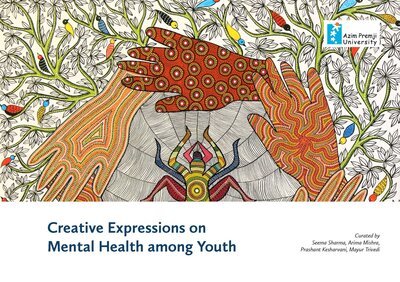
What does mental health mean to the youth? How is it expressed beyond just diagnostic labels? The book on ‘Creative expressions on mental health among youth’ features over 40 powerful contributions through a range of forms that include poetry, prose, Gond and Bhil art, sketches, doodle art as well as excerpts from diaries. The writings are presented in Hindi, English and Pardhi languages thus creating a safe and inclusive space for many. Each word and each image encapsulate a story that is hidden yet spoken. This book is an effort to break silences around the conversations on mental health.
Curators:
Seema Sharma, Arima Mishra, Prashant Kesharvani, Mayur Trivedi
Links
Capacity-Building Needs of Elected Women Representatives — Stories from Peri-Urban Panchayats of Bangalore
in Springer Nature

- Published
- Authors
Abstract
While the 73rd and 74th constitutional amendments contributed to the increase in women elected representatives in the Indian political ecosystem, the efficacy of this phenomenon has been questioned multiple times. The evidence points out that electoral participation is merely a symbolic gesture, which ultimately undercuts women’s empowerment by co-opting them into a patently corrupt, male-dominated political system. It is widely acknowledged that the political journey is not smooth for elected women representatives (EWR) in a patriarchal society, which is further divided on caste lines. Due to the existing structural challenges and insufficient support system, EWRs take a longer time to understand their responsibilities and perform their duties effectively. Training and awareness-building programmes of the state government and NGOs have had limited success in solving these challenges. Therefore, this research project was taken up by faculty and students of Azim Premji University to understand the challenges faced by EWRs, and thereby, design training modules, which will help them resolve these challenges. Data collection was done in seven panchayats around Azim Premji University. EWRs along with other respondents have given us substantial insights based on which an attempt to create a typology of challenges by EWRs is made.
Links

- Published
- Authors
Abstract
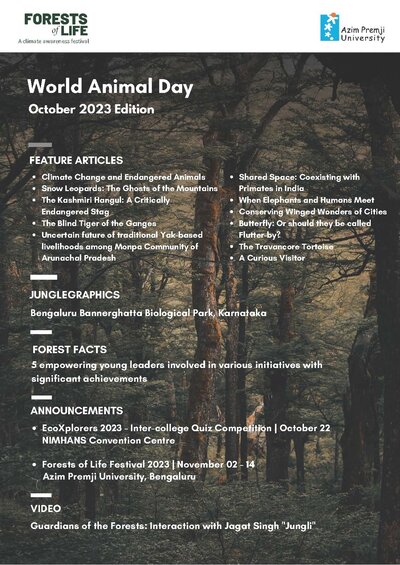
Forests of Life Newsletter is a monthly limited edition newsletter curated by Azim Premji University, offering glimpses of our upcoming mega festival, Forests of Life, which will be held at our Bengaluru campus from 02 to 24 November 2023. This month, we celebrate World Animal Day which is commemorated on 04 October every year to celebrate animal rights and their welfare with the collective aim to bring together people who are promoting the improved treatment and welfare of animals, both in the wild and on farms.
Links

- Published
- Authors
Abstract
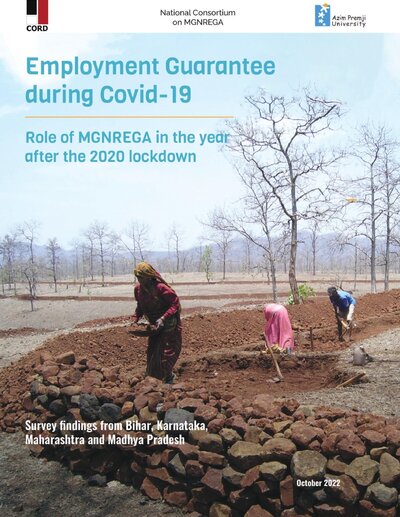
This study examines the performance of MGNREGA during the Covid-19 pandemic in eight blocks across four states of India, viz. Bihar, Karnataka, Maharashtra and Madhya Pradesh. MGNREGA functioning is analysed along the following dimensions: overall impressions of the programme among job card holding households, extent of unmet demand, wage payments, changes in programme functioning during the pandemic, and effectiveness of MGNREGA as a safety net. The blocks were chosen from a list of blocks in which Civil Society Organisations part of the NREGA Consortium are working. All blocks on this list were ranked based on their performance in MGNREGA as reflected in the Management Information System (MIS). Highest and lowest ranked blocks were chosen in each state and are referred to as high performing and low performing blocks in the study The blocks chosen were — Phulparas (Madhubani) and Chhatapur (Supaul) in Bihar, Bidar (Bidar) and Devadurga (Raichur) in Karnataka, Khalwa (Khandwa) and Ghatigaon (Gwalior) in Madhya Pradesh, and Wardha (Wardha) and Surgana (Nashik) in Maharashtra. A two stage random sampling was followed in the chosen blocks. In the first stage, five Gram Panchayats (GP) were randomly chosen in each block based on the Census 2011 list. In the second stage, 50 households were randomly selected in each GP from the MGNREGA MIS list of job card holders. The sampling method ensures representativeness of the results at the block level for all job card holding households. The survey was conducted in November-December 2021. Two reference periods were employed. The first covered the pre-Covid financial year (April 2019 to March 2020) and the second covered the Covid financial year (April 2020 to March 2021). This also includes executive summary of the report.
Download Executive Summary here (English, Kannada, Hindi).
Download Press Release here (English, Kannada, Hindi).
Links
An arachnid’s guide to being an ant: Morphological and behavioural mimicry in ant-mimicking spiders
in Behavioral Ecology

- Published
- Authors
Abstract
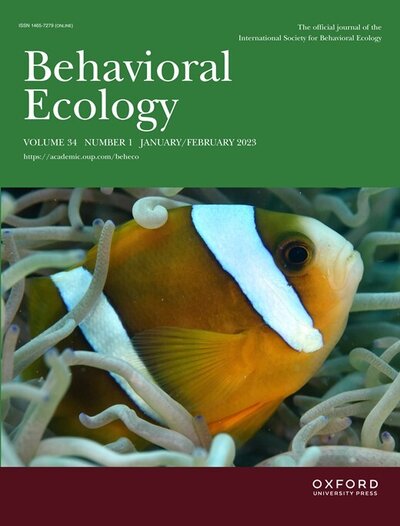
Batesian mimicry imposes several challenges to mimics and evokes adaptations in multiple sensory modalities. Myrmecomorphy, morphological and behavioral resemblance to ants, is seen in over 2000 arthropod species. Ant-like resemblance is observed in at least 13 spider families despite spiders having a distinct body plan compared to ants. Quantifying the extent to which spiders’ shape, size, and behavior resemble model ants will allow us to comprehend the evolutionary pressures that have facilitated myrmecomorphy. Myrmaplata plataleoides are thought to closely resemble weaver ants, Oecophylla smaragdina. In this study, we quantify the speed of movement of model, mimic, and non-mimetic jumping spiders. We use traditional and geometric morphometrics to quantify traits such as foreleg size and hindleg size, body shape between the model ant, mimic, and non-mimics. Our results suggest that while the mimics closely resemble the model ants in speed of movement, they occupy an intermediate morphological space compared to the model ants and non-mimics. Ant-mimicking spiders are better at mimicking ants’ locomotory movement than morphology and overall body shape. Some traits may compensate others, suggesting differential selection on these mimetic traits. Our study provides a framework to understand the multimodal nature of mimicry and helps discern the relative contributions of such traits that drive mimetic accuracy in ant-mimicking spiders.
Links
Creating Udyog Sahayak Enterprises Network (USENET) for Employment Generation and Scale-up in the MSME Sector
in Azim Premji University
- Published
- Authors
Abstract
We cannot achieve the demographic dividend unless we create jobs for millions of youth. There are multiple forces – thirteen of them identified in this report — working against employment growth in India from both supply side and the demand side. It is proven that large enterprises create very few jobs. Even these few jobs are created for educated youth. Only Micro and Small Enterprises (MSEs) can create large number of jobs across India for workers with wide range of skills and education. Out of a total of just over 63 million enterprises in the MSME sector, 62 million are informal micro and very small enterprises (MSEs). Of these, single worker firms (own-account) are 40 million, firms with 2 to 5 workers are 22 million and firms with more than 5 but less than 10 are estimated at 1 million. 107.6 million workers (97% of all employment in the MSME sector) are in this MSE segment. These MSEs, surprisingly, are more rural than urban — 51% are in rural India. Women-owned firms accounted for 20 % of all enterprises, 16 % of all workers and 9 % of aggregate value-added. There is a huge potential to grow these women owned enterprises. MSEs are the most important segment of the Indian Economy if we want to achieve GDP and Employment growth. Moreover, many of these enterprises are closely aligned with households, particularly in location and ownership. These enterprises play a pivotal role in linking the formal and the informal sector through value chains. We don’t need more micro-enterprises or more single-person firms. Instead, we need to scale-up these existing MSEs. How can we do this? By creating a support system which will make these MSEs go digital, grow in scale and increase their productivity. This will automatically create jobs The Udyog Sahayak Enterprise Network (USENET) proposed in this report is that support system. Why a support system? Because it is not possible to educate millions of the MSE entrepreneurs to become digital experts. Why now? Because India and the world are going digital. In the digital marketplace small can compete better and grow.
Download Policy Proposal Here.
Realising India’s demographic dividend requires a focused policy approach for employment generation. Micro and Small Enterprises (MSEs) can create millions of jobs, across India, for workers with wide range of skills and education. Out of a total of just over 63 million enterprises in the MSME sector, 62 million are informal micro and very small enterprises (MSEs). We do not need more micro-enterprises. Instead we need to help existing MSEs to grow in size. We can do this by creating a support system which enables them to go digital, avail of government schemes, adopt new technologies, and increase productivity. This will create millions of new jobs.
This report is a first of its kind collaboration between Azim Premji University, FICCI, and TISS-Mumbai. It proposes the creation of an Udyog Sahayak Enterprise Network (USENET) at the national level. USENET is a support system for MSEs that will improve Ease of Doing Business for micro and small entrepreneurs. Udyog Sahayak Enterprises will take servcies such as digitisation and formalisation, availing of government loans, subsidies or other benefits, ensuring compliance with local, regional, and national regulation, aiding partnership with digital marketing platforms and digital payment platforms, to the MSEs at their doorstep.
Media Coverage
Press Coverage USENET Report Release
The Times of India: Support system to up ease of doing business
The Economic Times: Azim Premji University, FICCI, TISS, roll out plan for employmenet generation in MSME sector
ETAuto: Policy proposal for employment generation, scale-up in MSME sector
Business Today: FICCI, Azim Premji University recommend 18 lakh Udyog Sahayak Enterprises network to assist MSEsThe Hindu: Draft policy to help grow nano, micro enterprises
The Hindu Businessline: ‘Set up USENET centres micro, small enterprises’The New Indian Express: Micro firms can create 10.3 million jobs: Report
The Statesman: Azim Premji University, FICCI and TISS form policy proposal for employment generation for MSMEs
Telangana Today: USENET could help MSMEs scale up
The New Indian Express – Edex Live: This network for MSEscan help create 56 million new jobs in 10 years. Here’s how
UNI: Azim Premji University, FICCI, TISS come out with new USENET policy for creating one crore job
The Hans India: Azim Premji varsity, FICCI, TISS roll out plan to generate jobs in MSME sector
SME Times: Report proposes ease of doing biz for MSEs
Nagaland Post: Policy proposal to scale up MSME sectorLinks
Economic Transition, Dualism, and Informality in India- Nature and Patterns of Household-level Transitions
in Azim Premji University
- Published
- Authors
Abstract
We examine the Indian economy during a peak period of high growth between 2005 – 2012 to analyze nature and patterns of household-level transitions across the different sectors of the economy and to relate these transitions to the broader process of structural change. We use a pan-India household-level panel data to categorize households according to their primary income sources into seven sectors characterized by varying degrees of formality/informality and various production structures and labour processes. We find that even this this relatively brief period, there has been a very large volume of transitions of households across these sectors. However, despite such volumes of transitions, the overall economic structure, and its segmentations, has continued to be reproduced, along with a regeneration of ‘traditional’ informal spaces that were often expected to dissolve over time with high economic growth. To ascertain the nature of these transitions – ‘favorable’ or ‘unfavorable’ – in terms of economic well-being of households, we employ a counterfactual analysis. We find that a majority of the transitions in the economy during the period of analysis have been ‘unfavourable’ in nature, with large proportion of households transitioning to sectors that are not ‘optimal’ locations for them, given their socioeconomic characteristics. Further, using a multinomial logit regression framework, we find that
the likelihood and nature of these transitions significantly vary with household characteristics, some of which, like social caste, are structurally given and cannot be optimally chosen by households. This dynamic process of reproducing a rather stagnant structure, along with substantial ‘unfavourable’ transitions towards ‘traditional’ informal economic spaces that are continuously reshuffled and reconstituted, provide insights into the complexity of India’s development trajectory that is often glossed over in the literature.Author:
- Surbhi Kesar
Links
Mechanisms of Surplus Appropriation in the Informal Sector- A Case Study of Tribal Migrants in Ahmedabad’s Construction Industry
in Azim Premji University

- Published
- Authors
Abstract
This paper is based on fieldwork I had undertaken regarding tribal migrant workers in the construction sector, in Ahmedabad in May-July 2018, coordinated by Aajevika Bureau(AB). I had undertaken this fieldwork to assess the work of AB and advise them about strategies to collectivize migrant labour groups. While interacting with a particular social group (Bhil tribals from South West Rajasthan) who work in the construction sector, I struggled to capture the specificity of their experience through the concept of informal labour. This paper is an attempt to characterize the specificity of their social experience, while also, reframing the concept of informal labour. I use the concept of labour process (Michael Burawoy: Manufacturing Consent) to argue that there is not a binary or one-dimensional power relationship between informal labour and owner/state/capital, but instead, the process of surplus appropriation occurs at multiple nodes through different agents. In this paper, I have identified multiple modes of surplus extraction which are embedded as institutions or social norms in the labour process. Further, I argue that there is a close link between the status of tribal workers as marginalized within society, and their status as displaced and marginalized in their living areas and workplace. This difference translates into identity based discrimination faced in the city, as well as, structural exclusion from the governance apparatus faced as migrants. Therefore, tribal migrant workers do not earn enough to subsist and are highly dependent on early child birth, non-remunerated services of their family and the social security net provided by their village community.
Author:
- Rahul De
Links


- Published
- Authors
Abstract
This issue is focused on the Pandemic. Read ‘The Basics’ section to explore: what strategies do epidemiologists use to control the spread of infection? Are viruses the most complex or the simplest forms of life? What has caused the spike in frequency of new zoonoses since the 20th century? In ‘The Infection’ section, engage with questions like: why do we believe that SARS-CoV‑2 is a product of natural evolution? How exact are measurements of death rates for an ongoing pandemic? Or, how does the nature and context of social interaction affect the spread of COVID-19? Delve into ‘Our Response’ section to read: why ‘designing’ and ‘making’ vaccines against SARS-CoV‑2 is uncertain and time-consuming? What can we learn from deliberately exposing healthy consenting individuals to a weakened form of the SARS-CoV‑2 virus? Which tests would be most effective for contact tracing & which for population-wide screening? How do we identify antivirals against SARS-CoV‑2? Can community health workers clinically diagnose COVID-19 syndrome in the absence of testing kits? Why is training and provision of personal protective equipment for ASHA workers essential for effective healthcare? How can a reverse quarantine approach help us use herd immunity to our advantage? That’s not all. Are you looking for resources on understanding concerns & approaches towards the mental health of the elderly, children, and those under quarantine? Or mythbusters around SARS-CoV‑2? Check out our Snippets.
Links
Handling Classroom Hunger: Comparing Modes of Mid-Day Meal Delivery in Anekal Block, Karnataka
in Azim Premji University


- Published
- Authors
Abstract
This working paper aimed to evaluate the impact of a quality-controlled mid-day meal program from a centralized kitchen on children’s nutritional indicators and learning outcomes. It also looked at household characteristics of students to determine their impact on children’s nutritional outcomes.
Links
- Published
- Authors
Abstract
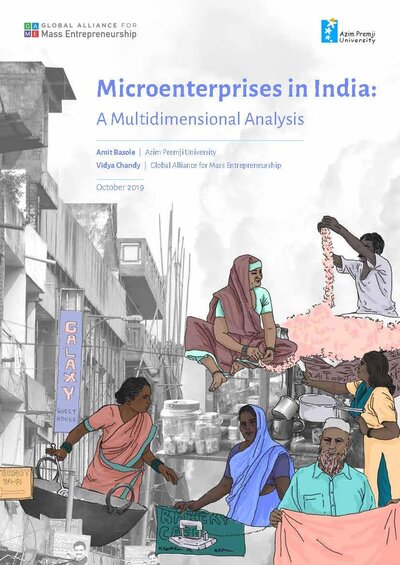
Microenterprises have been the engines of job growth in the majority of dynamic economies. India is home to thousands of microenterprise clusters as well as millions of distributed entrepreneurs who can become job creators. Fostering of such mass-entrepreneurship is key to addressing India’s employment challenge. Case studies of clusters in general, and of women entrepreneurs in particular, show that if key factors such as collective action, infrastructure, credit, and market linkages are in place, returns to entrepreneurship are vastly improved. Inspirational stories are also emerging in the use of fourth industrial revolution technologies to improve access to markets and enter global value chains in a way that awards greater agency to women entrepreneurs.
Links
India’s Employment Crisis- Rising Education Levels and Falling Non-agricultural Job Growth
in Azim Premji University
- Published
- Authors
Abstract
Falling total employment is an unprecedented trend seen from 2011-12 to 2017 – 18. Due to a decline of employment in agriculture and manufacturing and slow growth of construction jobs, the process of structural transformation, which had gained momentum post-2004 – 5, has stalled since 2012. Mounting educated youth unemployment, and lack of quality non-farm jobs have resulted in an increase of the disheartened labour force. Though the share of regular and formal employment increased marginally due to growth of formal jobs in the private sectors, the share of informal jobs within government/public sector increased. A dominant share of jobs is still generated by micro and small units of the unorganized sectors without any formal or written job contract. In both government and private sectors the number of contract jobs (with less than a year’s contract) is on the rise post 2011-12. Not surprisingly, real wages have not increased in either rural or urban areas.
Authors:
- Santosh Mehrotra
- Jajati K. Parida
Links

- Published
- Authors
Abstract
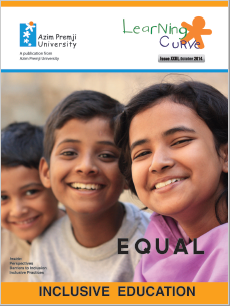
Learning Curve decided to devote this issue to Inclusive Education as a theme. In this issue, readers will find articles on literature for children particularly emphasizing inclusion, on gender stereotyping and an article on RTE and inclusion in schooling, among others. The issue also has an article on teaching language to include, caste as a barrier to education and upward social mobility and, finally, teacher preparedness in curriculum development.
Links

- Published
- Authors
Abstract
This issue of Learning Curve is devoted to the theme of language learning. In it, students, teachers, field practitioners and academicians talk about what language means to them, its multiple benefits and the issues and challenges associated with its learning.
Links