
Publications & Resources
Our faculty, students and researchers work together everyday to contribute to a better world by grappling with urgent problems we are facing in India. We conduct rigorous work to produce high quality learning resources and publications to contribute to public discourse and social change. Here, we feature a sample from our work for everyone to access. You can explore featured resources, policies, and the latest publications from the University.
To explore all the work of our University, please visit our publications repository.
List of Publications & Resources


- Published
- Authors
Abstract
The July 2026 issue talks of the joys of Living in a Mat(h)erial World – there is mathematics and material to teach it all around us. But the process of learning has to be facilitated skilfully, a delicate dance of exploration choreographed by the teacher who understands both the strengths and the needs of the student.


- Published
- Authors
- Climate Change and Sustainability
- School of Climate Change and Sustainability
Abstract
In May 2026, a team of glaciologists went on an expedition to the trekker’s paradise of Satopanth glacier in the upper Alaknanda basin of the Himalaya. The trek offered a harsh reality check. They encountered frequent rockfalls from the steep slopes of the Neelkanth mountain in the Garhwal Himalaya. They also witnessed retreating ice, expanding infrastructure near the pilgrimage centre of Badrinath and plastic waste-littered mountain glacial lakes. All of this pointed to a Himalayan landscape altered by pressures beyond rapid glacial melts.
Authors: Remya S N, Sunil Singh Shah
Links

- Published
- Authors
Abstract
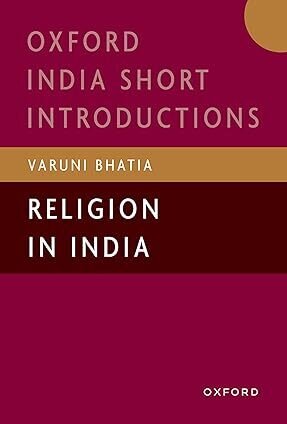
Religion in India is a constantly evolving and transformative entity that cannot be engaged with in isolation from other dimensions of life. This short introduction moves beyond traditional text- and scripture-based academic approaches to provide an overview of the dynamic role of religion in contemporary Indian society. Examining religion through the perspectives of religious actors, interlocutors, and practices, it highlights how religion intersects with the state, secularism, identity, and civic and economic life. An indispensable resource for general readers, students, and researchers, this book will foster grounds for dialogue towards a flourishing of pluralism in present-day India.
Links
Diversity in Approaches in Community-Based Mental Health Interventions in India: A Narrative Review and Synthesis
in Cambridge University Press

- Published
- Authors
- Mukta Gundi
- Rhea Kaikobad
- Seema Sharma
Abstract
Mental health is a global priority, fundamental to the health and development of all nations. The contribution of mental disorders to the global burden of disease is widely recognised; however, a significant care gap exists, particularly in the context of low-and middle-income countries. In India, for instance, there are 0.3 psychiatrists per 1,00,000 population. To address this severe shortage of mental health professionals and resources globally, the World Health Organisation has suggested the adoption of a community-based mental health care approach, where the locus of services shifts from institutional care to local communities. Over the last five decades in India, diverse approaches to mental health care have emerged because of the interaction of dominant discourses on community-based mental health care with various socio-cultural contexts. In addition to the government-run mental health programme and programmes run by medical colleges, civil society organisations have increasingly contributed to this space. Although studies have assessed individual interventions, there exists a need to map these interventions and synthesise the approaches for service delivery to inform public health practice in India and in low-and middle-income countries at large. This narrative review attempts to map and synthesise insights from community-based mental health interventions in India implemented across diverse contexts. The researchers searched peer-reviewed journal articles and book chapters published in the English language between 2010 and 2023. They present the synthesis of approaches used in 41 community-based mental health interventions, where they unpack key intervention components and processes adopted for primary prevention and promotion; identification and case detection; treatment and care, and rehabilitation in the community. This review presents key recommendations for practitioners about the role of community, the diversity and commonalities in various approaches across contexts, the roles of various actors in service delivery, and the shared values guiding the conceptualisation and implementation of community-based mental health interventions in India.
Links

- Published
- Authors
Abstract
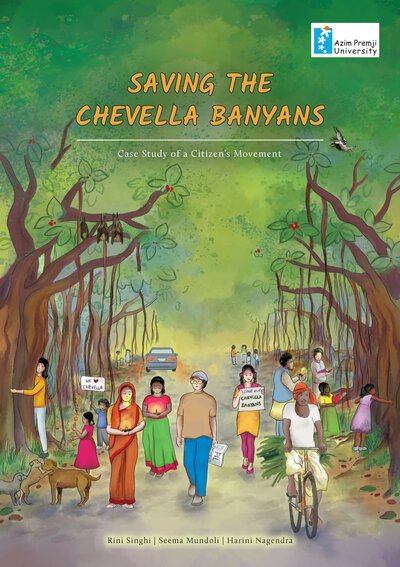
This case study, documents the trials, tribulations and victories of a citizen’s movement to protect the environment — in this case the Chevella banyans. These banyans that are of ecological, historical and cultural importance were under threat of being axed for a road widening project. This case study can be used as a teaching resource in undergraduate and postgraduate programmes, and by civil society organisations and citizens as a guiding document to understand how they can contribute to protecting the environment, the strategies they can apply and the challenges they might face.
Authors:
Rini Singhi, Seema Mundoli, Harini Nagendra
Links
Neoliberalism and Women’s Work: A Study of the Informal Economy in India
in Taylor & Francis

- Published
- Authors
Abstract
In this chapter, the researchers critically examine the emancipatory role of neoliberalism with a focus on women’s work in India. They argue that the multi-pronged crisis afflicting the labour market is a fallout of the implementation of the neoliberal project in India that had severely impacted women workers, who typically are one of the oppressed sections in society. They argue that neoliberalism leads to the proliferation of social orthodoxies that promote patriarchal gender contracts whereby men are the primary breadwinners while women are mainly responsible for social reproduction in the ‘domestic’ space.
They highlight that the neoliberal regime in India is associated with declining participation in paid work for women workers, notwithstanding the rapid growth rate of the Gross Domestic Product (GDP) that the economy has been witnessing. This is in the backdrop of India having one of the lowest rates of participation in paid employment of women workers. They claim that women’s work participation in India is affected by the production conditions in Indian agriculture and the burden of unpaid care work. However, increased participation in paid work — the quantitative dimension — does not necessarily lead to women’s empowerment under neoliberalism. This is largely due to the proliferation of the informal sector, which has been the major source of paid work for women workers. The researchers contend that women workers encounter two layers of subordination and control in the labour market that become acute in the informal sector, which is associated with a lack of worker’s rights. They are subordinated, first, by the dominance of capital and, second, by the patriarchal social order. These, in turn, adversely impact the quality and economic value of women’s work. They argue that the degradation of the economic value of women’s work has led to the accentuation of the gender bias that endangers the chances of survival of the girl child in a society characterised by deep-rooted patriarchy.
The contemporary precarity of women’s work — in terms of quantity and quality of work — also reflects the existing social orthodoxies that loom large in the private and public domains in India. Lastly, based on the latest Periodic Labour Force Survey database, they argue that the COVID-19 pandemic has widened the structural inequalities in the economy and added a layer to the existing vulnerabilities of women workers.
Authors: Mampi Bose, Shantanu De Roy
Links
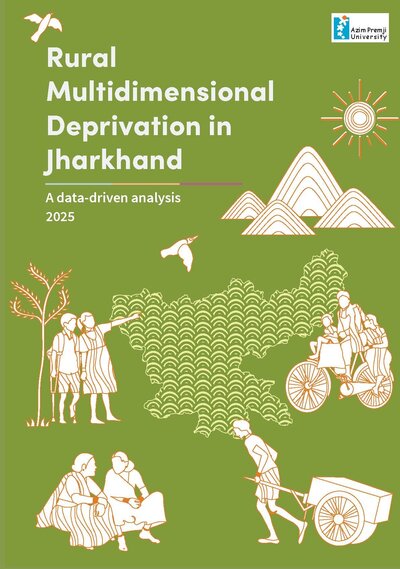
Rural Multidimensional Deprivation in Jharkhand: A Data-Driven Analysis 2025
in Azim Premji University

- Published
- Authors
- School of Development
Abstract
This report constructs a Rural Multidimensional Deprivation Index (RDI) for measuring deprivation in Jharkhand. An important feature of the index is that it is constructed using indicators on provisioning of basic infrastructural amenities at the village level. This is different from the usual poverty indices that are composed of financial indicators such as income or consumption; or indicators measuring development outcomes such as educational or nutritional levels. Observing the provisioning of basic infrastructural amenities, this report makes focused policy suggestions that can be easily implemented by functionaries working on the ground. The data for the index is sourced from the Mission Antyodaya Survey, which was carried out in 2019 at the village level across the country. The survey collects data related to provisioning and outcome of basic amenities in villages, along with demographic and socioeconomic variables. Because this is a periodic survey, it enables us to track the developmental progress of each village, district, state and the country over time. In total, there are about 182 variables that were captured in the 2019 round. The survey covers 31,175 out of 32,620 villages in Jharkhand, which is 95.6 percent of the total number of villages in the state; and 6,48,358 out of 6,67,933 villages in India, or 97.1 percent of the villages in the country.
Editors
Prasanna S, Sandhya Krishnan, Sanket Gharat, Puja Guha, Amalendu Jyotishi, Neeraj Hatekar
Links
Scholarly Insights into Sustainability, Climate Change, & Blue Food: A Perspective Aligned with Adoption of Sustainable Development Goals
in Springer Nature


- Published
- Authors
Abstract
The increasing global demand for food, coupled with the impacts of climate change and environmental degradation, has shifted attention towards blue food systems. While these systems offer a potential solution to food security challenges, their sustainability is threatened by various factors, including overfishing, habitat destruction, and climate change. Recognising these challenges, the Food and Agriculture Organisation of the United Nations (FAO, UN) advocates for ensuring the sustainable contribution of aquatic food systems to global food security and nutrition, aligning with the United Nation’s Sustainable Development Goals (UN-SDGs). It was hypothesised that adoption of UN-SDGs would increase the interest of researchers in sustainability of fisheries and aquaculture. Therefore, a bibliometric analysis of the relevant literature published between 2000 and 2023 was conducted to test this hypothesis. The analysis revealed a significant rise in publications addressing climate change and sustainability after the adoption of the UN-SDGs. The countries exhibiting high vulnerability to climate change contributed disproportionately fewer publications to the database. The United States emerged as the leading contributor in terms of publication volume, while Canada’s University of British Columbia was identified as the institution with the highest number of contributing authors. The findings underscore pronounced geographical disparities in research output, with a predominance of countries from the Global North. The underlying factors contributing to these disparities are discussed. Furthermore, the study discusses the policy implications of these findings and emphasises the imperative to prioritise equitable research initiatives. Such efforts are essential to effectively support the realisation of the SDGs within the domain of blue food systems and sustainability.


- Published
- Authors
Abstract
In this book, Prema, a young girl living in Mumbai, learns about heatwaves and their devastating effects when her father falls seriously ill during an intense summer. Through her eyes, readers explore the human impact of rising temperatures and the urgent need for climate awareness.
Authors: Shrunoti Ritesh Tatiya, Santonu Goswami, Seema Mundoli, Harini Nagendra
Illustrations: Shrunoti Ritesh Tatiya
Links

- Published
- Authors
Abstract
Craft new understanding in primary school mathematics with the July 2025 issue of At Right Angles. And do send in your feedback to AtRightAngles.editor@apu.edu.in
Article
- Published
- Authors
Abstract
When NASA provided free worldwide access to the Landsat data archive, scientists greatly expanded the analysis of new locations and novel topics. Of course, data democracy is not just for scientists. When citizens own the rights to generate and access data that speaks to their concerns, democracy is strengthened. Data democracy began to gain prominence in the early 2000s, with the growth of the open data movement. In today’s era of climate change, the term assumes increasing significance. Yet despite the large volume of opensource climate data, access remains largely limited to academia and business. Climate data democracy enables all sections of society to access climate data; understand how to use and interpret it; and be able to use data for climate action. Given the lack of data and severity of the crisis in the Global South, we argue that these regions must take the lead in driving conversations around climate data democracy.
Links


- Published
- Authors
Abstract
Explore the Joy of Mathematics and send in your feedback to AtRightAngles.editor@apu.edu.in in English, Hindi or Kannada.
The Rich Have Peers, the Poor Have Patrons: Engaging the State in a South Indian City
in American Journal of Sociology (AJS)

- Published
- Authors
Abstract
Research on democracy has shed much light on two kinds of democratic politics: patterns of voting and patterns of associational or movement politics. But there is growing recognition that in order to better understand the quality or depth of democracy, we need to move beyond this dualistic focus to better understand the everyday practices through which citizens can effectively wield their rights; these practices often diverge from the formal equality enshrined in laws and constitutions. The researchers study this question through a large, unique sample survey carried out in a South Indian city. We find that effective citizenship is refracted through the institutional specificities of urban India and that, as a result, the poor access the state through political participation and the rich through particularistic connections to persons of influence. But unlike the conventional celebration of participation as a citizenship-deepening activity, we also find that a substantial part of participation is associated with forms of brokerage that compromise democratic citizenship.
Article
- Published
- Authors
- School of Development
Abstract
If one asks a teacher in preschool learning spaces in India, about the most usual story that is narrated to children, what is the most common answer? Will there be unanimity in the fact that the story of Thirsty Crow works just as well in many Indian languages, as it does in Indian Sign Language? Those who engage with early childhood care and learning would often stress upon the need to have a visually rich environment in these learning spaces, full of picture books and enthusiastic teachers who never give up a chance to bring out yet another story. Bringing Indian Sign Language to early childhood learning spaces, creating an immersive experience for children before they enter school years by making available in these spaces Indian Sign Language resources (and then taking such initiatives to schools, colleges, and community spaces) would allow us to slowly move toward the dream cherished by deaf adults.
Fifteen Years of Fragmentation and Land Cover Change in India’s Ten Largest Cities – A Google Earth Engine Analysis
in Cities and the Environment (CATE)
Article
- Published
- Authors
- Harini Nagendra
- Preeti Rao
- Shivani Agarwal
Abstract
Urbanisation is one of the most transformative drivers of global environmental change today, with India representing one of the fastest urbanising countries. The researchers map the urban expansion of India’s ten largest cities from 2001 to 2016, through a regression tree classification of Landsat data in Google Earth Engine. Indian cities are growing through sprawl, and simultaneously densifying through in-filling. In Delhi, Mumbai and Pune, urban growth is multinucleated, aggregating to form a larger urban region. However, the dominant pattern in most cities is mono-nucleated growth via edge-expansion. The colonial signature is visible in many cities such as Bengaluru, where due to the British colonial practice of planting trees in the cantonment, the city interior has lower urban density at the core as compared to the periphery. Much of the urban growth between 2001 – 2016 is at the expense of agriculture and fallow areas. Across all cities, urban patches have expanded and coalesced into larger units. At the same time, there is an overall loss of surface water cover within cities. Urban growth has led to fragmentation of tree cover, agriculture/fallow and water bodies. This paper demonstrates that India’s urbanisation is leading to severe impacts on water security (because of the loss of surface water), biodiversity (because of the fragmentation of tree cover and the conversion of agriculture and fallow lands to built-up urban cover), factors which if left unaddressed will severely impact the sustainability of Indian urbanisation.

- Published
- Authors
Abstract
This chapter provides the emergence and practice of Dalit Studies within academia through a critical engagement with curriculum structures that exist within pedagogic discourses. It explores different kinds of academic writings that have prevailed within Dalit discourse by looking into their composition, engagement with the curriculum, and pedagogic practices. The Dalit community has created spaces for the emergence of public debates and conferences, study groups, and seminars that enable discursive engagement with Dalit Studies. One of the major milestones in Dalit discourse was taken up by Sukhadeo Thorat, who, under his chairmanship of University Grants Commission, granted the institutional setup of the Center for the Study of Social Discrimination and Exclusion for a systematic engagement with Dalit discourse. Dalit feminist scholars have highlighted “contradictions in schooling in that curricula and school cultures reproduce Brahmanical values”.

- Published
- Authors
- Climate Change and Sustainability
- Research Centre
Abstract
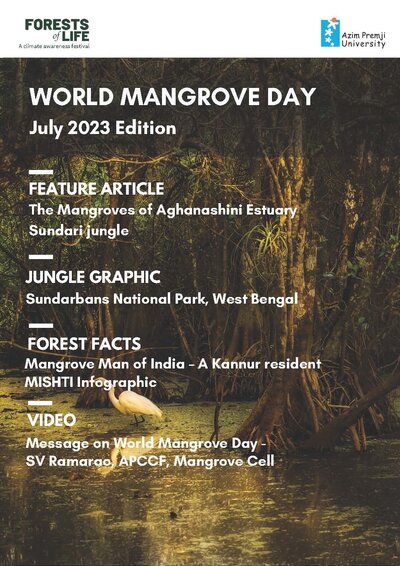
This is a monthly newsletter published by Azim Premji University, as a part of Forests of Life, a climate awareness festival celebrating forests — a quest and yatra of young people from across different parts to engage with the youth of this country. In this edition, we celebrate International Day for the Conservation of the Mangrove Ecosystem, aiming to raise awareness of the importance of mangrove ecosystems.
Links
- Published
- Authors
Links
Monolingual Ideologies in Multilingual Classrooms: Exploring Tacit Aspects of the Indian Education System
in Language and Language Teaching

- Published
- Authors
- School of Education
Abstract
Globalisation has resulted in ever increasing linguistic diversities and a worldwide recognition of the need to support linguistic pluralism through education (UNESCO, 2003). Keeping abreast with the global trend, India’s education policy has provided for the cultivation of multilingualism by including at least three languages in the curriculum. However, in reality, India’s education system is guided by monolingual ideologies that disregard multilingual realities and promote a form of “monolingual multilingualism” (Neumann, 2015). This translates into separatist pedagogy and practices that keep languages strictly compartmentalised at schools. Different time slots are allotted to teaching learning of disparate languages. Proficiency in a language is interpreted as the ability to use it without “resorting” to any other language. In effect, monolingual ideologies function to reject translanguaging (Garcia, 2009), or natural language practices of multilinguals, that enter into classrooms. Strategies such as code-switching and translating are invalidated when they occur in spoken or written conversations in classrooms. This article aims to study the monolingual ideologies that permeate the education system to understand their implications for the process of teaching and learning in Indian classrooms.


- Published
- Authors
Abstract
The Lens of Computational Thinking teaches us to look at the same things with fresh eyes, the July 2022 issue invites you to do just that!
Links
Structural Transformation and Employment Generation in India: Past Performance and the Way Forward
in The Indian Journal of Labour Economics
Article
- Published
- Authors
Abstract
Historical experience suggests that a sustained rise in per capita incomes and improvement in employment conditions is not attainable without a structural transformation that moves surplus labour from agriculture and other informal economic activities to higher productivity activities in the non-farm economy. In this paper, I analyse India’s performance from a cross-country comparative perspective, estimating the growth semi-elasticity of structural change. Using a cross-country panel regression, I estimate the effectiveness of growth in moving workers away from agricultural and informal activities as compared to other developing countries at similar levels of per capita income. I show that the performance in pulling workers out of agriculture is as expected given its level and growth of GDP per capita, but the same is not true for pulling workers out of the informal sector. I also propose the following five indicators that need to be kept track of when evaluating the growth process: the growth elasticity of employment, the growth semi-elasticity of structural change, the growth of labour productivity in the subsistence sector, the share of the organised sector in total employment and the workforce participation rate. Comparing these indicators across periods, states, regions or countries, allow us to understand which sets of policies have worked better than others to effective improvements in employment conditions. When taken together the indicators allow us to set structural change targets as well as to say whether the current pattern of growth is going to be sufficient to meet those targets.
Links
Article
- Published
- Authors
- School of Education
Abstract
Multilingual education is an urgent and pressing concern in the Indian educational scenario. While the National Education Policy (2020) acknowledges multilingualism as a resource in educational contexts and reiterates earlier policies calling for mother tongue-based education in elementary classrooms, it does not provide guidance in terms of how to productively accommodate multiple languages in the classroom. Multilingual education will be much stronger if it is based on a strong understanding of multilinguality — the idea that the human mind is fundamentally multilingual in nature. A new, but substantial paradigm of scholarship addressing multilinguality is that of ‘translanguaging’, which views named languages as socio-political constructs and argues that multilinguals have a unified linguistic repertoire that they flexibly, creatively and adaptively draw upon. Accepting the grounding assumptions of translanguaging would has important implications for curriculum, pedagogy and assessment in educational spaces. In this article, we describe and critique the translanguaging perspective, even while acknowledging its positive contributions. We point out, especially its failure to provide guidance in terms of how to productively accommodate translanguaging in classrooms.
Links
Article
- Published
- Authors
Abstract
Institutional births increased in India from 39% to 79% between 2005 and 2015. Drawing from 17 months of fieldwork, this article traces the shift from home to hospital births across three generations in a hamlet in Assam in Northeast India. Here, too, one finds that most births have shifted from home to hospital in less than a decade, aided by multiple factors. These include ‘free’ birthing facilities and financial incentives offered by government schemes, idiosyncratic changes within the hamlet, such as the introduction of biomedical practices through home births where oxytocin was used, and changes in cultural belief systems among local people. The exploration reveals significant transitions between (and fluidities of) categories such as local/global, tradition/modernity, past/present and nature/technology, creating a complex and ambivalent narrative of change, in which the voices of mothers should not be ignored.
Links

- Published
- Authors
Abstract
Perch on the branches of the Tremendous Tree of mathematics and enjoy your read. At Right Angles July 2021 is packed with a variety of articles and the online version has several absorbing additional articles.
Links
Where Do They Come From, Where Do They Go Labour Market Transitions in India
in Azim Premji University

- Published
- Authors
- Rahul Menon
- Paaritosh Nath
Abstract
Using two rounds of the Periodic Labour Force Survey (PLFS) covering the periods 2017 – 18 and 2018 – 19, we construct a panel of urban Indian individuals aged 15 to 65, and analyse the dynamics of their participation – or non-participation – in the labour force. We construct transition probabilities to study the movement of individuals through three distinct statuses — employment, unemployment and non-participation – at the aggregate level and for different demographic groups. We find evidence of considerable movements from the labour force to non-participation; there exists a significant discouraged worker effect as well as a pronounced movement from employment outside the labour force, specifically for women. A majority of those unemployed in the beginning of the year remain so at the end of the year, indicating the presence of long-term unemployment. The reduction in unemployment rates from 2017 – 18 to 2018 – 19 hides significant weaknesses in Indian urban labour markets. This study represents an original contribution to the field of Indian labour economics, given the paucity of large-scale studies of the dynamics of Indian labour.
Authors:
- Rahul Menon
- Paaritosh Nath
Links
Article
- Published
- Authors
- School of Policy & Governance
Abstract
A recent writ petition on renaming India as Bharat, which got dismissed by the Supreme Court, is discussed. There are political motives behind naming or renaming a place, but Hindustan, Bharat, and Hind — are all part of the package that is India.
Building a Social Security Architecture for Informal Workers in India, Finally!
in Azim Premji University
- Published
- Authors
Abstract
Social protection and social security have very limited coverage in India. This reality has not changed since independence, one of greatest failures of the development strategy India adopted in the early fifties. The labour force is predominantly unorganized. As much as 91 per cent of the labour force are in informal employment, i.e. without any social insurance we estimated from the NSO’s Periodic Labour Force Survey (2017−18) (Mehrotra and Parida, 2019). This is barely down 2 percentage points from 93% in 2011-12 (NSO’s 68th Round). In fact, regardless of the growth rate of GDP, this high share of informality in the workforce had not changed until 2012, and when it fell recently, it did so by merely 2 points. The rest 9 per cent of the workforce has varying levels of social security in the form of provident fund, paid leave, medical insurance and other benefits.
Author:
- Santosh Mehrotra
Links

- Published
- Authors
Abstract
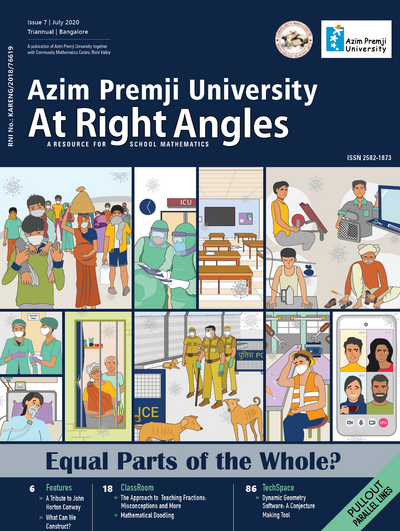
As the world goes through lock down and social distancing, it is easy to feel less and less a part of the whole and more and more a small, isolated part. But that does not make us or anybody else, any less a part of the whole and we need to realise that every part of the whole matters.
But are all the parts of the whole equal? If not, what can we do to redress the balance?
Think mathematically!
Links

- Published
- Authors
Abstract
The July 2019 issue features Fractals on the cover — those distant and beautiful and highly mathematical creations have been brought a click away in our TechSpace section. Enjoy creating them and adding to your repertoire. We also take you through the magical tour of the beauty of mathematics starting with an article on Pentagons. Pi enters the ClassRoom section and the primary has plenty of learning — have fun joining the dots and exploring geometrical figures with different lenses. Students share their mathematical findings in two exciting articles. Our pedagogy article helps you to Understand Learners’ Thinking. And the Middle School problem corner is a Do_It_Yourself hands on problem solving section. The PullOut is on Ratio.
Links
Inequalities in the Gendered Labour Market- What can be Done
in Azim Premji University

- Published
- Authors
Abstract
Globally, research has shown that, there is a high correlation between the level of per capita income and the rate of female labour force participation. At the same time the agency and autonomy of women in a country improve with the level of female labour force participation.
Authors:
- Santosh Mehrotra
Links