
Publications & Resources
Our faculty, students and researchers work together everyday to contribute to a better world by grappling with urgent problems we are facing in India. We conduct rigorous work to produce high quality learning resources and publications to contribute to public discourse and social change. Here, we feature a sample from our work for everyone to access. You can explore featured resources, policies, and the latest publications from the University.
To explore all the work of our University, please visit our publications repository.

- Published
- Authors
- School of Development
Abstract
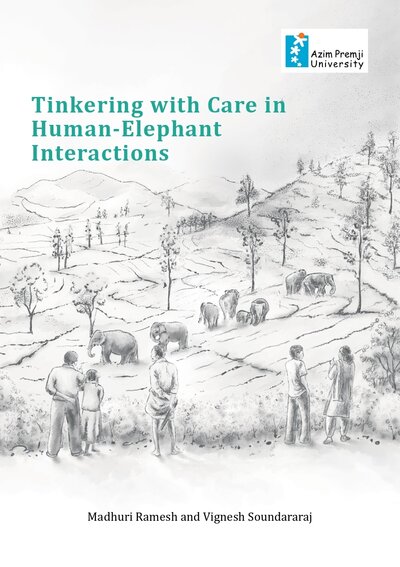
In the Valparai plateau in southern India, encounters between people and Asian elephants (Elephas maximus) are common and sometimes they result in conflict. Building on almost a year of fieldwork, this book presents a polyvocal account of how the Nature Conservation Foundation along with other actors such as the forest department, workers and management of tea plantation companies and ordinary residents engage in a range of care-ful and caring practices that enable people and elephants to share space and cultivate a sense of interspecies sociality. This book speaks to the anthropology of biodiversity conservation, human-wildlife coexistence and multispecies studies.
Authors: Madhuri Ramesh, Vignesh Soundararaj
Links

- Published
- Authors
Abstract
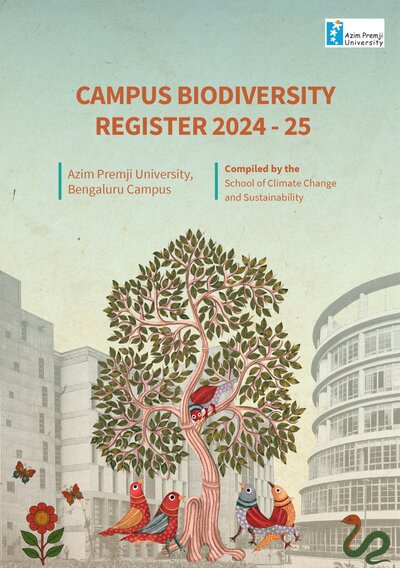
More than just an academic space, the Azim Premji University campus in Bengaluru is fast becoming a thriving ecosystem of its own. Located in Sarjapura, the campus is more than classrooms and labs — it is a habitat shared with birds, reptiles, insects, small mammals, and a growing canopy of trees and plants. This report is a first step in documenting the biodiversity of our campus. From trees and shrubs to spiders and snakes, students of the BSc in Environmental Science and Sustainability, teachers, and other members have come together to observe and record the life that surrounds us. Thus, this is a collective effort that reflects both scientific curiosity and deep care for our environment. As the campus grows, we aim not only to track carbon sequestration and environmental change — but also to nurture a sense of stewardship and belonging in everyone who calls this campus home.
Links
Article
The Ontological Choreography of Conservation Practice at a Marine Turtle Rookery in India
in Conservation and Society

- Published
- Authors
Abstract
The Rushikulya beach in eastern India is considered to be an important rookery (nesting site) for a species of migratory marine turtle, the olive ridleys Lepidochelys olivacea, because it is one of a handful of sites around the world where an arribada or mass-nesting event occurs. During an arribada, thousands of ridleys nest simultaneously over a small section of the beach, and several weeks later, millions of hatchlings emerge from these nests and crawl into the sea. Given the uniqueness of this phenomenon, conservation programmes have emphasised the monitoring and protection of ridleys during an arribada. In Rushikulya, this involves an assemblage of multiple actors, including biologists, their local assistants, and staff of the Odisha Forest Department. In this article, I use the concept of ontological choreography, drawn from multispecies scholarship, to focus attention on how members of this assemblage bring together different ontological orders, mainly nature and the individual self, to protect the ridleys. Further, I use this concept to direct attention to the hybrid nature of conservation practice — that it can simultaneously be affective, embodied, performative, sensory and technical. Overall, this article demonstrates how multispecies approaches can enrich social studies of conservation.
Authors:
Links

- Published
- Authors
Abstract
Biological invasions have profound impacts on biodiversity and ecosystem functioning and services, resulting in substantial economic and health costs estimated in the trillions of dollars. Preventing and managing biological invasions are vital for sustainable development, aligning with the goals of the United Nations Biodiversity Conference. However, some invasive species also offer occasional benefits, leading to divergent perceptions among stakeholders and sectors. Claims that invasion science overlooks positive contributions threaten to hinder proper impact assessment and undermine management. Quantitatively balancing benefits and costs is misleading, because they coexist without offsetting each other. Any benefits also come at a price, affecting communities and regions differently over time. An integrated approach considering both costs and benefits is necessary for understanding and effective management of biological invasions.
Authors: Laís Carneiro, Philip E Hulme, Ross N Cuthbert, Melina Kourantidou, Alok Bang, Phillip J Haubrock, Corey J A Bradshaw, Paride Balzani, Sven Bacher, Guillaume Latombe, Thomas W Bodey, Anna F Probert, Claudio S Quilodrán, Franck Courchamp
Links
Article
A Classic Case of “Waste Dumping” or a Latent Opportunity: Alang-Sosiya and the Making of the World’s Largest Shipbreaking Yards
in Sudasien – Chronik/South Asia Chronicle

- Published
- Authors
Abstract
This article explores the birth of multiple shipbreaking yards in India, such as Darukhana, Mumbai (1912); Sachana, Jamnagar (1977); and Alang, Gujarat (1983). It tells a story of how, specifically, the inception of the Alang shipbreaking yards is intricately linked to the changing geographies of ship disposal facilities in the 1970s and 1980s. This article demonstrates how India’s domestic policies on importing obsolete vessels for scrapping were in tandem with the shift in global waste flows. As major ship scrapping facilities closed in Western countries followed by Southeast Asian countries, shipbreaking yards mushroomed in different parts of South Asia, primarily in India, Bangladesh, and Pakistan. This article scrutinises the convoluted image of the Alang shipbreaking yards as a passive recipient of “waste” in the form of end-of-life vessels from the Global North.
Links
Article
Good Luck or Bad Omen: Attitudes Towards the Slender Loris in the City of Bengaluru, India
in Urbanisation

- Published
- Authors
- Harini Nagendra
- Kaberi Kar Gupta
- Varsha Bhaskaran
Abstract
Cities are characterised by social and cultural diversity. The management of urban wildlife requires developing a better understanding of cultural beliefs associated with wildlife in diverse urban settings. We document a range of cultural beliefs associated with the slender loris (Loris lydekkerianus), an endemic, nocturnal primate, in the Indian megacity of Bengaluru. Many residents associate the loris with practices such as black magic, and they believe that the animal’s call is a bad omen that brings death and misfortune. Others consider it a harbinger of good luck that offers protection to young children. These superstitious beliefs may motivate illegal wildlife trafficking of the loris. Urbanisation has led to changes in these perceptions, and many respondents now report that they consider these beliefs to be old-fashioned superstitions that hold no place in a modern city. This study contributes to knowledge on changing urban attitudes to wildlife, which is vital to developing conservation strategies that involve local residents.
Article
Testing the Novel Weapons Hypothesis of the Argentine ant venom on amphibians
in Toxins, MDPI


- Published
- Authors
Abstract
The globally invasive Argentine ant (Linepithema humile) possesses a venom lethal to some amphibian species in the invaded range. To test the novel weapons hypothesis (NWH), the effects of the toxin on the cohabiting amphibian species in the ant’s native range need to be investigated. The invader should benefit from the novel chemical in the invaded range, because the species are not adapted, but the venom should not be effective in the native range. The researchers explore the venom effects on juveniles of three amphibian species with different degrees of myrmecophagy inhabiting the ant’s native range: Rhinella arenarum, Odontophrynus americanus, and Boana pulchella. They exposed the amphibians to the ant venom, determined the toxic dose, and evaluated the short-(10 min to 24 h) and medium-term (14 days) effects. All amphibian species were affected by the venom independently of myrmecophagy. In addition to amphibian sensitivity, the researchers discuss how the differential Argentine ant abundance and density in the two ranges could be the key to the susceptibility of amphibians to the venom, resulting in the possibility of NWH. Their results confirm the potential magnitude of the impact of the Argentine ant in successfully invaded areas for the conservation of already threatened amphibians.
Author: Alok Bang
Article
‘Songs of the lake’: Understanding cultural expressions of nature through dwindling folk-songs and mythologies in Bengaluru
in South Asia: Journal of South Asian Studies
Article
- Published
- Authors
Abstract
Culture-specific knowledge plays an important role in shaping environmental conservation. Yet we lack a holistic and contemporary understanding of how such local cultural systems interface(d) with ecologies, especially in the fast-growing cities of the Global South which face profound environmental challenges. In this paper, we explore nature-based cultural systems embedded in folk-songs to understand situated social-ecological histories of human-inhabited peri-urban landscapes in the city of Bengaluru in South India. Drawing on empirical observations from the city, we trace local imageries of erstwhile lake-based social systems through folk-songs, mythologies and oral narratives. We demonstrate how many of these cultural narratives, largely embedded within symbolic linkages to the lake ecology, continue to manifest themselves as folk expressions in the city, despite the fact that most of the lakes have been polluted or are managed via restrictions that prohibit village residents from accessing them as they once did for agriculture, livelihoods and domestic use. The songs are also rich reminders of socialities, which, despite being divisive and hierarchical to a large extent, were symbolically and materially embedded in nature.
Links
Report
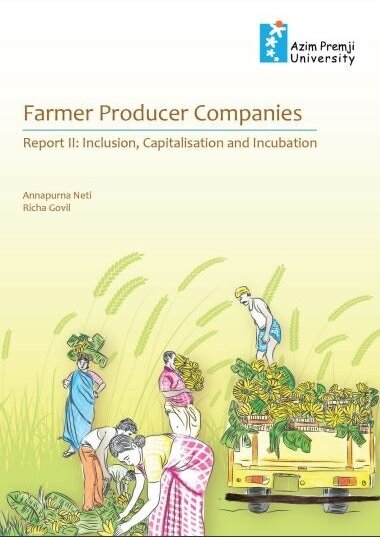
Farmer Producer Companies Report II: Inclusion, Capitalisation and Incubation
in Azim Premji University

- Published
- Authors
Abstract
This report examines the changes in the producer company landscape in the last two years by analysing data on producer companies registered in the country from April 1, 2019 to March 31, 2021. The report examines changes in geographical spread and capitalization of producer companies in the last two years, in order to determine the extent to which the gaps in the previous promotion efforts have been addressed. It also analyses recent policies to understand their impact on the producer company ecosystem. The report identifies five focus areas to enable the sector to reach its full potential in enhancing the incomes and reducing the vulnerabilities of small producers.
Article
Does the male Indian Robin Copsychus fulicatus share incubation duties?
in Indian BIRDS, New Ornis Foundation

- Published
- Authors
Abstract
During our frequent visits to the countryside of Solapur city, we observed an unusual behaviour in a pair of Indian Robins Copsychus fulicatus. It was a hot summer day in May 2021 and we noticed the pair collecting nest material such as grassroots, twigs, and hair. The nest was situated on a 1.5 m high mound of soil. To avoid disturbing them, we observed them from a distance of c. 9 m, with the help of 10x binoculars and 65x camera. The location of the nest was clearly visible — in a westward-facing hole, 1.4 m above the ground.
Links

- Published
- Authors
Abstract
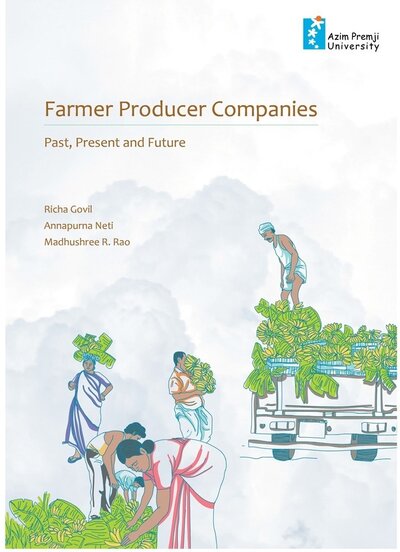
Eighty-seven percent of agricultural households in India are small and marginal producers, cultivating small plots which generate low returns. Their average monthly income is Rs 6426, making farming on small plots economically unviable (NSSO 2014). Therefore, policy makers and practitioners are turning to producer collectives as a means for improving the economic situation of small producers.