
Publications & Resources
Our faculty, students and researchers work together everyday to contribute to a better world by grappling with urgent problems we are facing in India. We conduct rigorous work to produce high quality learning resources and publications to contribute to public discourse and social change. Here, we feature a sample from our work for everyone to access. You can explore featured resources, policies, and the latest publications from the University.
To explore all the work of our University, please visit our publications repository.
List of Publications & Resources

- Published
- Authors
Abstract
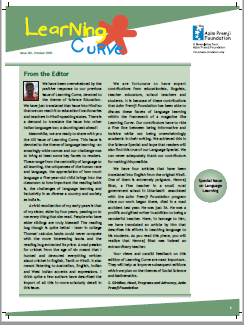
This issue of Learning Curve is devoted to the theme of language learning. In it, students, teachers, field practitioners and academicians talk about what language means to them, its multiple benefits and the issues and challenges associated with its learning.
Links

- Published
- Authors
Abstract
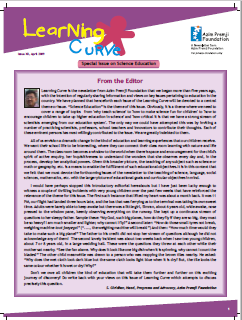
In this issue of the Learning Curve, practising scientists, professors, school teachers and innovators ruminate on the methods and merits of science education. A range of topics from ‘why teach science’ to ‘how to make science fun for children’ to ‘how to encourage children to take up higher education in science’ and ‘how critical it is that we have a strong stream of scientists emerging from our education system’ are addressed in this issue.
Links

- Published
- Authors
Abstract
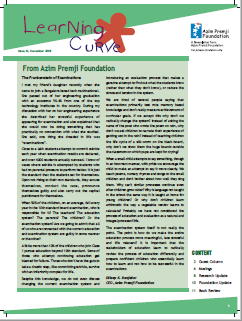
In this issue of the Learning Curve, read about how the Educational Development Index is calculated and what constitutes an effective education system. Krishna Kumar’s book ‘The Political Agenda of Education’, a comprehensive account of the goals of the Indian Education system under British rule and its ramifications for independent India, is also reviewed.
Links

- Published
- Authors
Abstract
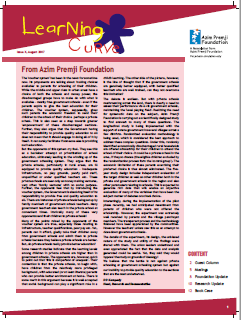
In this issue of the Learning Curve, the pros and cons of the voucher system are discussed and the value of arts in the school curriculum is elaborated upon. The book ‘Escape from Childhood’, in which author John Holt advocates for a broader definition of childhood, inclusive of political and economic rights for children, is also reviewed.
Links
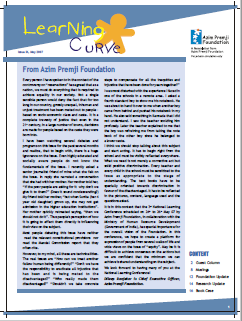
- Published
- Authors
Abstract
In this issue of the Learning Curve, the importance of community participation in education is explored and we read about Bindooben, a highly remarkable teacher in Gujarat. Paulo Freire’s ‘Pedagogy of the Oppressed’, in which the author delineates the incredible potency of education as a tool for liberation (genuine revolution of the people) and its capacity to dominate people, is reviewed.
Links
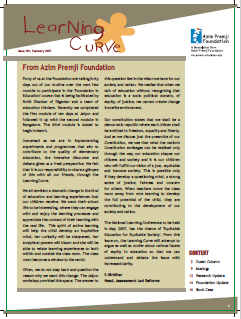

- Published
- Authors
Abstract
In this issue of the Learning Curve, we explore the various obstacles standing in the way of equity in the Indian Education system. Factors responsible for low access to schooling of disadvantaged groups like the Scheduled castes and the minorities are discussed.
Links
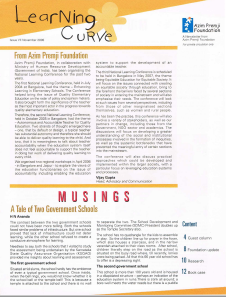

- Published
- Authors
Abstract
In this issue of the Learning Curve, Jean Dreze talks about the beneficial aspects of the Mid-day Meal Scheme and the Spastics Society of Karnataka elaborates on the accommodations and modifications required to integrate children with special needs into mainstream schools.
Links
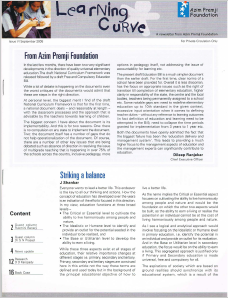

- Published
- Authors
Abstract
In this issue of the Learning Curve, updates of the Foundation’s programs and research studies are detailed in some length. An article on School Development Planning explores the benefits of training head teachers in devising plans for their schools.
Links

- Published
- Authors
Abstract
In this issue of the Learning Curve, the tricky exercise of measuring learning is addressed by experts in the field and the much neglected area of Mathematics Education Research is discussed for its utility in diagnosing the difficulties students face in assimilating Mathematics.
Links
- Published
- Authors
Abstract
In this issue of the Learning Curve, teacher absence in India, one of the Education system’s most insistent problems, is discussed and observations from Chinese Mathematics Classrooms are documented for their potential to serve as lessons for India.
Links
- Published
- Authors
Abstract
In this issue of the Learning Curve, the utility of researches in the development sector is discussed along with the outcomes of two such research studies, namely, ‘Factors differentiating the successful schools from others in the Learning Guarantee Program’ and ‘Impact of Computer Aided Learning on Learning Achievements’.
Links

- Published
- Authors
Abstract
The first issue of Learning Curve introduces the reader to the Foundation’s Accelerated Learning Program, the Learning Guarantee Program and the Computer Assisted Learning Centres.
Links
Report: Covid-19 crisis: Survey on internal challenges faced by social sector organisations
in Azim Premji University

- Authors
Abstract
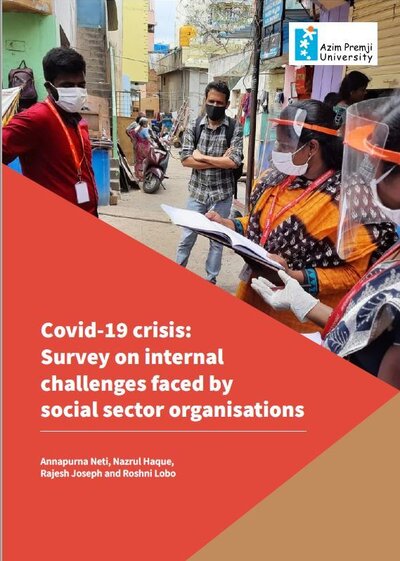
This report is based on a study to understand how the Social Sector Organisations (SSOs) are adapting their operations and resources to the challenges posed by the pandemic and the kind of changes they anticipate in the social sector in the next few years as they adjust to a post-Covid world. The study specifically focuses on the internal organisational changes of SSOs both in the short-term and medium-term.
The situation assessment study was carried out over five months during January-May 2021. The study was carried in two parts: (a) A survey of SSOs followed by (b) qualitative in-depth interviews with senior management of select organisations.
Of the 107 organisations that responded to the survey, we identified 28 respondents for the qualitative interviews, covering small, medium and large organisations operating in different states and domains such as livelihoods, health, education, human rights and gender.
The findings are organised into the following categories:
a. Humanitarian work carried out by SSOs
b. Impact of the pandemic on the existing programmes of SSOs
c. Impact of the pandemic on the workforce of SSOs
d. Impact on funding to SSOs

- Authors
Abstract
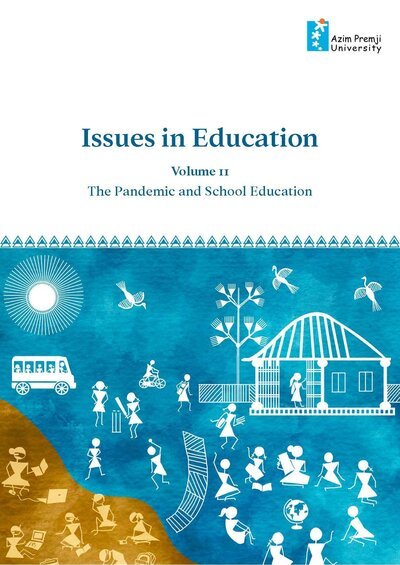
The COVID-19 pandemic was an unprecedented situation, which resulted in prolonged school closure in India and across the world. Schools were fully or partially closed in India for over two years, among the longest periods in any country. Governments responded as best as they could, primarily through enabling education using technology. However, given the nature of digital divide in the country and the lack of readiness of teachers, these efforts were suboptimal at best. Further, while face to face learning was not possible, some efforts at teacher-driven community-based learning were made. However well-meaning, these efforts could not prevent the loss of curricular learning for the period schools were closed as well as loss of learning or forgetting what had been learnt before schools were closed. At the same time, the efforts of teachers during these difficult times must be noted. Despite these severe unprecedented challenges during the pandemic, it was the concerted effort of engaged and motivated teachers that provided rays of hope. As frontline professionals who are the best positioned to understand, empathise, and devise innovative and consistent approaches to the challenges faced by the children who come to their schools, many teachers across the country showed how the seemingly insurmountable problems of the pandemic could also be addressed. Like other frontline workers across government departments, many engaged teachers across the country ignored the ‘fear’ of the pandemic and took it as their professional calling to devise ways and means to stay connected with the children from their schools and communities, offering what they only can do to help children stay connected with schools and learning processes even during multiple adversities they were facing. This volume brings together a series of studies done during the pandemic. It is an attempt to document and to highlight the unique challenges of the situation as well as efforts to overcome these challenges.
Links
- Authors
Abstract
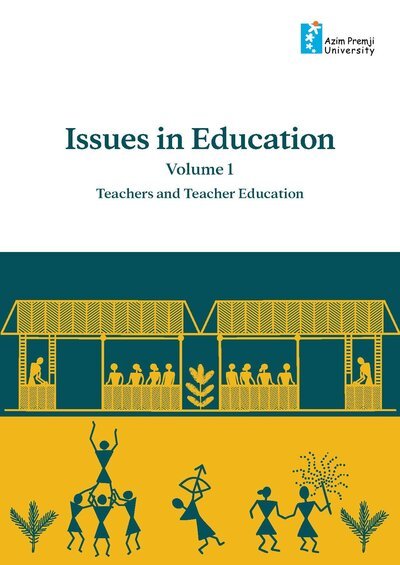
Education is fundamental to every society in many ways. It is the most organised process for economic, social and cultural development. It is also a systematic effort of a society to progress towards its ideals. In the case of India, to bring to life the vision and values of the Constitution. For a democratic society, a vibrant public education system is foundational.
Our Series on Issues in Education aims to bring into focus educational matters that are important for the improvement of the education system in India. It will attempt to connect to the reality of education on the ground, which is often complex and defies any kind of clear narrative and definitive conclusions.
This series emerges from the deep presence of Azim Premji Foundation in 50 disadvantaged districts in the country and our work with school systems in over 15 States and the Government of India. We bring to bear our 19 years of experience in working directly and continuously with over a million public schools, teachers and education leaders. The first volume in this series is on teachers and teacher education.
In this volume, we look at the functioning of teacher education institutions, examine the kind of support that teachers in the public system receive and understand the conditions within which teachers work.
Links
‘Aren’t we frontline warriors?’ Experiences of grassroots health workers during COVID-19
in Azim Premji University

- Authors
Abstract
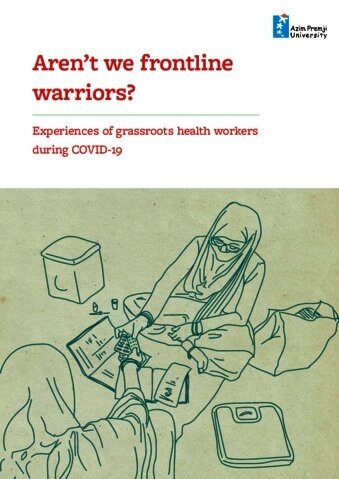
‘Aren’t we frontline warriors?’ asks a community health worker in a webinar that we had organised in May 2020 where grassroots health care workers were at the centre stage sharing their experience of working during COVID-19.1 This question resonates with several other community health workers who have been braving their lives against all odds to protect the communities against COVID-19. Yet a sense of lack of recognition of their contributions distinctly looms large! The idea of this compendium arises from the felt need of the community health workers to be heard. It was evident during the webinar that spaces for sharing such experiences are few while opportunities for garnering support and shared learning are many.
Links

Abstract
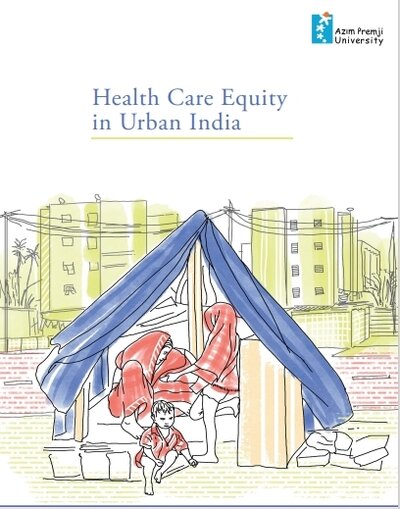
The report is based on the data drawn from detailed interactions with civil society organisations working on urban health in different cities and town across geographies including Mumbai, Bengaluru, Surat, Lucknow, Guwahati, Ranchi, Delhi etc., inputs from health officials in select cities, analysis of select data bases including NFHS, Census of India, government websites and secondary literature on urban health.
The report focuses on:
a) Understanding the health vulnerabilities of the urban poor
b) Availability, accessibility, cost and quality of health care facilities and challenges therein
c) Propose possible pathways towards fixing the gaps in urban health care governance and provisioning. It also outlines the detailed provision and governance of health care in four different cities and towns including Bengaluru (Tier I), Thiruvananthapuram (Tier II), Raipur (Tier III) and Davanagere (Tier III).