
Publications & Resources
Our faculty, students and researchers work together everyday to contribute to a better world by grappling with urgent problems we are facing in India. We conduct rigorous work to produce high quality learning resources and publications to contribute to public discourse and social change. Here, we feature a sample from our work for everyone to access. You can explore featured resources, policies, and the latest publications from the University.
To explore all the work of our University, please visit our publications repository.

- Published
- Authors
Abstract
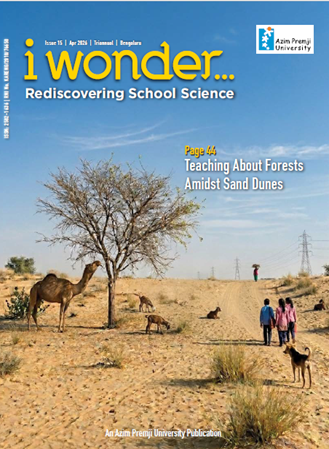
How can we use textbooks to teach our students about forests from direct observation of local ecosystems? In ‘Teaching about forests: Interpreting curricular aims’ a government school teacher explores national curricular aims within a state’s cultural history. ‘Teaching about forests amidst sand dunes’ shows how a teacher educator extends dense, wet forest examples to community-managed scrub forests in arid landscapes. ‘Teaching about forests in the laboratory of the real world’ uses a journalist’s lens to reveal the uneven impacts of conservation models on forest-dependent communities. Together, these stories show how we can use the textbook to turn our surrounding environments into living, breathing science classrooms.
Links

- Published
- Authors
Abstract
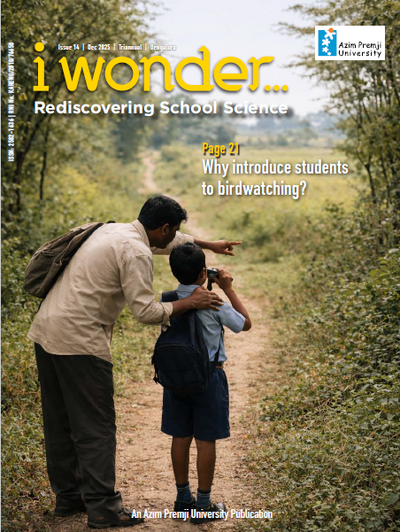
Science teachers often struggle to make space for themes that feel personal or are not directly linked to examinations. This issue focuses on two such themes: adolescence and birdwatching. ‘Using science to support students in navigating adolescence’ illustrates how science can help students understand physical, emotional, and social changes, while creating a supportive space for discussion. ‘Why introduce students to birdwatching?’ shows how a simple, low-cost activity can build core scientific practices such as observation, recording, comparison, and inference. Together, the articles offer practical ways to connect science teaching with students’ everyday lives and local environments.

- Published
- Authors
Abstract
Students learn about the properties of matter in Grade VI and its particulate nature in Grade VIII. But can they connect these concepts with observations and experiences of ‘air’ from their everyday world? Can we use an empty tumbler and an inflated balloon to offer visual evidence of these properties? Explore these questions through the articles and classroom resources in our theme section ‘Materials Around Us’.

- Published
- Authors
Abstract
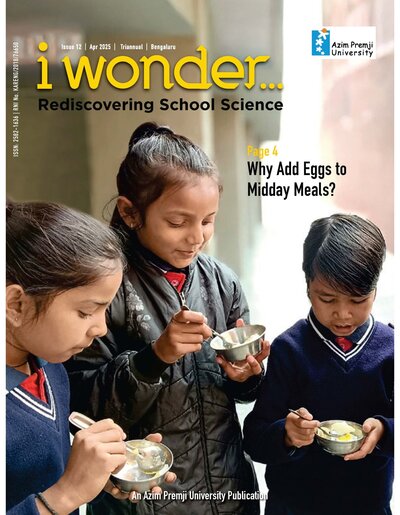
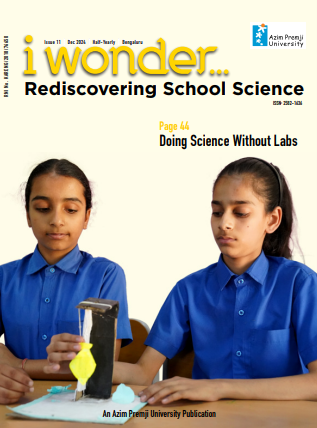
Can textbook concepts on health and nutrition equip students with the ability to critically analyse common beliefs around the addition of eggs in midday meals?
What can students learn about infectious diseases and the nature of science from the real-world example of the GBS outbreak in Pune?
Explore these and related questions in our theme section ‘Science in Action’. Find articles and classroom resources that support you in creating opportunities for your students to appreciate the relevance of textbook concepts and principles in preparatory-stage EVS and middle-stage science in their real world.

- Published
- Authors
Abstract
How can the experience of making a simple pinhole camera with inexpensive materials help our students think more creatively and critically about light?
How can conversations around an athlete’s record-breaking sprint actively engage our students in learning concepts around linear motion?
What do our students learn about the practice of science when we encourage them to write the biographies of scientists who appear in their textbook?
How do we provide spaces for our students to make and manipulate new materials from old discarded or inexpensive material?
Read this issue to explore these and many other such teaching-learning experiences in middle-stage science and preparatory stage EVS.

- Published
- Authors
Abstract
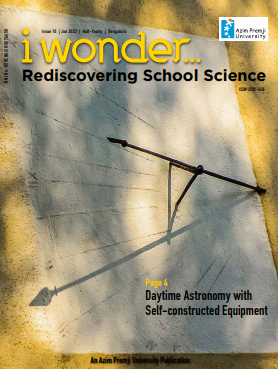
How do we introduce students to astronomy without the expensive instruments modern astronomers use and when regular school hours are nearly always during the day?
How can engaging with justice issues empower science learning, especially for learners who come from communities that have been traditionally excluded from science learning and careers?
Who are the pollinators in our neighbourhood and can we identify them by traits that plants may evolved to attract them?
Can simple practical demonstrations, like pushing a chair or dropping objects from a height, help students understand the relationship between force and motion more accurately?
Join us in exploring these and many other such questions in our commemorative issue.

- Published
- Authors
Abstract
What role do ‘chemical experiences’ play in helping children grasp the particulate nature of matter and use this idea to explain observed phenomena?
How do we use the art and aesthetics of lithography to introduce children to chemical reactions? What skills would children learn from this multisensorial and fun approach to science?
Why is it important for teachers to trace the history of evolving definitions of elements and atoms, and communicate the conditional nature of their validity?
Can we use poetry to teach chemistry? How would it change the ways in which students engage with science?
Join us in exploring these questions in three sections of our latest issue – Our Chemical World, I am a Scientist, and Snippets.
Links

- Published
- Authors
Abstract
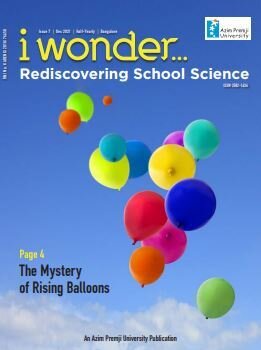
Why do party balloons rise in air? How high can they go? When do they drift to the ground?
How much water do plants lose? Do they lose it only as water vapour? Can they regulate water-loss?
Which chemical bonds are stronger — covalent or ionic? How can we tell?
Can we grow a dense forest of native species in congested urban spaces or degraded land? How long would this take?
Who were the first people to measure the size of the earth? How did they do it?
Join us in exploring these questions in our new section — Ask a Question.
Links