
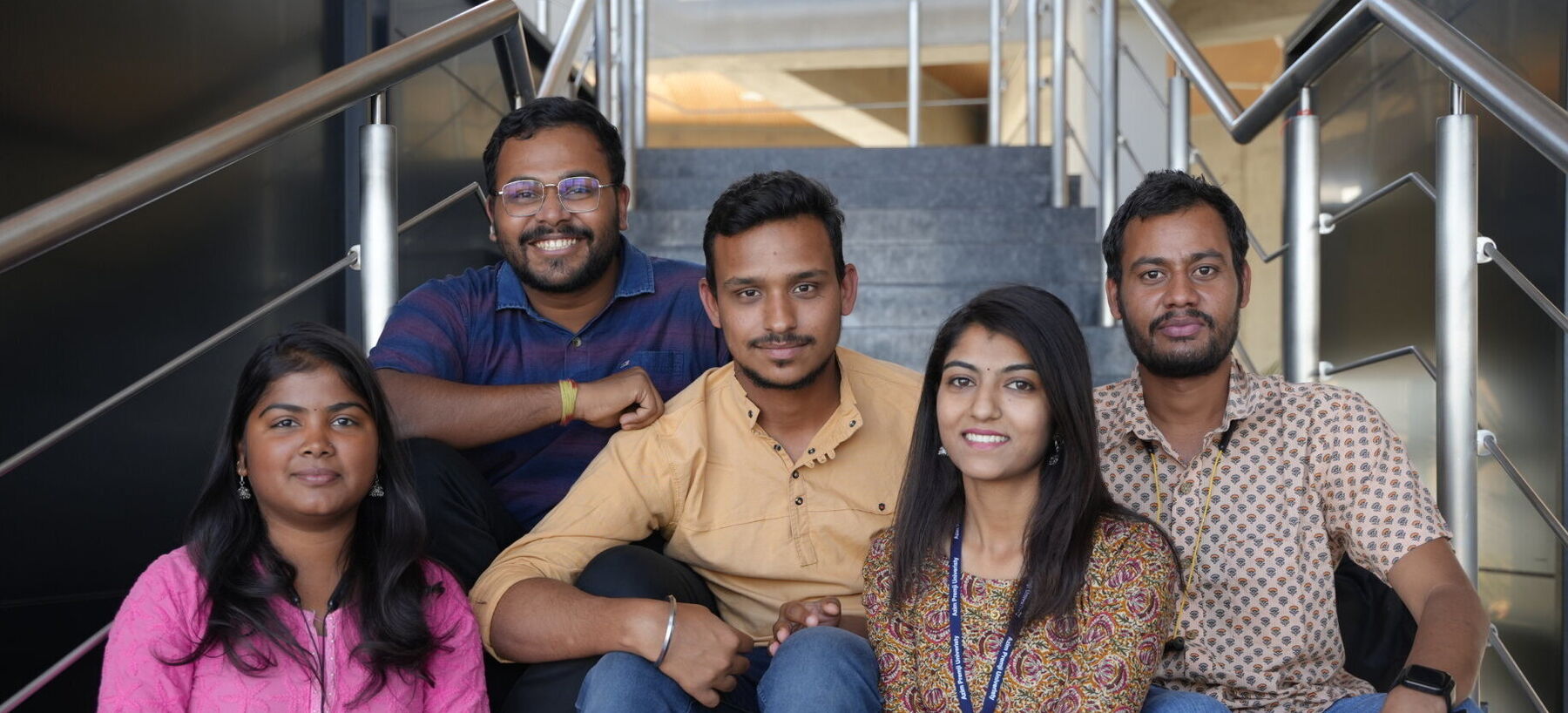
BA in Economics
Batch of
An understanding of everyday lives and activities that produce and reproduce livelihoods and social structures.
Economics is an attempt to understand everyday lives, a study of how people interact with each other and the natural environment to produce and reproduce their livelihoods. It is about the various sorts of social dealings that create, coordinate and maintain the structures of our lives: markets, states or social norms. Some of its questions attempt to understand how human beings cooperate and work together, why productive activity takes different forms, and why labour, which we all do in different ways, are treated with different values.
Who should join us?
Our programme is designed to provide a strong understanding of the Indian economy, economic theory, tools of analysis, and practical application of these skills to current economic issues. We help you make connections between the minute details and larger ideas. We believe that an understanding of history and philosophical approaches will enable you to think actively about the social and political present.
Why study with us?
We offer Interdisciplinary Openness
Our programmes encourage you to explore and follow your interests. We design our courses to ensure that you can specialise in a subject of your choice while learning various subjects across disciplines.
A Common Curriculum for all students
You will meet all your classmates at the beginning of your course to build all the tools you need for your four years of study. This includes foundational courses, an understanding of India, interdisciplinary studies, and courses in creative expressions.
We provide Academic Assistance
Our consistent academic assistance through language support, peer tutoring, faculty mentorship, etc., ensures that you meet the programme’s academic requirements.
We ensure Financial Support
We extend need-based financial assistance to students that cover tuition and accommodation expenses.
Programme Structure

Course Structure
The Common Curriculum will introduce students to the study of the themes and areas that emphasise and build critical and analytical abilities, and sensibilities for dialogue, reflection and cooperative learning. The Common Curriculum has four sub-components organised as below:
Academic Reading and Writing: Introduces students to domain specific reading and writing skills
Creative Expressions: Students are empowered to participate with meaningful social connection, fostering a community of active and responsible citizens
Public Reasoning/The World of Computing: The students will do one of the two courses.
- Public Reasoning: Introduces students to the practices of understanding as well arguing for claims in the public realm.
- The World of Computing: This enables students to explore the potential of computing devices and computational reasoning
Understanding India: India’s history, society and possible future.
Introduction to Economics I
Disciplinary Major
Understand economic behaviour and interactions through key economics concepts and tools.
Introduction to Economics II
Disciplinary Major
What makes an economy healthy, and how can economic ill-health be treated?
Introduction to Statistics and Programming
Disciplinary Major
An introduction to statistical approaches and computer programming used by economists to study real-world problems.
Intermediate Microeconomic Theory
Disciplinary Major
Do individuals calculate their actions to suit consequences? Are individual’s choices purely self-interested? How do individual behaviours affect social institutions? And how can policies take heed to these behaviours?
Intermediate Macroeconomic Theory
Disciplinary Major
Why do economies grow? What causes price to rise?
Political Economy
Disciplinary Major
What does it mean to understand the economy through the lens of power? What are the key power relations in the Indian economy?
Introduction to Econometrics
Disciplinary Major
What economic, social and political questions can we answer using data? What can we know using simple trends and summary statistics? It turns out, quite a lot!
Economic History
Disciplinary Major
Why were a handful of European countries able to impose themselves on the rest of the globe and what have the consequences been?
History of Economic Thought
Disciplinary Major
Where do current theories of modern economics come from? Do all economists agree on their approach to economic problems?
Indian Economy
Disciplinary Major
Various perspectives on the evolution of the Indian economy over recent history.
Students must be prepared for the world of work at the end of the programme should they choose to enter it. We aim to provide the required skills and competencies for this through a Minor featuring courses in an Occupational or Interdisciplinary theme. These sets of courses are aimed to provide both conceptual understanding and skills and tools that will allow students to contribute through work and further study.
Students can opt for a Minor in any one of the indicative areas listed below.
The selection of these indicative areas is based on the availability of courses and our evaluation of the student’s interests and academic needs. For each cohort, a final list of available courses will be announced at the end of their second semester.
Music Education
The undergraduate Occupational Track programme in Music Education is designed in collaboration with SaPa, the Subramaniam Academy of Performing Arts. SaPa is on a mission to make quality music education accessible to all. A large part of this involves creating enough music teachers to build the ecosystem for music education, and creating certifications and knowledge sets to make music teachers employable, both in schools and at music institutions.The Music Education OT aligns with this objective and aims to offer students an understanding of music itself, and how music may be taught in different environments. This will help students be employable,…Design for Communities
Design concerns itself with envisioning, planning and creating objects, spaces or interactive systems to address a need or a problem. It attempts to meet the needs of a variety of users with responses that are aligned with their specific contexts. It aims to understand situations and create holistic, appropriate solutions. While design is a large discipline with many domains, this Occupational Track will look at the design of products, the practical use of technology in various enterprises and the design of spaces for accessibility and interaction. It includes the process of ideating, developing and refining products that meet specific market…Data, Democracy and Development
The set of courses will orient you to think about data as an essential part of building empathy and democratic values. We ensure you have the requisite tools for data collection, analysis, presentation, and dissemination so that you can construct the right platforms and build technologies that embody democratic principles. These courses will foster a culture of investigation with data, keeping in mind questions of ethics and politics.Climate Studies
These courses will help you develop the knowledge necessary to understand the earth’s climate systems. You will examine and analyse the role of human activity on the earth’s climate and its effects on the present and future climate scenarios, and identify the effects of climate change on biodiversity through the lens of historical changes in the Holocene. We hope you will apply systems thinking to examine the origins of the climate crisis and proposed solutions and grow comfortable with civic engagement and transfer of knowledge and resources for climate solutions at different levels.Technology for Social Good
The Technology for Social Good occupational track has been designed based on the Azim Premji Foundation’s extensive experience in working with social sector organizations. Many of these organizations are addressing long-standing social problems through utmost dedication and a strong desire to improve the society we live in. There is a lot of scope for facilitating the work of these organizations through the use of digital technology. While accomplishing social change is a slow process requiring long-term engagement, digital technology can assist these organizations in making their operations more effective and by permitting better utilization of scarce resources. At present, these…Biodiversity Conservation
Biodiversity conservation, management, and habitat restoration requires a multi-pronged approach, and an interdisciplinary understanding is essential. This OT will acquaint students with the rich biodiversity of the Indian subcontinent and the associated threats to them, and provide the students with the lens to identify pertinent questions such as — what to conserve, why to conserve, when to conserve, and how to conserve. The field of conservation binds the need for species and ecosystem conservation with the requirements for human well-being, livelihood, and rights. Through this curriculum, the students will be aware of the interdisciplinary approach in this field and will…Media and Journalism
These courses will introduce you to the critical and conceptual tools involved in media texts. This course is based on research and practice, and you will study how media texts are created and their social, historical and political contexts. This course is for students who wish to prepare for careers in journalism, communications, and social work.Education
The Occupational Track (OT) in Education at Azim Premji University leverages the liberal arts tradition by fostering a deep understanding of human society and its relationship with education. This program delves into psychology, sociology, politics, and philosophy, revealing how these disciplines influence how individuals and societies approach learning. Additionally, the arts, humanities, and diverse philosophical perspectives enrich our understanding of educational thought and practice.The OT in Education recognizes the importance of analysing educational processes and systems at various levels, from individual student experiences to national and international trends. By examining different perspectives – personal, communal, organisational, national, and international –…Sports and Fitness
We believe that a regimen of physical activity can have a powerful effect on an individual’s physical, mental, and emotional well-being. Sport can be used as an effective tool to help an individual learn crucial life skills and also to build an empathetic, equitable community. In these set of courses, we want you to have a powerful experience of sport not just as a physical activity but as a way to build yourself and your social surroundings. We also want to teach you ways in which you can create these transformational experiences for others.

Students can craft their own educational experience by selecting courses in the following ways:
- Students will have the option to take additional courses in their Disciplinary Major.
- Interdisciplinary Minor that will enable them for their further higher studies or career pathways.
These courses could also be selected to enhance and broaden their
- Language skills and Quantitative reasoning capacities/programming skills.
- Understanding of themes outside their Major subject.
Classroom Practices
Over the course of the programme, students will be exposed to a range of pedagogical practices including lectures, seminars, group-based learning, and active learning strategies.
We are committed to providing an environment where students and faculty are engaged in active learning, which involves the practical application of knowledge and skills through real-world experiences and problem-solving. There are a number of ways we promote active learning and direct application of economics for students outside of the classroom from fieldwork, internships, and opportunities for research.
We recognise the diversity of backgrounds and capabilities that students come with and have designed the programme to respond to their individual needs including those with disabilities and neurodiversity.
Honours Projects
You can work closely with a faculty member on a specific topic, and develop a research question to write up a thesis. To choose this path, you should have completed credits from classroom courses and a project.
Some ongoing thesis projects are:
A historical analysis of Shiv Sena, labor movements and identity politics in Mumbai, Amit Wagh, mentored by Amit Basole
Changes in Monetary Policy During Time of Crisis, Avantika V.A., mentored by Zico Dasgupta
Domestic Violence in India: An Analysis of Trends in Perpetretors’ Characteristics, Behaviors, and Attitudes, Nandini S., mentored by Kade Finnoff
Tanisha Hiremath: Kautilya’s Arthashastra: The Determination of Prices, Wages and Taxes; Advisor: Alex Thomas
Land distribution, land accumulation and land conflicts in Telangana: A historical study, Jayant, mentored by Dontha Prashanth
Publications
Opinion Articles
Let’s not underestimate deprivation in the country — Amit Basole in Mint
Why David Card, Joshua Angrist and Imbens won the Nobel prize in economics? — Anand Shrivastava and Avinash Tripathi in Hindustan Times
Want Vaccine Fast? Suspend Intellectual Property Rights — Arjun Jayadev (and others) in The New York Times
Plugging education gaps as schools reopen — Garima Agarwal in Indian Express
Number Theory: Four Charts which explain India’s Net Zero emissions challenge — KC Adaina and Kedar Kulkarni in Hindustan Times
The Narendra Modi Stadium is India’s “It’s not cricket” moment — Rajendran Narayanan in scroll.in
Can the increase in MSP for paddy help boost its yield? — Srishti Yadav in Hindustan Times
What’s missing from India’s monetisation debate — Tamoghna Halder in Aljazeera
Why Rupee Depreciation is bad, not good news — Zico Dasgupta in Hindustan Times
Understanding the formulation of the budget — Zico Dasgupta in The Hindu
Interviews
Amit Basole on Jobs and Economic Growth in CNBC
Amit Basole and Rajendran Narayanan on MGNREGA as a safety net during COVID in the Indian Express
Anand Shrivastava on electoral polarisation in Frontline
Alex Thomas speaks on his latest book “Macroeconomics: An Introduction”
Arjun Jayadev on Inequality at the Institute of New Economic Thinking
Kedar Kulkarni on “Vulnerability to Climate Change” at Oregon State University
Rahul De in conversation with Sanjay Reddy on evolution of economics education in India
Rahul De in a panel discussion with teachers from different Economics Departments in India on creating a pluralistic economics programme
Srishti Yadav on “Caste, Diversification, and the Contemporary Agrarian Question in India” at the Foundation for Agrarian Studies Online Meeting
Srishti Yadav speaks on the Agrarian Question in India on the “A Correction: Podcast”
Zico Dasgupta in The Hindu on whether the declining rupee is a crisis or opportunity for the Indian Economy
Zico Dasgupta in ET Now on whether India will see a Millionaire rush by 2030
Zico Dasgupta in a discussion with Barkha Dutt on the Economic Survey 22 – 23
Conferences and Workshops
International Conference on the History of Economic Thought 2023
The conference hosted close to 50 paper presentations over two days, covering a wide range of themes and thinkers: African to Indian economic thought, Ambedkar to Sraffa, Keynesian to Feminist economics, Kautilya to Ibn Khaldun. The presenters also span various stages of career, with a large number of presentations by undergraduate and graduate students, who were able to receive feedback from senior and distinguished scholars in the field. The conference was preceded by a one-day workshop oriented at teachers of History of Economic Thought.
The two keynote lectures were delivered by leading HET scholars Maria Bach and Francois Allison, both affiliated with the Centre Walras Pareto, University of Lausanne, Switzerland. Explore more details here.
Demystifying Economics 2023
The second edition of the Demystifying Economics has been jointly organised by Azim Premji University, Bahujan Economists and School for Democracy.
The idea of this workshop is not to lecture participants on Economics, but to the extent possible, democratise the language and the discipline of Economics itself. This is because the participants of this workshop, who are members of various civil society organisations across India, are already best positioned to understand the complex nature of the social, political and economic reality on the ground, but owing to a variety of factors, most notably being bereft of technical vocabulary, they get relegated to being spectators in the larger gambit. Keeping this in mind, we have designed multiple sessions in this workshop, shedding light on the concepts of Microeconomics, Macroeconomics, Political Economy and Statistics as relevant to the contexts of our participants.
Find the outline of the workshop here.
Advanced Graduate Workshop 2023
In 2006, Professors Joseph Stiglitz and Akbar Noman started a small interdisciplinary workshop titled ‘Advanced Graduate Workshop (AGW) on Poverty, Development and Globalisation’. Ever since, the workshop has mentored and hosted scholars from all across the world. For the past 10 years, AGW has been organised by Azim Premji University in collaboration with the Institute for New Economic Thinking. The Economics group at Azim Premji University remains closely associated with this workshop in various scopes and roles.
The goal of the workshop is to bring together graduate students studying economic development at a sufficiently advanced stage of their dissertation to be able to discuss and receive feedback on their research. The success of AGW lies in creating a supportive and friendly environment which makes students comfortable to discuss and provide feedback on each other’s work. Explore more details here.
The programme at Azim Premji University has several mechanisms to provide learning support to students. Economics students will be particularly encouraged to avail of support in quantitative methods as well as analytical and writing support.
Depending on the course context and student preparation, additional support is provided in the form of group and individual tutorials, peer tutoring, pre-semester immersion programmes, winter & summer term supporting courses and sustained support from the Academic Resource Centre (ARC) for English and Mathematics.
For students wanting to explore the subject further, the economics programme will also provide external resources for students to engage in Indian economic issues, both within and outside the classroom; including access to data, news, blogs, and journals, and guest lectures and interactions with economists outside the University. There is an active student-led Economics Club that regularly organises seminars, movie screenings, games, and other events.
Explore

Faculty
- Abhishek Shaw
- Alex M Thomas
- Amit Basole
- Anand Kumar
- Anand Shrivastava
- Arjun Jayadev
- Arjun Prakash
- Arpan Ganguly
- Ayushi Choudhary
- Bilal Ahmad Bhat
- Chinmaya Kumar
- Dontha Prashanth
- Garima Agarwal
- Indulekha Guha
- K C Adaina
- Kade Finnoff
- Kartikeya Batra
- Kedar Kulkarni
- Lokesh Posti
- Malavika Thirumalai Ananthakrishnan
- Mampi Bose
- Nandu S Nair
- Rahul De
- Rajendran Narayanan
- Rosa Abraham
- Satyam Kumar Rai
- Srishti Yadav
- Sukanya Bose
- Sunit Arora
- Suranjana Kundu
- Tamoghna Halder
- Zico Dasgupta
32 of 33 All Programme faculty →