
Publications & Resources
Our faculty, students and researchers work together everyday to contribute to a better world by grappling with urgent problems we are facing in India. We conduct rigorous work to produce high quality learning resources and publications to contribute to public discourse and social change. Here, we feature a sample from our work for everyone to access. You can explore featured resources, policies, and the latest publications from the University.
To explore all the work of our University, please visit our publications repository.
List of Publications & Resources

- Published
- Authors
Abstract
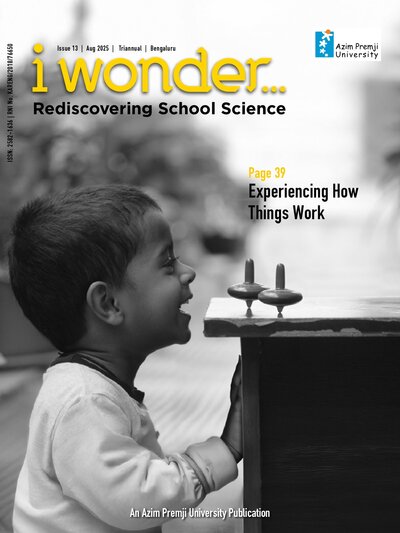
Students learn about the properties of matter in Grade VI and its particulate nature in Grade VIII. But can they connect these concepts with observations and experiences of ‘air’ from their everyday world? Can we use an empty tumbler and an inflated balloon to offer visual evidence of these properties? Explore these questions through the articles and classroom resources in our theme section ‘Materials Around Us’.

- Published
- Authors
Abstract
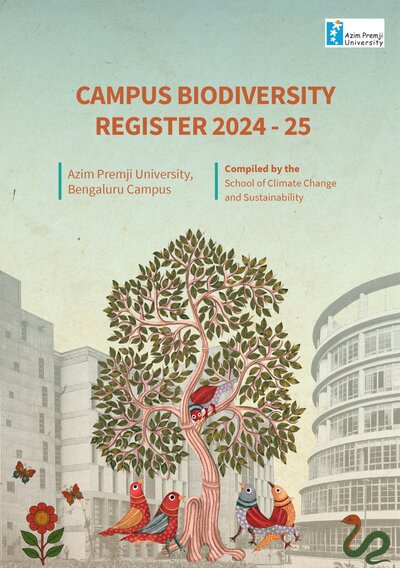
More than just an academic space, the Azim Premji University campus in Bengaluru is fast becoming a thriving ecosystem of its own. Located in Sarjapura, the campus is more than classrooms and labs — it is a habitat shared with birds, reptiles, insects, small mammals, and a growing canopy of trees and plants. This report is a first step in documenting the biodiversity of our campus. From trees and shrubs to spiders and snakes, students of the BSc in Environmental Science and Sustainability, teachers, and other members have come together to observe and record the life that surrounds us. Thus, this is a collective effort that reflects both scientific curiosity and deep care for our environment. As the campus grows, we aim not only to track carbon sequestration and environmental change — but also to nurture a sense of stewardship and belonging in everyone who calls this campus home.
Links
Economic concentration in India: The role of financial conditions
in Azim Premji University

- Published
- Authors
Abstract
This paper examines recent trends in corporate concentration in India’s non-financial sector, with a focus on developments since 2015. Using firm-level data from the CMIE Prowess database we document changes in asset and income distribution across firms. We find that while the overall decline in the public sector’s share of assets and income contributed to a reduction in measured concentration in earlier years, this was accompanied by a steady increase in the share held by large private business groups. By 2023 – 24, the top five business groups — Reliance, Tata, Adani, Aditya Birla, and Bharti — accounted for approximately 24(%) of total assets and 16(%) of total income in the non-financial corporate sector.
Authors:
Links
Cross state comparison of excess deaths during the covid pandemic in India: Some measurement and methodological considerations
in Azim Premji University

- Published
- Authors
Abstract
This paper assesses excess mortality in India during the COVID-19 pandemic, focusing on the year 2021 when the country experienced a substantial surge in deaths. Drawing on newly released official data from the Civil Registration System (CRS) and the Sample Registration System (SRS), and supplemented with estimates based on the National Family Health Survey (NFHS‑5), we construct a range of mortality estimates using multiple baseline comparisons. Excess deaths are calculated in absolute terms, per 1,000 population, and using age-standardised death rates to facilitate cross-state and international comparisons. Particular attention is paid to persistent challenges in India’s mortality data landscape, including regional disparities in death registration completeness, limitations in cause-of-death certification, and inconsistencies between administrative and survey-based sources. The analysis includes alternative projections that adjust for estimated registration completeness, underscoring the sensitivity of mortality estimates to underlying data assumptions. By applying standard demographic techniques such as age standardisation, we attempt to mitigate the effects of India’s heterogeneous age structure and registration coverage. The findings suggest a substantial mortality impact from the pandemic, exceeding officially reported figures, and raise broader questions about the capacity of statistical systems to support real-time health surveillance. We identify correlates in terms of state capacity.These results have implications for public health preparedness, intergovernmental coordination, and the long-term strengthening of civil registration and vital statistics systems in India.
Authors:
B S Bhargav, Dipa Sinha and Arjun Jayadev
Links
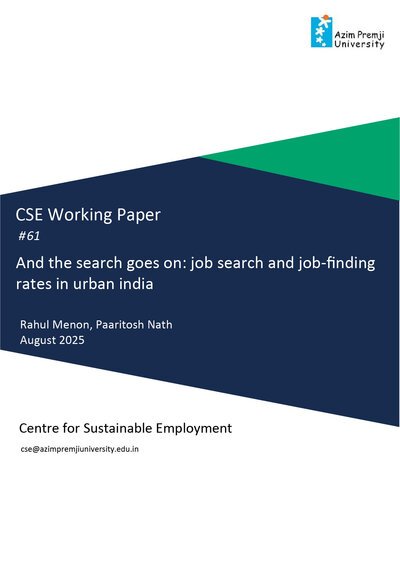
And the search goes on: Job search and job-finding rates in urban India
in Azim Premji University

- Published
- Authors
Abstract
The cross-sectional nature of Indian employment surveys limits a true understanding of labour market dynamics. Using innovations in official national-level labour surveys that track urban individuals across four quarters, we study transitions from unemployment to employment — defined as the job-finding rate — to understand whether those seeking employment are able to find suitable work in urban India. Our analysis reveals significant weaknesses in the urban Indian economy over the period 2017 to 2023. On an average, only 17 per cent of unemployed individuals in any quarter find a job in the next quarter. Job-finding rates are the lowest for women, the young and the highly educated. Hazard-rate analyses reveals that the same cohorts take the longest time to find jobs, with a majority remaining unemployed even after four quarters of job search. We demonstrate the impact of the pandemic on urban labour markets in two ways. Not only are job-finding rates significantly lower in the post-lockdown period relative to pre-lockdown, there has also been a shift in the nature of jobs created, with casual work rising and regular wage and self-employment falling post-lockdown. Our analysis has important policy implications for understanding labour market dynamics and for the design of urban employment schemes.
Authors:
Rahul Menon & Paaritosh Nath
Links

- Published
- Authors
Abstract
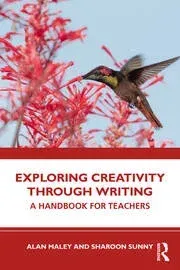
The book explores the nature of human creativity and its importance in education with reference to past and ongoing work on creativity theory. It aims to direct the attention of teachers to the need for creativity in education by dispelling the mystique surrounding it, and the feelings of inadequacy or apprehension it may evoke in educators, particularly in the Asia region.
The book offers an introduction to creativity in writing: the rationale for including it in language programmes, the benefits it can bestow and the results it can produce – as well as dealing with common objections to it. It divides creative writing into two major sections – poetry and stories, followed by a copious set of varied classroom activities. For each activity, a standard format is adopted to offer teachers maximum support in implementing the procedures, including supplementary comments on each activity. It is distinct for its accessibility and clarity, its abundance of practical and ready-touse classroom activities and its unique combination of theoretical underpinnings and practical implementation.
This book will be useful to students, pre-service teachers and researchers who are new to the teaching of English Language, both in the Asian context and in the wider world. It will also be an essential companion to practicing in-service teachers and Teacher Trainers to further sharpen their concepts and skills.
Links