
Publications & Resources
Our faculty, students and researchers work together everyday to contribute to a better world by grappling with urgent problems we are facing in India. We conduct rigorous work to produce high quality learning resources and publications to contribute to public discourse and social change. Here, we feature a sample from our work for everyone to access. You can explore featured resources, policies, and the latest publications from the University.
To explore all the work of our University, please visit our publications repository.
List of Publications & Resources

- Published
- Authors
Abstract
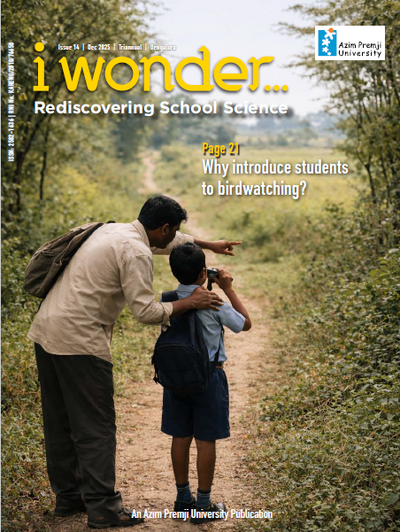
Science teachers often struggle to make space for themes that feel personal or are not directly linked to examinations. This issue focuses on two such themes: adolescence and birdwatching. ‘Using science to support students in navigating adolescence’ illustrates how science can help students understand physical, emotional, and social changes, while creating a supportive space for discussion. ‘Why introduce students to birdwatching?’ shows how a simple, low-cost activity can build core scientific practices such as observation, recording, comparison, and inference. Together, the articles offer practical ways to connect science teaching with students’ everyday lives and local environments.
Rural Transformation in India: What can we learn from village studies?
in Azim Premji University

- Published
- Authors
Abstract
This article examines rural transformation in India through a review of longitudinal village studies conducted over the past three decades. It argues that rural India is not undergoing structural transformation in the classical sense. While labour is steadily moving out of agriculture, this shift has not led to higher productivity in agriculture or the development of a robust rural nonfarm economy. Instead, what unfolds is a process of deagrarianisation, driven by out-migration of male workers to cities where they engage in informal nonfarm employment. This transition is uneven and remains deeply embedded in existing hierarchies of caste, class, and gender, which shape both access to opportunities and outcomes. By identifying common patterns across diverse regional contexts, the article shows how village studies provides a grounded perspective on the nature of rural change.
Author:
C.R. YaduLinks

- Published
- Authors
Abstract
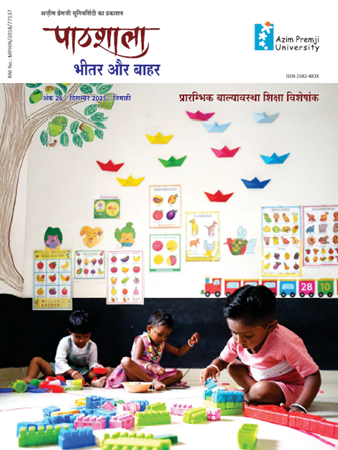
पाठशाला भीतर और बाहर का दिसम्बर अंक केन्द्रित है ‘प्रारम्भिक बाल्यावस्था और शिक्षा’ पर। इस अंक में प्रारम्भिक बाल्यावस्था और शिक्षा पर केन्द्रित विविध अनुभव-आधारित आलेख, एक सैद्धान्तिक लेख, शिक्षकों की डायरी में दर्ज उनके अनुभव उन्हीं की कलम से, कुछ रोचक तथा आसानी से की जा सकने वाली गतिविधियाँ और ऐसी किताबें, जिनका उपयोग प्रारम्भिक बाल्यावस्था के लिए किया जा सके, शामिल हैं। साथ ही ‘उम्मीद जगाते शिक्षक’ के अन्तर्गत एक आँगनवाड़ी कार्यकर्त्री, जिन्होंने अपने केन्द्र को बदलाव के नए स्तर दिए, की यात्रा के अनुभव, उनकी कहानी भी है।
Widespread practices and sustainability benefits of foraging in urban blue spaces of India
in Nature Cities
Article
- Published
- Authors
Abstract
Urban blue spaces, such as lakes and rivers, are increasingly recognised for their ecological and social roles, yet their contributions to sustainable food systems remain understudied. Here, the researchers examine the extent and benefits of foraging in urban blue spaces across four major Indian cities through a survey of 1,200 users. We identify three forager groups, that is, ‘rare’, ‘occasional’ and ‘frequent’ foragers, whose behaviours differ in frequency and practice. Women, the elderly and marginalised communities most frequently collect, share, cook and sell edibles. Access to home or community gardens strongly motivates occasional foragers. Frequent foragers emphasise benefits relating to nutrition and income, as well as culture and social capital, whereas occasional foragers appreciate nature- and culture-related benefits. The findings challenge conventional perspectives on urban food provisioning, highlighting urban blue spaces as vital yet overlooked spaces for food access and resilience. Integrating foraging into urban planning can enhance equitable food systems, fostering transformative change toward sustainable urban landscapes.
Authors: Sukanya Basu, Brenda Maria Zoderer, Harini Nagendra, Peter H Verburg, Tobias Plieninger
Links