
Publications & Resources
Our faculty, students and researchers work together everyday to contribute to a better world by grappling with urgent problems we are facing in India. We conduct rigorous work to produce high quality learning resources and publications to contribute to public discourse and social change. Here, we feature a sample from our work for everyone to access. You can explore featured resources, policies, and the latest publications from the University.
To explore all the work of our University, please visit our publications repository.
List of Publications & Resources
Diversity in Approaches in Community-Based Mental Health Interventions in India: A Narrative Review and Synthesis
in Cambridge University Press


- Published
- Authors
- Mukta Gundi
- Rhea Kaikobad
- Seema Sharma
Abstract
Mental health is a global priority, fundamental to the health and development of all nations. The contribution of mental disorders to the global burden of disease is widely recognised; however, a significant care gap exists, particularly in the context of low-and middle-income countries. In India, for instance, there are 0.3 psychiatrists per 1,00,000 population. To address this severe shortage of mental health professionals and resources globally, the World Health Organisation has suggested the adoption of a community-based mental health care approach, where the locus of services shifts from institutional care to local communities. Over the last five decades in India, diverse approaches to mental health care have emerged because of the interaction of dominant discourses on community-based mental health care with various socio-cultural contexts. In addition to the government-run mental health programme and programmes run by medical colleges, civil society organisations have increasingly contributed to this space. Although studies have assessed individual interventions, there exists a need to map these interventions and synthesise the approaches for service delivery to inform public health practice in India and in low-and middle-income countries at large. This narrative review attempts to map and synthesise insights from community-based mental health interventions in India implemented across diverse contexts. The researchers searched peer-reviewed journal articles and book chapters published in the English language between 2010 and 2023. They present the synthesis of approaches used in 41 community-based mental health interventions, where they unpack key intervention components and processes adopted for primary prevention and promotion; identification and case detection; treatment and care, and rehabilitation in the community. This review presents key recommendations for practitioners about the role of community, the diversity and commonalities in various approaches across contexts, the roles of various actors in service delivery, and the shared values guiding the conceptualisation and implementation of community-based mental health interventions in India.
Links


- Published
- Authors
Abstract
Religion in India is a constantly evolving and transformative entity that cannot be engaged with in isolation from other dimensions of life. This short introduction moves beyond traditional text- and scripture-based academic approaches to provide an overview of the dynamic role of religion in contemporary Indian society. Examining religion through the perspectives of religious actors, interlocutors, and practices, it highlights how religion intersects with the state, secularism, identity, and civic and economic life. An indispensable resource for general readers, students, and researchers, this book will foster grounds for dialogue towards a flourishing of pluralism in present-day India.
Links

- Published
- Authors
Abstract
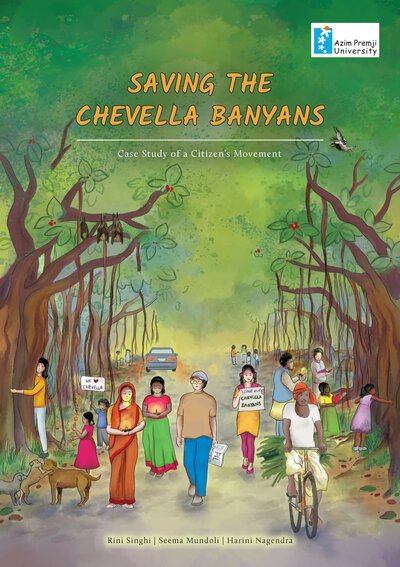
This case study, documents the trials, tribulations and victories of a citizen’s movement to protect the environment — in this case the Chevella banyans. These banyans that are of ecological, historical and cultural importance were under threat of being axed for a road widening project. This case study can be used as a teaching resource in undergraduate and postgraduate programmes, and by civil society organisations and citizens as a guiding document to understand how they can contribute to protecting the environment, the strategies they can apply and the challenges they might face.
Authors:
Rini Singhi, Seema Mundoli, Harini Nagendra
Links
Scholarly Insights into Sustainability, Climate Change, & Blue Food: A Perspective Aligned with Adoption of Sustainable Development Goals
in Springer Nature


- Published
- Authors
Abstract
The increasing global demand for food, coupled with the impacts of climate change and environmental degradation, has shifted attention towards blue food systems. While these systems offer a potential solution to food security challenges, their sustainability is threatened by various factors, including overfishing, habitat destruction, and climate change. Recognising these challenges, the Food and Agriculture Organisation of the United Nations (FAO, UN) advocates for ensuring the sustainable contribution of aquatic food systems to global food security and nutrition, aligning with the United Nation’s Sustainable Development Goals (UN-SDGs). It was hypothesised that adoption of UN-SDGs would increase the interest of researchers in sustainability of fisheries and aquaculture. Therefore, a bibliometric analysis of the relevant literature published between 2000 and 2023 was conducted to test this hypothesis. The analysis revealed a significant rise in publications addressing climate change and sustainability after the adoption of the UN-SDGs. The countries exhibiting high vulnerability to climate change contributed disproportionately fewer publications to the database. The United States emerged as the leading contributor in terms of publication volume, while Canada’s University of British Columbia was identified as the institution with the highest number of contributing authors. The findings underscore pronounced geographical disparities in research output, with a predominance of countries from the Global North. The underlying factors contributing to these disparities are discussed. Furthermore, the study discusses the policy implications of these findings and emphasises the imperative to prioritise equitable research initiatives. Such efforts are essential to effectively support the realisation of the SDGs within the domain of blue food systems and sustainability.
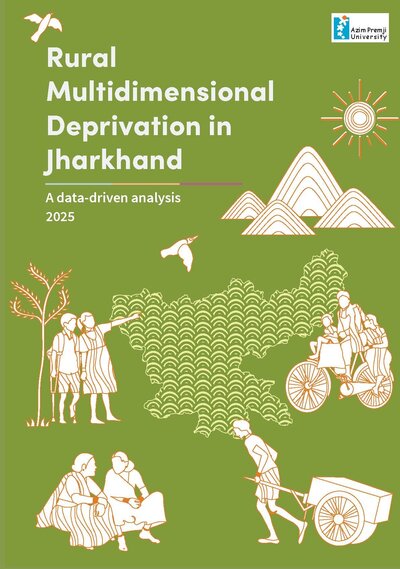
Rural Multidimensional Deprivation in Jharkhand: A Data-Driven Analysis 2025
in Azim Premji University

- Published
- Authors
- School of Development
Abstract
This report constructs a Rural Multidimensional Deprivation Index (RDI) for measuring deprivation in Jharkhand. An important feature of the index is that it is constructed using indicators on provisioning of basic infrastructural amenities at the village level. This is different from the usual poverty indices that are composed of financial indicators such as income or consumption; or indicators measuring development outcomes such as educational or nutritional levels. Observing the provisioning of basic infrastructural amenities, this report makes focused policy suggestions that can be easily implemented by functionaries working on the ground. The data for the index is sourced from the Mission Antyodaya Survey, which was carried out in 2019 at the village level across the country. The survey collects data related to provisioning and outcome of basic amenities in villages, along with demographic and socioeconomic variables. Because this is a periodic survey, it enables us to track the developmental progress of each village, district, state and the country over time. In total, there are about 182 variables that were captured in the 2019 round. The survey covers 31,175 out of 32,620 villages in Jharkhand, which is 95.6 percent of the total number of villages in the state; and 6,48,358 out of 6,67,933 villages in India, or 97.1 percent of the villages in the country.
Editors
Prasanna S, Sandhya Krishnan, Sanket Gharat, Puja Guha, Amalendu Jyotishi, Neeraj Hatekar
Links
Neoliberalism and Women’s Work: A Study of the Informal Economy in India
in Taylor & Francis

- Published
- Authors
Abstract
In this chapter, the researchers critically examine the emancipatory role of neoliberalism with a focus on women’s work in India. They argue that the multi-pronged crisis afflicting the labour market is a fallout of the implementation of the neoliberal project in India that had severely impacted women workers, who typically are one of the oppressed sections in society. They argue that neoliberalism leads to the proliferation of social orthodoxies that promote patriarchal gender contracts whereby men are the primary breadwinners while women are mainly responsible for social reproduction in the ‘domestic’ space.
They highlight that the neoliberal regime in India is associated with declining participation in paid work for women workers, notwithstanding the rapid growth rate of the Gross Domestic Product (GDP) that the economy has been witnessing. This is in the backdrop of India having one of the lowest rates of participation in paid employment of women workers. They claim that women’s work participation in India is affected by the production conditions in Indian agriculture and the burden of unpaid care work. However, increased participation in paid work — the quantitative dimension — does not necessarily lead to women’s empowerment under neoliberalism. This is largely due to the proliferation of the informal sector, which has been the major source of paid work for women workers. The researchers contend that women workers encounter two layers of subordination and control in the labour market that become acute in the informal sector, which is associated with a lack of worker’s rights. They are subordinated, first, by the dominance of capital and, second, by the patriarchal social order. These, in turn, adversely impact the quality and economic value of women’s work. They argue that the degradation of the economic value of women’s work has led to the accentuation of the gender bias that endangers the chances of survival of the girl child in a society characterised by deep-rooted patriarchy.
The contemporary precarity of women’s work — in terms of quantity and quality of work — also reflects the existing social orthodoxies that loom large in the private and public domains in India. Lastly, based on the latest Periodic Labour Force Survey database, they argue that the COVID-19 pandemic has widened the structural inequalities in the economy and added a layer to the existing vulnerabilities of women workers.
Authors: Mampi Bose, Shantanu De Roy
Links


- Published
- Authors
Abstract
In this book, Prema, a young girl living in Mumbai, learns about heatwaves and their devastating effects when her father falls seriously ill during an intense summer. Through her eyes, readers explore the human impact of rising temperatures and the urgent need for climate awareness.
Authors: Shrunoti Ritesh Tatiya, Santonu Goswami, Seema Mundoli, Harini Nagendra
Illustrations: Shrunoti Ritesh Tatiya
Links


- Published
- Authors
Abstract
Craft new understanding in primary school mathematics with the July 2025 issue of At Right Angles. And do send in your feedback to AtRightAngles.editor@apu.edu.in