
Publications & Resources
Our faculty, students and researchers work together everyday to contribute to a better world by grappling with urgent problems we are facing in India. We conduct rigorous work to produce high quality learning resources and publications to contribute to public discourse and social change. Here, we feature a sample from our work for everyone to access. You can explore featured resources, policies, and the latest publications from the University.
To explore all the work of our University, please visit our publications repository.
List of Publications & Resources
Regressive income shocks during COVID-19: Evidence from India
in Azim Premji University

- Published
- Authors
Abstract
Studies based on the Consumer Pyramids Household Survey (CPHS) in India have shown that the impact of the Covid-19 lockdown on household incomes was progressive in nature — richer households suffered more. But several media reports as well as purposive surveys carried out during the pandemic suggest that the poor suffered more than the rich. We use nationally representative panel data for urban India from the official Periodic Labour Force Survey (PLFS) to show that households that were relatively richer prior to the start of the pandemic suffered relatively less during the lockdown compared to households that were poorer. That is, the shock was regressive in nature. We also confirm that, as per CPHS, richer households did indeed experience higher drops in income than poorer ones. But we show that this progressivity is much less than what prevailed prior to the pandemic. Thus the pandemic either disrupted ongoing progressive income changes or was outright regressive in its impacts.
Authors:
Amit Basole, Anand Shrivastava, Jay Kulkarni and Akshit Arora
Links
Contexts and Priorities: Reflections on Developing a Master of Public Health Programme in India
in Azim Premji University

- Published
- Authors
- School of Development
Abstract
While the recent COVID-19 pandemic has accentuated attention to the public health challenges of our times, many of these concerns are certainly not new. There are multiple public health concerns including the rising burden of non-communicable diseases, health risks due to environmental degradation and climate change, and re-emergence of several communicable diseases. Responses to these challenges, including educational responses, have often been reductionist and hence found to be inadequate. There has been an increasing global recognition of the need for transformative education to address the complex health challenges of the 21st century. In this article, we discuss one such effort in designing a public health education programme in India that echoes the sentiment of transformative learning that is contextual, competency-driven, trans disciplinary, reflective, and collaborative. We discuss how these aspects of learning were reflected and considered through a series of internal deliberations within the university and external consultations with different stakeholders. This process involved examining existing gaps in public health education, articulating the core competencies, developing the curriculum, and envisaging students’ contribution to public health practice in India.
Authors:
Arima Mishra, Adithya Pradyumna, Mukta Gundi, Edward Premdas Pinto and Prasanna Saligram
Links
Rural Multidimensional Deprivation in Chhattisgarh | A Data-Driven Analysis
in Azim Premji University


- Published
- Authors
- School of Development
Abstract
Poverty in India has been defined and measured in several different ways over the years. This report presents a unique way to measure rural poverty in Chhattisgarh using data from the Mission Antyodaya Survey of 2019. We construct a rural multidimensional deprivation index (RDI), composed of indicators in the areas of infrastructure, health and education. The index can be decomposed into its different sub-components to understand which of the indicators contribute the most to deprivation and can be analysed at different levels, starting from the block to the taluka, district and state level. From a policy and public action perspective, the RDI is extremely useful because it is composed of public provisioning of amenities at the village level. A high RDI reflects lack of access to public amenities and deprivation in villages. Because India has a decentralised structure where the Panchayats are responsible for taking governance at the grassroot levels. Results from this report can be extremely useful to these institutions as they can identify which villages need provisioning of what amenities and act accordingly.
Editors: Sandhya Krishnan, Prasanna S, Sanket Gharat, Puja Guha, Amalendu Jyotishi, and Neeraj Hatekar.
Links
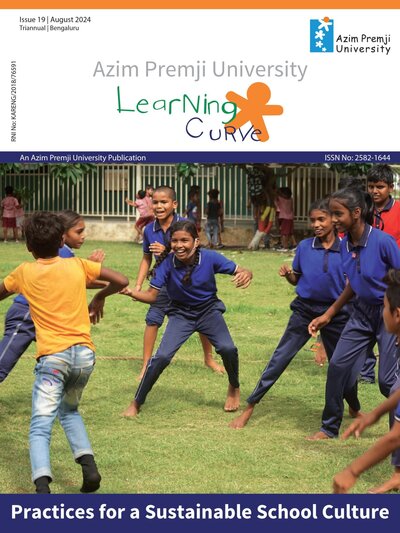
Learning Curve Issue 19 | Practices for a Sustainable School Culture
in Azim Premji University

- Published
- Authors
Abstract
This issue focuses on practices that build a school culture – practices that become so ingrained in the school’s ethos that they come naturally to everyone and do not change if those who helped develop these move out of the school. It includes several aspects of the school culture, such as creating an environment where all students feel safe, valued, and seen; where there is no fear of any subject, where there is a high level of collaboration among teachers and continuous engagement with parents.
Links