
Publications & Resources
Our faculty, students and researchers work together everyday to contribute to a better world by grappling with urgent problems we are facing in India. We conduct rigorous work to produce high quality learning resources and publications to contribute to public discourse and social change. Here, we feature a sample from our work for everyone to access. You can explore featured resources, policies, and the latest publications from the University.
To explore all the work of our University, please visit our publications repository.
List of Publications & Resources
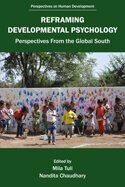
Inclusive Education in India: Examining Emerging Epistemologies
in Reframing Developmental Psychology: Perspectives from the Global South, Emerald Publishing Limited

- Published
- Authors
Abstract
This chapter critically examines the different conceptions and emerging paradigms in the discourse on inclusion in the context of education in India. The researcher interrogates the nature of inclusive education and argues for an epistemology that emerges from the paradoxes, diversity and disparities that characterise schools and classrooms in the Indian context. In doing so, the researcher scrutinises the emerging trends in education research and the ‘new’ epistemology from the global North which attributes agency to the practitioner, the parent and the child to participate in the education discourse, shifting the equation of power in the construction of knowledge. In this chapter, she examines the connotations of these new, emerging trends for research, practice, and policy on inclusion for India. The chapter presents the tensions in arriving at conceptions of inclusive education and how that has impacted policy and its realisation in practice. The central thesis of the paper is constructed through a close examination of the different forms of marginalisation that characterise Indian classrooms, the situation of the disadvantaged child, the parent and the teacher in the context of education.
Links
Social norms and women’s employment in India: A district level analysis
in Azim Premji University

- Published
- Authors
Abstract
Reducing gender disparities in workforce participation is an important policy goal in several developing countries. India, in particular, has historically had low levels of women’s workforce participation as compared to men and as compared to peer economies. Prior research has identified both supply and demand-side explanations for low levels of women’s participation in paid work. On the supply side, social norms constraining women’s mobility and autonomy are commonly invoked as one explanation. We test the relevance of such norms in explaining heterogeneity in women’s employment using district-level data from the National Family Health Survey (NFHS) 2015 – 16 and the Sixth Economic Census (2013). Norms indices are constructed using Principal Components Analysis for 640 districts of India. The findings indicate that less restrictive norms related to decision-making, mobility, and asset ownership are positively correlated with higher levels of women’s employment.
Authors:
Subhapriya Chakraborty and Amit Basole
Links

- Published
- Authors
Abstract
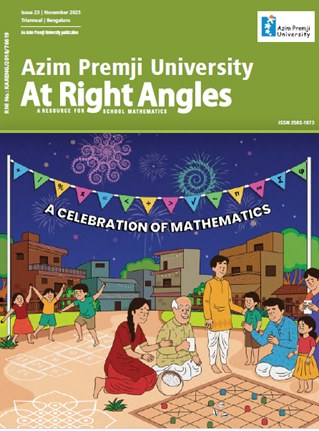
The November 2025 issue of At Right Angles takes a look at the annual celebration of the National Day of Mathematics on December 22. Celebrating mathematics makes perfect sense to some, far less to others- with the articles in this issue, we hope to make persuasive arguments that cause shift towards those who love patterns, who enjoy discovery, who believe in celebrating reason, elegant arguments – in short, Mathematics!
Towards Strengthening Primary Health Care: Lessons from a Government-Civil Society Collaborative Intervention in India
in Journal of Community Systems for Health (JCSH)

- Published
- Authors
- School of Development
Abstract
The need to strengthen comprehensive primary health care towards ensuring “Health for All” is well established yet operationalising this has remained a challenge globally as well as in India. Based on a qualitative study of a collaborative initiative between the government and a civil society organisation, this article discusses what factors and processes explain successful implementation of primary health care in a remote rural area in central India.
Authors: Arima Mishra, Raman Kataria, Roseline Sagar, Pawan Singh, Pankaj Tiwari, Shivkant Tripathi, Vinay Vishwakarma, Sapna Mishra
Links