
Publications & Resources
Our faculty, students and researchers work together everyday to contribute to a better world by grappling with urgent problems we are facing in India. We conduct rigorous work to produce high quality learning resources and publications to contribute to public discourse and social change. Here, we feature a sample from our work for everyone to access. You can explore featured resources, policies, and the latest publications from the University.
To explore all the work of our University, please visit our publications repository.
List of Publications & Resources
Trajectories of Labour Market Transitions in the Indian Economy
in World Development, Elsevier

- Published
- Authors
Abstract
The Indian economy, despite registering high growth, is characterised by a persistent and vast informal economy. Using it as an illustration, the researchers draw lessons for characterising labour markets in contexts of high informality. They employ a group-based statistical modelling method to identify whether there exist systematic patterns in the high volume of worker transitions across different employment arrangements. Using panel data for eight points between 2017 and 2019, they identify seven dominant labour market trajectories. The trajectory capturing stable formal salaried employment, with highest average earnings, accounts for only 6.7% of the sample. None of the dominant trajectories denote a job ladder from informal to formal work, and the sorting of individuals into informal trajectories is far from voluntary, indicating an existence of formal and informal segmentation. The most populous trajectory, comprising 38.4% of the sample, with second highest average income (although half of that of the formal salaried trajectory), is stable self-employment, followed by the trajectory representing transition within different forms of informal wage work at 27.2%. Most trajectory groups associated with informal wage arrangements have high flux, indicating lack of stability. Furthermore, trajectories associated with informal wage employment have even lower earnings than those with informal self-employment. Far from suggesting a desirability of informal self-employment, this is indicative of a breaking down of the expected voluntary transition from self to wage employment in the transformation process. Additionally, access to trajectories is stratified along various correlates, especially caste. Caste hierarchy operates most starkly at the node of accessing the trajectories, while in terms of penalties or gains in earnings, traditional caste-hierarchy may not always operate uniformly. The findings disrupt the standard expectation in structural transformation models and labour market theories, while highlighting the need to foreground evolving nature of informality in labour market models for developing economies.
Authors: Rosa Abraham, Surbhi Kesar
Links

- Published
- Authors
Abstract
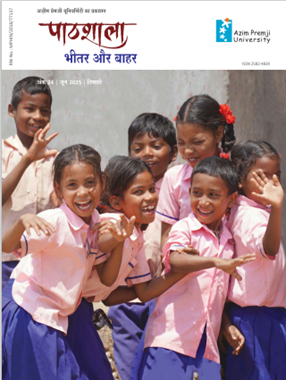
पाठशाला भीतर और बाहर के जून अंक (24वाँ) में एफ़एलएन की अवधारणा, कक्षा अनुभव, चुनौतियाँ, आदि को केन्द्र में रखकर लिखे गए कुछ लेख हैं। बातचीत के ज़रिए विद्यार्थियों से जुड़ना और उस बातचीत का शिक्षण प्रक्रिया में उपयोग कैसे हो, बच्चों को रचनात्मक लेखन से कैसे जोड़ें, पाठ योजना बनाकर पढ़ाना कैसे उपयोगी होता है, जैसे लेख भी शामिल हैं। एक ऐसे विद्यालय की कहानी को पढ़ना दिलचस्प होगा जिसका नामांकन एकदम कम हो गया था, लेकिन कुछ ख़ास प्रक्रियाएँ अपनाने से उस विद्यालय में न सिर्फ़ नामांकन बढ़ा, बल्कि विद्यार्थियों के सीखने का स्तर भी बेहतर हुआ।
हमेशा की तरह ईसीसीई पर आलेख है जिसमें आँगनवाड़ी केन्द्र के माहौल और गतिविधियों से जुड़े अनुभव शामिल हैं। नियमित स्तम्भ के अन्तर्गत इस बार ‘इनसे मिलिए’ में मध्य प्रदेश की शिक्षिका से जानेंगे उनके अनुभव, कि कैसे और कौन‑सी प्रक्रियाओं के चलते सीखना बेहतर हुआ। इसके अलावा, इस अंक में ‘शिक्षकों की डायरी से’, ‘किताबों से दोस्ती’, और ‘आइए, करके देखें’ स्तम्भ भी शामिल हैं।