
Publications & Resources
Our faculty, students and researchers work together everyday to contribute to a better world by grappling with urgent problems we are facing in India. We conduct rigorous work to produce high quality learning resources and publications to contribute to public discourse and social change. Here, we feature a sample from our work for everyone to access. You can explore featured resources, policies, and the latest publications from the University.
To explore all the work of our University, please visit our publications repository.
List of Publications & Resources
The Intersection of Justice and Urban Greening: Future Directions and Opportunities for Research and Practice
in Urban Forestry and Urban Greening

- Published
- Authors
Abstract
The global uptake of green infrastructure in urban settings holds considerable promise for fostering both social and ecological benefits. Recognising the imperative to ensure equitable distribution of these advantages, this paper draws on the rich traditions of justice considerations within urban studies to inform research on urban greening. Focusing on three key trends — reconceptualising the ‘urban’ category, acknowledging the role of historical processes in shaping contemporary uneven and unjust geographies, and considering power dynamics in infrastructure development — we propose five tenets for advancing justice-focused urban greening research. These tenets encourage researchers to act as knowledge brokers, practice reflexivity, recognise the complex dimensions of justice which diversity of scale might reveal, embrace uncertainty, and cultivate a “modest imaginary” concerning infrastructure projects.
Authors:
Derickson, K., Walker, R., Hamann, M., Anderson, Adegun, O.B., Castillo, A. C.,Guerry, A., Keeler, B., Llewellyn, Liz, Matheney, A., Mogosetsi-Gabriel, N., Mundoli, S., Gajjar, S.P., Sitas, N., & Xie, L.P.
Links
Schooling and Constructions of Citizenship: Some Reflections on Student Agency and Choice
in Contemporary Education Dialogue

- Published
- Authors
Abstract
A national system of education in modern nation-states is usually geared towards nation-building and schools play a significant role in grooming children as future citizens. While the dominant and powerful usually emerge as the ‘ideal citizen’ in the national imagination, the marginalised are constructed as the ‘other’, vilified, and stigmatised. The school, with its overt and hidden curriculum, operates as a major site for the reproduction of dominant ideology while at the same time creating opportunities for exercising human agency. This article, an ethnographic study conducted in a government co-educational school in Delhi, examines how it sought to mould the students into ‘ideal’ citizens and how this was received by them. Belonging to a relatively lower socio-economic background compared to the teaching community, did they give their acquiescence? Or were they able to exercise their agency to challenge the entrenched power structures in society? Were their responses shaped by their specific social locations and the unfolding of ‘cultural politics’? Moreover, when the nature of ‘official knowledge’ itself has undergone radical shifts and the idea of citizenship has been redefined with the introduction of the National Curriculum Framework 2005, were the students able to leverage the epistemological shifts embodied in the textbooks to reimagine and construct ideas of citizenship regarding marginalised communities? These are some questions that the present article seeks to address.
Perceptions of ecosystem services and knowledge of sustainable development goals around community and private wetlands users in a rapidly growing city
in Landscape and Urban Planning

- Published
- Authors
Abstract
Urban wetlands are well-known to provide multiple ecosystem services and are essential for achieving the UN Sustainable Development Goals (SDGs). The management practices of local institutions are strongly influential on the sustainability outcomes of urban wetlands, yet the beliefs and value systems underlying distinct management approaches have not been studied thoroughly. Therefore, this study aims to elucidate the perceptions of local stakeholders regarding the ecosystem services provided by urban wetlands, their linkages to the SDGs, and pertinent threats to the wetlands, to reveal the connections between local awareness and sustainable management practices. Using the East Kolkata Wetlands (EKW) in India as a case study, we used a mixed-method approach to interview 120 local stakeholders associated with two differentially managed wetland systems – community and private. Our results demonstrate that the community wetlands are more socially inclusive in nature than the private wetlands. The private users emphasized economic benefits and livelihood security above all, whereas the community users strongly valued diverse provisioning services and cultural services in addition to the livelihood security. Further, community users identified a greater number of ecosystem services as contributing toward the SDGs relative to private users. We suggest that sustainable development strategies consult and incorporate the perceptions of local community wetland management groups, as these management practices are rooted in more comprehensive value systems and are more aligned with sustainable outcomes. These insights reveal the importance of local awareness of ecosystem services, and may be of value to urban planners and policymakers working toward sustainable urban management.
Authors: Sukanya Basu, Harini Nagendra, Peter Verburg, Tobias Plieninger
Links

- Published
- Authors
- Climate Change and Sustainability
- Research Centre
Abstract
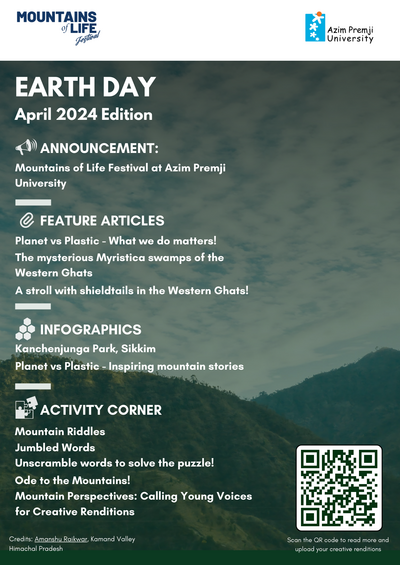
Building on the success of the Forests of Life newsletters last year, and with the upcoming Mountains of Life festival scheduled in November 2024, we are excited to bring you a collection of mountain wonders through captivating stories, insights into challenges faced by the communities and calls for action. Additionally, we facilitate a platform for young voices to showcase their creative renditions, encouraging them to explore the various facets of the mountain ecosystems and the need for their conservation. With “Planet vs Plastics” as the theme of this newsletter, we intend to raise awareness about the danger of plastic pollution in the mountains, advocate for the reduction of single-use plastics, acknowledge the efforts of some unsung heroes, and call for more sustainable alternatives.
Links
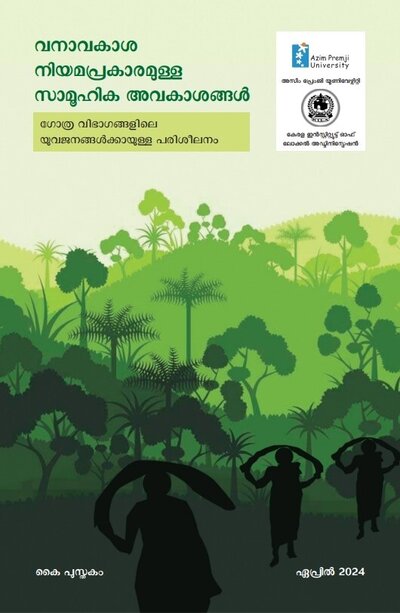
വനാവകാശ നിയമപ്രകാരമുള്ള സാമൂഹികഅവകാശങ്ങൾ: ഗോത്ര വിഭാഗങ്ങളിലെ യുവജനങ്ങൾക്കായുള്ള പരിശീലനം
in Azim Premji University

- Published
- Authors
- School of Development
Abstract
Hand book for a course on Community Forest Rights for the tribal youth in Kerala Azim Premji University’s FRA initiative, in collaboration with the Kerala Institute of Local Administration (KILA), launched a two-months long course on Forest Rights Act (2006), focusing on the Community Forest Rights (CFR). The course was tailor made for the tribal youth in the state of Kerala, following case studies[1][2][3] and orientation workshops conducted between 2020 and 2022. This handbook is the basic resource for this training. Students are expected to be informed and equipped for initiating the vesting of CFR working with their gram sabhas. Course Content and Delivery: The pedagogical approach is a blend of class room and hands-on learning, including field visits and computer lab sessions. There are three weeks of classroom interactions and five weeks of hands-on learning. The course has four units: the first unit, ‘Tribals and forests – a historical perspective,’ examines the historical context of tribal issues both globally and within the regional landscape. Second unit, ‘Understanding FRA,’ covers the history of FRA and comprehensively unpacks the Act, Rules, and the implementation challenges. Unit 3,‘Skills & competencies for Community Forest Resource Management (CFRM)’ imparts specific skills including accountancy, communication and mobilization skills as well as biodiversity management, necessary for effective implementation of CFR. The fourth unit ‘Individual field project’ is to be carried out by each student in two phases: (a)identification of the challenges and opportunities for implementation of FRA — for 2 weeks (b) finding responses to address the specific challenges identified during the first phase of 2 weeks. [1]https://practiceconnect.azimpremjiuniversity.edu.in/implementation-of-forest-rights-act-observations-from-keralas-attappadi-block/ [2]https://practiceconnect.azimpremjiuniversity.edu.in/implementation-of-forest-rights-act-lessons-from-vazhachal-division-of-kerala/ [3]https://practiceconnect.azimpremjiuniversity.edu.in/implementation-of-forest-rights-act-observations-from-wayanad-district-of-kerala/
Links
- Published
- Authors
Abstract
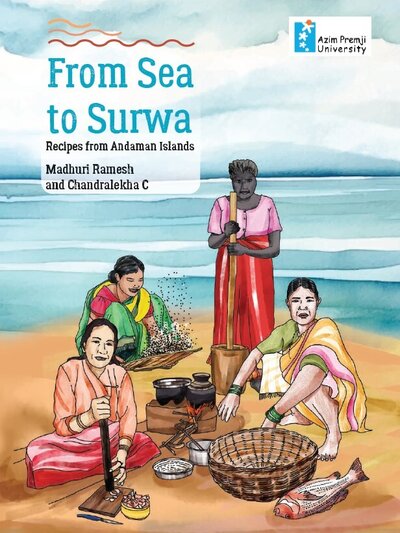
Food is the product of a community’s culture and environment. Hence a study of ‘foodways’ can tell us about what food resources are available as well as how customs, beliefs and practices shape the use of these resources. In this report, we share some of the stories and recipes we collected from women in different settler communities between June to November 2023. Our report showcases how these women use marine resources in creative and careful ways to improve the nutritional security of their families. In the process, the report offers a glimpse of the cultural, historical and ecological connections of settler communities of the Andaman Islands.
Authors:
Madhuri Ramesh
Chandralekha C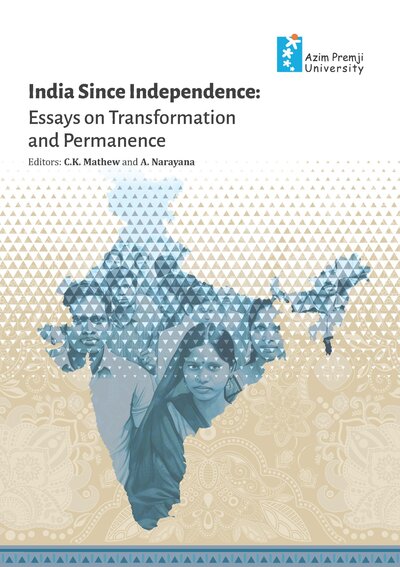

- Published
- Authors
Abstract
The Azim Premji University has been encouraging the expression of diverse and disparate views on a variety of subjects in the past too. Over the last two decades of its existence, the Azim Premji Foundation under which the University operates has been consistently focusing on its vision of contributing towards a more just, equitable, humane, and sustainable society through extensive on-the-groundwork across the country as well as through its partners. In this context we may venture to say that the present collection of essays is an expression of that focus, while encouraging views and counterviews on various perspectives on the national endeavour, with the goal of working towards the Foundation’s vision.
Amidst the Corona crisis of 2020 to 2022, another compendium of essays entitled Understanding Post-Covid-19 Challenges in India had been published in March 2022. The essays in that collection too had looked at certain key domains such as Health, School Education, Impact of Covid on vulnerable groups, urban development, the systems of recording deaths etc. While that collection tried to document how the nation navigated through a short period of the toughest challenge, this collection tries to offer a snapshot of more than 75 years of history
since Independence.It is hoped that this collection of essays will encourage its readers to think about the myriad activities that India as a nation has undertaken in its unending search for building a better society, the complexities that it has to encounter and the challenges that it has had to overcome, in trying to achieve that objective. The essays here are collected over a year’s time following the 75th year of Independence, and as such some of the essays might not have captured the latest developments in the themes that they focus on. The readers’ responses are welcome.
Editors:
Links
- Published
- Authors
Abstract
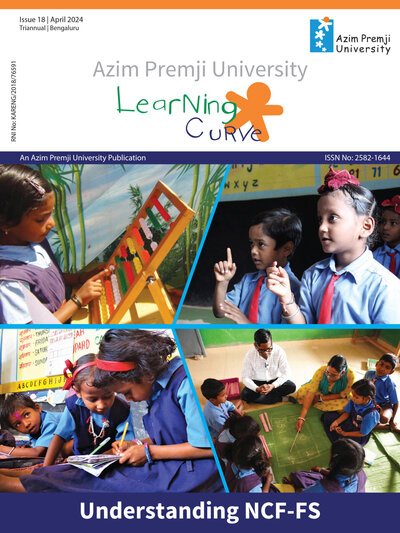
The National Curriculum Framework for Foundation Stage (NCF-FS) document has not reached all teachers and is yet to be translated into regional languages. But as we wait for this, we thought we could start to understand it and the experience of some teachers in Azim Premji Schools and those who we work with in government schools in several states who have been implementing parts of it in their classrooms.
Links
Impact of Interventions Supporting Girls’ Education on Early Marriage, Pregnancy and Work Participation: Evidence Synthesis
in Indian Journal of Human Development
Article
- Published
- Authors
- Mukta Gundi
- Radhika Dayal
Abstract
This article synthesises the evidence on the impact of interventions supporting adolescent girls’ and young women’s education on delaying marriage, childbearing and improving work participation. A total of 13 studies (eight from sub-Saharan Africa and five from South Asia) during the years 2000 – 2020 met our inclusion criteria. A major focus of the included studies was to reduce the schooling cost, with limited focus on strategies such as supplementary coaching, making schools girl-friendly, monitoring performance and sensitising communities about educating girls. Most studies that measured the effects on marriage and childbearing showed a positive impact. However, interventions were less successful in influencing work participation. Although a majority of studies reported positive effects on educational outcomes, fewer measured or reported positive effects on other social and health outcomes. This evidence synthesis suggests a need for studying long-term effects of such interventions on girls’ and women’s families, work and social life to inform policy. Studies that explore the varying impacts of such interventions on girls and women from different sociocultural settings are needed. Our evidence synthesis underscores the importance of making comprehensive efforts to support girls’ education in order to meet the global development commitments of ensuring equitable life opportunities for adolescent girls and young women.
Links
Entrepreneurship and Marginalised Social Identities in India
in Economic and Political Weekly
Article
- Published
- Authors
Abstract
The nature and extent of the under-representation of marginalised caste groups in enterprise ownership in India are examined. It is found that exclusion takes place in three distinct stages. First, the share of Scheduled Caste (SC), Scheduled Tribe (ST) or Other Backward Class (OBC) individuals in ownership of any enterprise is less than their share in the workforce. Second, among those who do engage in entrepreneurial activities, a disproportionately higher share of entrepreneurs from the marginalised identity groups are engaged in enterprises, which are not purely commercial and are likely to be subsistence-oriented. And finally, even within the owners of purely commercial enterprises, those from marginalised groups tend to be concentrated in the smaller enterprises and are severely under-represented in the larger and more productive ones.
Links

- Published
- Authors
Abstract
Explore the Point of Mathematics and send in your feedback to AtRightAngles.editor@apu.edu.in.
Article
- Published
- Authors
Abstract
Fifty years ago this week, Gaura Devi, an ordinary woman from a nondescript village in India, hugged a tree, using her body as a shield to stop the tree from being cut down. Little did she know that this simple act of defiance would be a seminal moment in the history of India and the world. Or that Reni village, where she lived, would come to be recognised as the fountainhead of the Chipko environmental movement. What the foot soldiers of Chipko wanted was an acknowledgement of their Indigenous rights to access forest resources that were crucial for their survival. What they got instead was a national law and a ministry populated by a new breed of power brokers — who, in the years to come, would decide at times that habitat preservation is possible only by keeping local communities out.
“I pray to God that greed never sets in”: Community health workers’ reflections on “care” during the COVID-19 pandemic
in Indian Journal of Medical Ethics

- Published
- Authors
- Arima Mishra
- Sanjana Santosh
Abstract
Background: Care provision received renewed attention during the COVID-19 pandemic as several healthcare providers vied for the coveted title of “frontline warrior” while they struggled to provide care efficiently under varying health system constraints. While several studies on the health workforce during the pandemic highlighted their difficulties, there is little reflection on what “care” or “caring” itself meant specifically for community health workers (CHWs) as they navigated different community and health systems settings. The study aimed to examine CHWs’ caregiving experiences during the pandemic.
Methods: Twenty narrative interviews with CHWs including ASHAs (Accredited Social Health Activists) and ANMs (Auxiliary Nurse Midwives) were conducted in different states between July and December 2020.
Results: Our findings highlight the moral, affectual, and relational dimensions of care in the CHWs’ engagement with their routine and Covid-19 related services, as well as the “technical” aspects of it. In this article, we argue that these two aspects are, in fact, enmeshed in complex ways. CHWs extend this moral understanding not just to their work, but also to their relationship with the health system and the government, as they express a deep sense of neglect and the lack of “being cared for” by the health system.
Conclusion: CHWs’ experiences demand a more nuanced understanding of the ethics of care or caring that challenges the binaries between the “technical” and moral aspects of care.
Links

- Published
- Authors
Abstract
पाठशाला भीतर और बाहर के उन्नीसवें अंक के ज़्यादातर लेख पुस्तकालय और भाषा की पढ़ाई के विविध पहलुओं पर केन्द्रित हैं। इन लेखों में, अच्छी किताबों से ही अच्छे स्कूल पुस्तकालय की कल्पना साकार होती है व पुस्तकालय को जीवन्त और सक्रिय कैसे बनाया जाए, जैसे विषयों को उठाया गया है। एक लेख लोकतंत्र में संवाद की संस्कृति बनाने व इसके महत्त्व के बारे में है। साक्षात्कार में चिन्तनशील शिक्षक और इनकी रचनात्मकता के विकास की प्रक्रिया पर चर्चा की गई है। संवाद में, संवैधानिक मूल्य बन्धुता के भाव को विकसित करने के लिए स्कूली स्तर पर किए जाने वाले प्रयासों के बारे में अनुभवपरक विचार रखे गए हैं।
Links
Public Health Perspectives on Mental Health: Reflections from Teaching
in Indian Journal of Medical Ethics
- Published
- Authors
Abstract
The mental health discourse in India has been primarily viewed through a biomedical lens that often overlooks the cultural context and social inequalities. To ensure equitable access to preventive, promotive, curative, and rehabilitative mental healthcare, India needs practitioners who combine a social perspective with an empathetic approach. To address this need, we designed a course titled “Critical Perspectives on Mental Health” that aims to introduce the relevant perspectives and community-based approaches to mental health. In this article, we share our reflections on designing this course and facilitating it in the form of a post-graduation programme.
Links

- Published
- Authors
Abstract
Biological invasions have profound impacts on biodiversity and ecosystem functioning and services, resulting in substantial economic and health costs estimated in the trillions of dollars. Preventing and managing biological invasions are vital for sustainable development, aligning with the goals of the United Nations Biodiversity Conference. However, some invasive species also offer occasional benefits, leading to divergent perceptions among stakeholders and sectors. Claims that invasion science overlooks positive contributions threaten to hinder proper impact assessment and undermine management. Quantitatively balancing benefits and costs is misleading, because they coexist without offsetting each other. Any benefits also come at a price, affecting communities and regions differently over time. An integrated approach considering both costs and benefits is necessary for understanding and effective management of biological invasions.
Authors: Laís Carneiro, Philip E Hulme, Ross N Cuthbert, Melina Kourantidou, Alok Bang, Phillip J Haubrock, Corey J A Bradshaw, Paride Balzani, Sven Bacher, Guillaume Latombe, Thomas W Bodey, Anna F Probert, Claudio S Quilodrán, Franck Courchamp
Links
Reflections on the Design and Application of ‘Surveypura’: A Simulation-Based Pedagogical Tool for Quantitative Research Methods in Public Health and Social Sciences
in BMC Advances in Simulation, Springer Nature

- Published
- Authors
Abstract
It has been reported from various contexts that learning quantitative methods for public health and social research is challenging for students. Based on our observations of these challenges, we designed a simulation-based pedagogical tool called Surveypura to support classroom-based learning of quantitative research methods. The tool includes a large illustration of a fictional village with 155 houses, alongside data for each of the households. The features of the houses, household characteristics, and the village have been carefully designed to give the visual feel of an actual village and better assist the pedagogical process. The tool was used by five facilitators with their master’s students at Azim Premji University in courses on social research and epidemiology. Our observations of the sessions and interactions with facilitators and students suggested that the tool supported more engaged learning of quantitative research methods in a non-intimidating manner. We believe that Surveypura can be a useful simulation-based pedagogical tool to teach quantitative research methods in epidemiology and social sciences even in other contexts.
Explore more here.
To Link or Not to Link: How Aadhaar Impacts the Delivery of Welfare
in Economic and Political Weekly

- Published
- Authors
Abstract
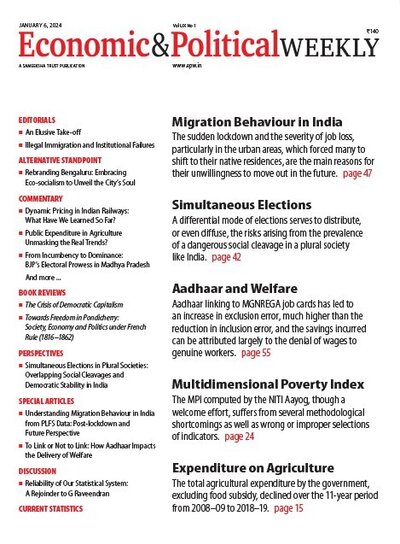
According to the Government of India, linking Aadhaar with the delivery of welfare schemes has saved nearly INR 2,73,093 crore till March 2022 due to, apparently, the removal of duplicate/fake beneficiaries and plugging of leakages, etc. What is the overall impact of Aadhaar on welfare delivery? We try to understand this through a case study of MGNREGA in Jharkhand. Surveying nearly 3,000 workers in eight villages in Jharkhand to assess both the costs and benefits of linking MGNREGA with Aadhaar, the paper focuses on its impact on errors of inclusion and exclusion.
Authors:
Anjor Bhaskar, Arpita Sarkar, Preeti Singh