
Publications & Resources
Our faculty, students and researchers work together everyday to contribute to a better world by grappling with urgent problems we are facing in India. We conduct rigorous work to produce high quality learning resources and publications to contribute to public discourse and social change. Here, we feature a sample from our work for everyone to access. You can explore featured resources, policies, and the latest publications from the University.
To explore all the work of our University, please visit our publications repository.
List of Publications & Resources
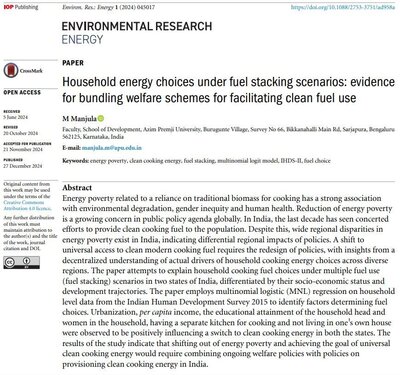
Household energy choices under fuel stacking scenarios: evidence for bundling welfare schemes for facilitating clean fuel use
in IOP Publishing Ltd

- Published
- Authors
Abstract
Energy poverty related to a reliance on traditional biomass for cooking has a strong association with environmental degradation, gender inequity and human health. Reduction of energy poverty is a growing concern in public policy agenda globally. In India, the last decade has seen concerted efforts to provide clean cooking fuel to the population. Despite this, wide regional disparities in energy poverty exist in India, indicating differential regional impacts of policies. A shift to universal access to clean modern cooking fuel requires the redesign of policies, with insights from a decentralized understanding of actual drivers of household cooking energy choices across diverse regions. The paper attempts to explain household cooking fuel choices under multiple fuel use (fuel stacking) scenarios in two states of India, differentiated by their socio-economic status and development trajectories. The paper employs multinomial logistic (MNL) regression on household level data from the Indian Human Development Survey 2015 to identify factors determining fuel choices. Urbanization, per capita income, the educational attainment of the household head and women in the household, having a separate kitchen for cooking and not living in one’s own house were observed to be positively influencing a switch to clean cooking energy in both the states. The results of the study indicate that shifting out of energy poverty and achieving the goal of universal clean cooking energy would require combining ongoing welfare policies with policies on provisioning clean cooking energy in India.
Authors: M Manjula
Links

- Published
- Authors
Abstract
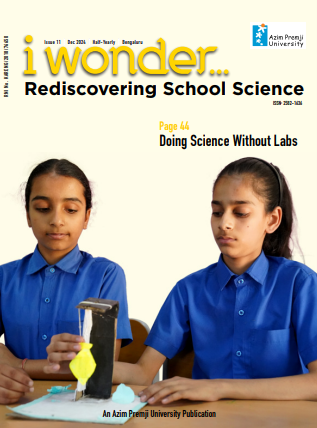
How can the experience of making a simple pinhole camera with inexpensive materials help our students think more creatively and critically about light?
How can conversations around an athlete’s record-breaking sprint actively engage our students in learning concepts around linear motion?
What do our students learn about the practice of science when we encourage them to write the biographies of scientists who appear in their textbook?
How do we provide spaces for our students to make and manipulate new materials from old discarded or inexpensive material?
Read this issue to explore these and many other such teaching-learning experiences in middle-stage science and preparatory stage EVS.

- Published
- Authors
Abstract
Science education literature states that fostering students’ and teachers’ knowledge of NOS has shifted from being a desirable goal to an essential one. This article focuses on the development of NOS conceptions among MA Education students. To develop those conceptions, the researcher designed various learning activities in the context of ‘research of history on DNA’. Seven students were observed and audiotaped while working in groups in this classroom qualitative study. Before the intervention, pre-test on ‘views on science’- Chen (2006) and group discussions held with participants indicated that their NOS conceptions were basic. After 7 sessions, a post-test was administered to students asking to justify NOS conceptions. These conceptions: scientifc knowledge is tentative, laws are generalisations or universal relationships, theories are inferred explanations of nature; and that science is empirically based, socio-culturally embedded, and creative. Classroom discourses and responses to a post-test indicated that participants justifed some NOS conceptions very well and some not so very well. It also argues that HOS ofers potential for improved learning of NOS.

- Published
- Authors
Abstract
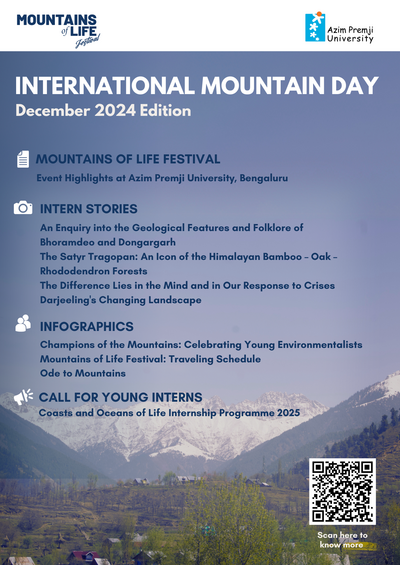
The fourth edition of the Mountains of Life newsletter celebrates International Mountain Day, focussing on sustainable mountain solutions through innovation, adaptation, and youth engagement. The newsletter includes the highlights of the Mountains of Life festival, held at our Bengaluru campus from 13 – 26 November 2024. We also feature inspiring stories from interns, and acknowledge the efforts of mountain enthusiasts, especially the youth, alongside select contributions from readers. Thank you for your continued support — happy reading!
Links
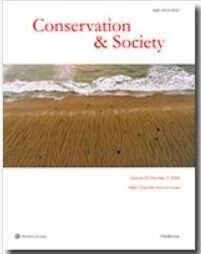
The Ontological Choreography of Conservation Practice at a Marine Turtle Rookery in India
in Conservation and Society

- Published
- Authors
Abstract
The Rushikulya beach in eastern India is considered to be an important rookery (nesting site) for a species of migratory marine turtle, the olive ridleys Lepidochelys olivacea, because it is one of a handful of sites around the world where an arribada or mass-nesting event occurs. During an arribada, thousands of ridleys nest simultaneously over a small section of the beach, and several weeks later, millions of hatchlings emerge from these nests and crawl into the sea. Given the uniqueness of this phenomenon, conservation programmes have emphasised the monitoring and protection of ridleys during an arribada. In Rushikulya, this involves an assemblage of multiple actors, including biologists, their local assistants, and staff of the Odisha Forest Department. In this article, I use the concept of ontological choreography, drawn from multispecies scholarship, to focus attention on how members of this assemblage bring together different ontological orders, mainly nature and the individual self, to protect the ridleys. Further, I use this concept to direct attention to the hybrid nature of conservation practice — that it can simultaneously be affective, embodied, performative, sensory and technical. Overall, this article demonstrates how multispecies approaches can enrich social studies of conservation.
Authors:
Links

- Published
- Authors
Abstract
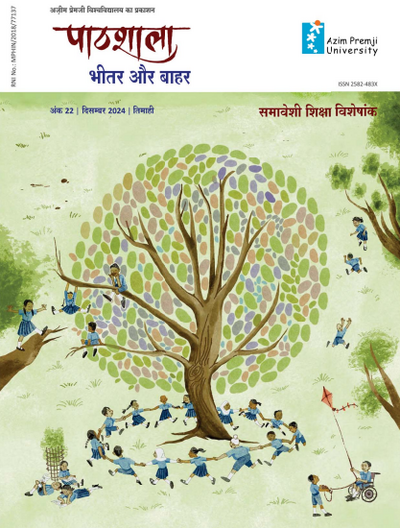
पाठशाला भीतर और बाहर का 22वाँ अंक ‘समावेशी शिक्षा विशेषांक’ है। समावेशन शब्द एकबारगी विशेष दक्षता वाले बच्चों के बारे में ध्वनित होता मालूम होता है। लेकिन इसकी परतों को खोलने पर समझ में आता है कि इसमें विशेष दक्षता वाले बच्चों की बात तो निश्चित तौर पर है ही, साथ ही बात है अलग-अलग सामाजिक‑आर्थिक और सांस्कृतिक परिवेश के विविध मनोभावों वाले वंचित समुदाय के बच्चों की शिक्षा और संसाधनों के बारे में भी। संवैधानिक मूल्यों में रचे बसे स्नेह और सम्मान जैसे मानवीय मूल्य हर बच्चे के लिए ज़रूरी हैं।
इस अंक में आप पढ़ेंगे कि शिक्षक शिक्षा में समावेशन को लेकर किस तरह की योजनाएँ हैं; किस तरह एक विशेष विद्यालय को समावेशी विद्यालय बनाया जा सका; और कलाओं, खेलों, संगीत, आदि के ज़रिए किस तरह समावेशन को दस्तावेज़ों से निकालकर हक़ीक़त में उतारा गया।
आप इस अंक में कुछ स्थाई स्तम्भ भी पढ़ेंगे जिनमें ‘उम्मीद जगाते शिक्षक’ की कहानी है, ‘किताबों से दोस्ती’ में जानेंगे 3 सुन्दर किताबों के बारे में, और ‘आइए, करके देखें’ में समावेशन पर आधारित ऐसी गतिविधियाँ जिन्हें आसानी से कराया जा सकता है। इनके साथ ‘शिक्षकों की डायरी’ स्तम्भ में आप पढ़ेंगे शिक्षकों के काम, उनकी बातें, उनके अनुभव।
The Prospects of Employment Opportunities in India: A Medium — term Sectoral Analysis
in Azim Premji University

- Published
- Authors
Abstract
Employment projection, particularly at the micro or sectoral level, is considered as a useful tool for economic planners and policymakers to have a better understanding of future trends and growth, and accordingly, the policies and planning could be designed for the supply side of the labour market.
This study finds that there is a lack of literature in the recent past on the above issue in the context of India, hence in this paper, we have tried to estimate employment numbers for seven broad economic sectors for the period 2024 – 25 to 2030 – 31. The study uses the “Top-down” approach to estimate and project the employment numbers by using the employment-output elasticities and forecasted values of growth rates of gross value added (GVA) at the sectoral level.
Three broad conclusions have been drawn from the employment estimates. First, the agriculture and allied sector continued to be the dominant force in creating employment opportunities till 2030 – 31, however, a surge of employment in the sector in recent years may unlikely continue in the future. Second, the slowing down of economic activities in services sector is expected to dent high employment growth prospects in the sector. Third, a phenomenal rise of employment in industry particularly in manufacturing sector in recent years augurs well for the economy which is expected to remain buoyant in the medium term as well
Links
Exploring Beneficiary Awareness and Access to Grievance Redressal Systems in Government-Sponsored Health Insurance Schemes in Gujarat, India
in Azim Premji University
- Published
- Authors
Abstract
The Government of India launched Pradhan Mantri Jan Arogya Yojana (PMJAY) in 2018 to mitigate catastrophic out-of-pocket health expenditure. This government-sponsored health insurance scheme is implemented through six digital portals, including a grievance redressal system, with the involvement of multiple stakeholders. The grievance redressal mechanisms in PMJAY are aimed at ensuring access to information, contribute to the responsiveness of the scheme and safeguard it against any fraudulent practices.
As a pioneering effort, this research explores the role and experiences of grievance redressal systems by exploring the following research questions: 1) What are the processes of collecting and responding to grievances in PMJAY? 2) How is the awareness about the Grievance Redressal System among the beneficiaries?, and 3) What is the experience of beneficiaries of interaction with the Grievance Redressal System of PMJAY?
A cross-sectional descriptive study was conducted from January 2022 to August 2023 in Gujarat, using a mixed-method approach to data collection from various primary and secondary sources. The findings from the study show that multiple formal and informal channels are active with varying accessibility among the beneficiaries. A significant proportion of beneficiaries were unaware of their entitlements and grievance redressal mechanisms. Awareness was low regarding internet-based formal channels and communication through letters or emails.
The findings underscore the necessity for enhanced outreach efforts, using detailed information dissemination via print and outdoor media. Building trust in the grievance redressal system is essential to increase its use and demand among the beneficiaries. Insights from this study will be useful to strengthen the grievance redressal system of the PMJAY scheme or similar government schemes.
Links