
Publications & Resources
Our faculty, students and researchers work together everyday to contribute to a better world by grappling with urgent problems we are facing in India. We conduct rigorous work to produce high quality learning resources and publications to contribute to public discourse and social change. Here, we feature a sample from our work for everyone to access. You can explore featured resources, policies, and the latest publications from the University.
To explore all the work of our University, please visit our publications repository.
List of Publications & Resources
Entrepreneurship and Marginalised Social Identities in India
in Economic and Political Weekly
Article
- Published
- Authors
Abstract
The nature and extent of the under-representation of marginalised caste groups in enterprise ownership in India are examined. It is found that exclusion takes place in three distinct stages. First, the share of Scheduled Caste (SC), Scheduled Tribe (ST) or Other Backward Class (OBC) individuals in ownership of any enterprise is less than their share in the workforce. Second, among those who do engage in entrepreneurial activities, a disproportionately higher share of entrepreneurs from the marginalised identity groups are engaged in enterprises, which are not purely commercial and are likely to be subsistence-oriented. And finally, even within the owners of purely commercial enterprises, those from marginalised groups tend to be concentrated in the smaller enterprises and are severely under-represented in the larger and more productive ones.
Links


- Published
- Authors
Abstract
Explore the Point of Mathematics and send in your feedback to AtRightAngles.editor@apu.edu.in.
Article
- Published
- Authors
Abstract
Fifty years ago this week, Gaura Devi, an ordinary woman from a nondescript village in India, hugged a tree, using her body as a shield to stop the tree from being cut down. Little did she know that this simple act of defiance would be a seminal moment in the history of India and the world. Or that Reni village, where she lived, would come to be recognised as the fountainhead of the Chipko environmental movement. What the foot soldiers of Chipko wanted was an acknowledgement of their Indigenous rights to access forest resources that were crucial for their survival. What they got instead was a national law and a ministry populated by a new breed of power brokers — who, in the years to come, would decide at times that habitat preservation is possible only by keeping local communities out.
“I pray to God that greed never sets in”: Community health workers’ reflections on “care” during the COVID-19 pandemic
in Indian Journal of Medical Ethics

- Published
- Authors
- Arima Mishra
- Sanjana Santosh
Abstract
Background: Care provision received renewed attention during the COVID-19 pandemic as several healthcare providers vied for the coveted title of “frontline warrior” while they struggled to provide care efficiently under varying health system constraints. While several studies on the health workforce during the pandemic highlighted their difficulties, there is little reflection on what “care” or “caring” itself meant specifically for community health workers (CHWs) as they navigated different community and health systems settings. The study aimed to examine CHWs’ caregiving experiences during the pandemic.
Methods: Twenty narrative interviews with CHWs including ASHAs (Accredited Social Health Activists) and ANMs (Auxiliary Nurse Midwives) were conducted in different states between July and December 2020.
Results: Our findings highlight the moral, affectual, and relational dimensions of care in the CHWs’ engagement with their routine and Covid-19 related services, as well as the “technical” aspects of it. In this article, we argue that these two aspects are, in fact, enmeshed in complex ways. CHWs extend this moral understanding not just to their work, but also to their relationship with the health system and the government, as they express a deep sense of neglect and the lack of “being cared for” by the health system.
Conclusion: CHWs’ experiences demand a more nuanced understanding of the ethics of care or caring that challenges the binaries between the “technical” and moral aspects of care.
Links

- Published
- Authors
Abstract
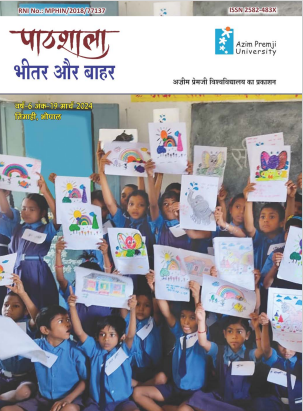
पाठशाला भीतर और बाहर के उन्नीसवें अंक के ज़्यादातर लेख पुस्तकालय और भाषा की पढ़ाई के विविध पहलुओं पर केन्द्रित हैं। इन लेखों में, अच्छी किताबों से ही अच्छे स्कूल पुस्तकालय की कल्पना साकार होती है व पुस्तकालय को जीवन्त और सक्रिय कैसे बनाया जाए, जैसे विषयों को उठाया गया है। एक लेख लोकतंत्र में संवाद की संस्कृति बनाने व इसके महत्त्व के बारे में है। साक्षात्कार में चिन्तनशील शिक्षक और इनकी रचनात्मकता के विकास की प्रक्रिया पर चर्चा की गई है। संवाद में, संवैधानिक मूल्य बन्धुता के भाव को विकसित करने के लिए स्कूली स्तर पर किए जाने वाले प्रयासों के बारे में अनुभवपरक विचार रखे गए हैं।
Links
Public Health Perspectives on Mental Health: Reflections from Teaching
in Indian Journal of Medical Ethics
- Published
- Authors
Abstract
The mental health discourse in India has been primarily viewed through a biomedical lens that often overlooks the cultural context and social inequalities. To ensure equitable access to preventive, promotive, curative, and rehabilitative mental healthcare, India needs practitioners who combine a social perspective with an empathetic approach. To address this need, we designed a course titled “Critical Perspectives on Mental Health” that aims to introduce the relevant perspectives and community-based approaches to mental health. In this article, we share our reflections on designing this course and facilitating it in the form of a post-graduation programme.
Links


- Published
- Authors
Abstract
Biological invasions have profound impacts on biodiversity and ecosystem functioning and services, resulting in substantial economic and health costs estimated in the trillions of dollars. Preventing and managing biological invasions are vital for sustainable development, aligning with the goals of the United Nations Biodiversity Conference. However, some invasive species also offer occasional benefits, leading to divergent perceptions among stakeholders and sectors. Claims that invasion science overlooks positive contributions threaten to hinder proper impact assessment and undermine management. Quantitatively balancing benefits and costs is misleading, because they coexist without offsetting each other. Any benefits also come at a price, affecting communities and regions differently over time. An integrated approach considering both costs and benefits is necessary for understanding and effective management of biological invasions.
Authors: Laís Carneiro, Philip E Hulme, Ross N Cuthbert, Melina Kourantidou, Alok Bang, Phillip J Haubrock, Corey J A Bradshaw, Paride Balzani, Sven Bacher, Guillaume Latombe, Thomas W Bodey, Anna F Probert, Claudio S Quilodrán, Franck Courchamp
Links