
Publications & Resources
Our faculty, students and researchers work together everyday to contribute to a better world by grappling with urgent problems we are facing in India. We conduct rigorous work to produce high quality learning resources and publications to contribute to public discourse and social change. Here, we feature a sample from our work for everyone to access. You can explore featured resources, policies, and the latest publications from the University.
To explore all the work of our University, please visit our publications repository.
List of Publications & Resources
The persistent nucleus: atoms, power and energy policy discourse in the anthropocene
in Azim Premji University

- Published
- Authors
Abstract
Despite economic debacles, recurring “accidents”, reactor core meltdowns in Chernobyl and Fukushima and the cautious academic reflection it has engendered, civilian nuclear power continues to enjoy legitimacy in energy policy discourse. This may not be the case in all countries. But it is so in a number of influential states, such as, prominently, all the permanent members of the UN Security Council. Why does nuclear power persist in these and other key countries, such as India or Iran and Japan? How is it that economic costs, technology risks and weapons proliferation concerns point in one direction while energy policy and technology choice moves in the other? We suggest that for an important set of select countries this divergence can be ascribed to a “discourse of power” that is pegged to domestic concerns and, more importantly, to international relations. This discursive process constructs energy and material abundance as the cornerstone of social stability, political power and ultimately national sovereignty and geopolitical influence. The atom’s energy remains prominent in such imaginaries of abundance, more so in contexts of fossil energy insecurity and climate change. The questioning then of nuclear power by environmental and social concerns has to also question this discourse of power. The latter’s sanguinity vis-a-vis abundant energy needs to be problematised. This is not the case today in international relations. Practitioners focus on the consequences of environmental deterioration. The problem of climate refugees, for example. This paper argues that realist frames of power and self-interest in international relations be acknowledged explicitly as drivers of the discourse of power and in turn the socio-ecological consequences that ensue from this pursuit of cheap and abundant energy. To challenge nuclear power ultimately is to also challenge this medieval yet dominant norm of power play that pervades large swathes of international relations.
Links

- Published
- Authors
Abstract
India is one of the world’s fastest growing economies. To be a stable and prosperous democracy, this growth must be accompanied by the creation of meaningful, secure and remunerative employment. Realising this goal requires a grounded and comprehensive overview of the state of labour markets, employment generation, demographic challenges and the nature of growth.
The State of Working India (SWI) is envisioned as a regular publication that delivers well-researched, analytically useful information on India’s labour market, by bringing together researchers, journalists, civil society activists, and policymakers interested in labour and employment issues.
The report is based on the research of CSE staff, as well as on background papers which are available online. SWI conceives of India’s ongoing structural transformation as composed of two processes — movement of workers from agriculture to non-farm occupations (the Kuznets process) and from informal activities to formal ones (the Lewis process). But it adds crucial considerations of social equity and ecological sustainability to this standard framework. In the 21st century, Lewis and Kuznets have to meet Ambedkar and Gandhi.
Report Documents
Figure Data (XLS)
Background Papers
Bijolia’s Harvest of Stone: Conditions of Work Among Quarrying Labour in Rajasthan
Gender Differentials in Expansion of Informal Enterprises
Labour Absorption in Indian Manufacturing: The Case of the Garment Industry
Hard Work, Low Pay : Work Patterns Among Rural Women in West Bengal
Understanding the performance of India’s manufacturing sector: Evidence from firm-level data
The Indian Labour Market: A Fallacy, Two Looming Crises and a Silent Tragedy
Domestic Workers and the Challenges of Collective Action in Informal Work: A comment
Individual Chapters:
Chapter Two : Who Is Looking For Work?
Chapter Three : Where Is the Work?
Chapter Four: How Good Is The Work

- Published
- Authors
Abstract
What happens within the classroom has the power to change lives — for the better or for the worse. We ourselves know from our own school experiences of transactions which empowered or disabled or left us unmoved, according to the atmosphere in the classroom. This is not quite the same as the relationship between teacher and student, vital as that is. In this issue, we have a number of articles which explore the boundaries of the classroom and its importance as an investment for the future.
Links

- Published
- Authors
Abstract
The dictionary defines the word “enable” as, to make able, to give power, means or ability; to make competent, authorise, to make possible or easy. The word “enabling” when used as an indicator in school education can be defined as a comprehensive, multi-faceted series of empowering activities required to address the needs of youngsters facing barriers in the acquisition of both academic and life skills. In this Issue, we have tried to bring together articles recounting the experiences of practicing teachers, educators and students across India even one from a school at an altitude of 12,000 feet from distant Leh! — who have all been part of this process. We have articles that enlarge on the theme of empowerment through responsible citizenry by involving the community in the process, of methods used to facilitate collaborative learning by getting students and teachers to jointly examine their problems and concerns, of attitudinal changes enabled through dialogue.
Links

- Published
- Authors
Links

- Published
- Authors
Abstract
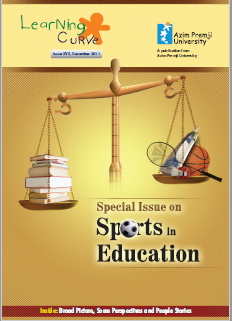
This issue of Learning Curve focuses on ‘sports in education’ which explores topics ranging from the interpersonal and collaborative influences that sports have on children to the skills it develops, from the harsh realities about why people don’t take up sporting careers to the challenges parents face while bringing up sporting kids, from questioning notions of competition in sports to detailing the power of a sporting mind, from examining the contribution of the RTE to revealing the NCF’s take on sports education.
Links

- Published
- Authors
Abstract
In this issue of the Learning Curve, read about how the Educational Development Index is calculated and what constitutes an effective education system. Krishna Kumar’s book ‘The Political Agenda of Education’, a comprehensive account of the goals of the Indian Education system under British rule and its ramifications for independent India, is also reviewed.
Links