
Publications & Resources
Our faculty, students and researchers work together everyday to contribute to a better world by grappling with urgent problems we are facing in India. We conduct rigorous work to produce high quality learning resources and publications to contribute to public discourse and social change. Here, we feature a sample from our work for everyone to access. You can explore featured resources, policies, and the latest publications from the University.
To explore all the work of our University, please visit our publications repository.
List of Publications & Resources
Widespread practices and sustainability benefits of foraging in urban blue spaces of India
in Nature Cities
Article
- Published
- Authors
Abstract
Urban blue spaces, such as lakes and rivers, are increasingly recognised for their ecological and social roles, yet their contributions to sustainable food systems remain understudied. Here, the researchers examine the extent and benefits of foraging in urban blue spaces across four major Indian cities through a survey of 1,200 users. We identify three forager groups, that is, ‘rare’, ‘occasional’ and ‘frequent’ foragers, whose behaviours differ in frequency and practice. Women, the elderly and marginalised communities most frequently collect, share, cook and sell edibles. Access to home or community gardens strongly motivates occasional foragers. Frequent foragers emphasise benefits relating to nutrition and income, as well as culture and social capital, whereas occasional foragers appreciate nature- and culture-related benefits. The findings challenge conventional perspectives on urban food provisioning, highlighting urban blue spaces as vital yet overlooked spaces for food access and resilience. Integrating foraging into urban planning can enhance equitable food systems, fostering transformative change toward sustainable urban landscapes.
Authors: Sukanya Basu, Brenda Maria Zoderer, Harini Nagendra, Peter H Verburg, Tobias Plieninger
Links
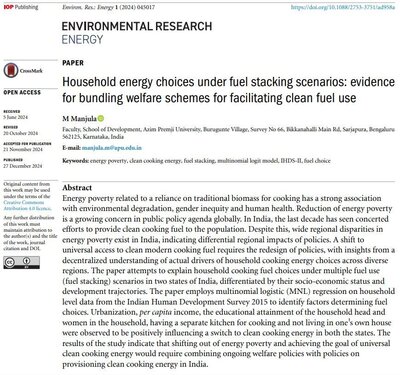
Household energy choices under fuel stacking scenarios: evidence for bundling welfare schemes for facilitating clean fuel use
in IOP Publishing Ltd

- Published
- Authors
Abstract
Energy poverty related to a reliance on traditional biomass for cooking has a strong association with environmental degradation, gender inequity and human health. Reduction of energy poverty is a growing concern in public policy agenda globally. In India, the last decade has seen concerted efforts to provide clean cooking fuel to the population. Despite this, wide regional disparities in energy poverty exist in India, indicating differential regional impacts of policies. A shift to universal access to clean modern cooking fuel requires the redesign of policies, with insights from a decentralized understanding of actual drivers of household cooking energy choices across diverse regions. The paper attempts to explain household cooking fuel choices under multiple fuel use (fuel stacking) scenarios in two states of India, differentiated by their socio-economic status and development trajectories. The paper employs multinomial logistic (MNL) regression on household level data from the Indian Human Development Survey 2015 to identify factors determining fuel choices. Urbanization, per capita income, the educational attainment of the household head and women in the household, having a separate kitchen for cooking and not living in one’s own house were observed to be positively influencing a switch to clean cooking energy in both the states. The results of the study indicate that shifting out of energy poverty and achieving the goal of universal clean cooking energy would require combining ongoing welfare policies with policies on provisioning clean cooking energy in India.
Authors: M Manjula
Links

- Published
- Authors
Abstract
Science education literature states that fostering students’ and teachers’ knowledge of NOS has shifted from being a desirable goal to an essential one. This article focuses on the development of NOS conceptions among MA Education students. To develop those conceptions, the researcher designed various learning activities in the context of ‘research of history on DNA’. Seven students were observed and audiotaped while working in groups in this classroom qualitative study. Before the intervention, pre-test on ‘views on science’- Chen (2006) and group discussions held with participants indicated that their NOS conceptions were basic. After 7 sessions, a post-test was administered to students asking to justify NOS conceptions. These conceptions: scientifc knowledge is tentative, laws are generalisations or universal relationships, theories are inferred explanations of nature; and that science is empirically based, socio-culturally embedded, and creative. Classroom discourses and responses to a post-test indicated that participants justifed some NOS conceptions very well and some not so very well. It also argues that HOS ofers potential for improved learning of NOS.
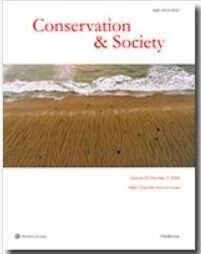
The Ontological Choreography of Conservation Practice at a Marine Turtle Rookery in India
in Conservation and Society

- Published
- Authors
Abstract
The Rushikulya beach in eastern India is considered to be an important rookery (nesting site) for a species of migratory marine turtle, the olive ridleys Lepidochelys olivacea, because it is one of a handful of sites around the world where an arribada or mass-nesting event occurs. During an arribada, thousands of ridleys nest simultaneously over a small section of the beach, and several weeks later, millions of hatchlings emerge from these nests and crawl into the sea. Given the uniqueness of this phenomenon, conservation programmes have emphasised the monitoring and protection of ridleys during an arribada. In Rushikulya, this involves an assemblage of multiple actors, including biologists, their local assistants, and staff of the Odisha Forest Department. In this article, I use the concept of ontological choreography, drawn from multispecies scholarship, to focus attention on how members of this assemblage bring together different ontological orders, mainly nature and the individual self, to protect the ridleys. Further, I use this concept to direct attention to the hybrid nature of conservation practice — that it can simultaneously be affective, embodied, performative, sensory and technical. Overall, this article demonstrates how multispecies approaches can enrich social studies of conservation.
Authors:
Links
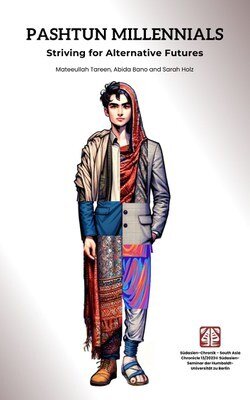
A Classic Case of “Waste Dumping” or a Latent Opportunity: Alang-Sosiya and the Making of the World’s Largest Shipbreaking Yards
in Sudasien – Chronik/South Asia Chronicle

- Published
- Authors
Abstract
This article explores the birth of multiple shipbreaking yards in India, such as Darukhana, Mumbai (1912); Sachana, Jamnagar (1977); and Alang, Gujarat (1983). It tells a story of how, specifically, the inception of the Alang shipbreaking yards is intricately linked to the changing geographies of ship disposal facilities in the 1970s and 1980s. This article demonstrates how India’s domestic policies on importing obsolete vessels for scrapping were in tandem with the shift in global waste flows. As major ship scrapping facilities closed in Western countries followed by Southeast Asian countries, shipbreaking yards mushroomed in different parts of South Asia, primarily in India, Bangladesh, and Pakistan. This article scrutinises the convoluted image of the Alang shipbreaking yards as a passive recipient of “waste” in the form of end-of-life vessels from the Global North.
Links
Rethinking inclusivity and justice agendas in restoration of urban ecological commons: A case study of Bangalore lakes
in Lakes and Reservoirs: Research and Management

- Published
- Authors
Abstract
The present study analyses civic and community-based initiatives in conserving urban ecological commons in India, which have been increasingly polluted, encroached upon and degraded because of rapid land-use transformations. Bangalore, a city in south India, has one of the largest networks of manmade lakes, some of which are restored and managed by citizen groups, civil society, environmental activists and voluntary private bodies. The restoration process interfaces with urban policy making, shaping predominant management agendas in association with the State. Community initiatives in conserving the lakes are not only well-organised, but also play a crucial role in making city commons vibrant and integral nodes of cultural and social identification. However, the contemporary management system involving citizen groups in lake conservation is largely at odds with the tradition of community-managed lake systems previously existing in the city, which have eroded as the city became industrialised and increased in size and population, resulting in rapid landscape transformations. Against this background, the present study aims to illustrate that a seemingly representative community management of city ecologies is often embedded in an overwhelming political context. It also discusses the need for an urgent deconstruction to better understand how overtly flexible and dynamic restoration actions interact with inequality, power and conflicts. The results of the present study emphasise that the current participatory and community-driven initiatives of ecological restoration in Indian cities unfortunately accord limited significance to the overarching questions of social justice and relations of power.