
Publications & Resources
Our faculty, students and researchers work together everyday to contribute to a better world by grappling with urgent problems we are facing in India. We conduct rigorous work to produce high quality learning resources and publications to contribute to public discourse and social change. Here, we feature a sample from our work for everyone to access. You can explore featured resources, policies, and the latest publications from the University.
To explore all the work of our University, please visit our publications repository.
Article
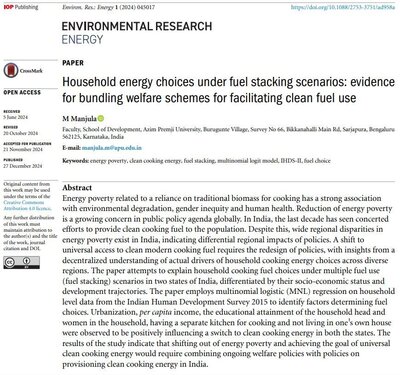
Household energy choices under fuel stacking scenarios: evidence for bundling welfare schemes for facilitating clean fuel use
in IOP Publishing Ltd

- Published
- Authors
Abstract
Energy poverty related to a reliance on traditional biomass for cooking has a strong association with environmental degradation, gender inequity and human health. Reduction of energy poverty is a growing concern in public policy agenda globally. In India, the last decade has seen concerted efforts to provide clean cooking fuel to the population. Despite this, wide regional disparities in energy poverty exist in India, indicating differential regional impacts of policies. A shift to universal access to clean modern cooking fuel requires the redesign of policies, with insights from a decentralized understanding of actual drivers of household cooking energy choices across diverse regions. The paper attempts to explain household cooking fuel choices under multiple fuel use (fuel stacking) scenarios in two states of India, differentiated by their socio-economic status and development trajectories. The paper employs multinomial logistic (MNL) regression on household level data from the Indian Human Development Survey 2015 to identify factors determining fuel choices. Urbanization, per capita income, the educational attainment of the household head and women in the household, having a separate kitchen for cooking and not living in one’s own house were observed to be positively influencing a switch to clean cooking energy in both the states. The results of the study indicate that shifting out of energy poverty and achieving the goal of universal clean cooking energy would require combining ongoing welfare policies with policies on provisioning clean cooking energy in India.
Authors: M Manjula
Links
University Working Paper Series
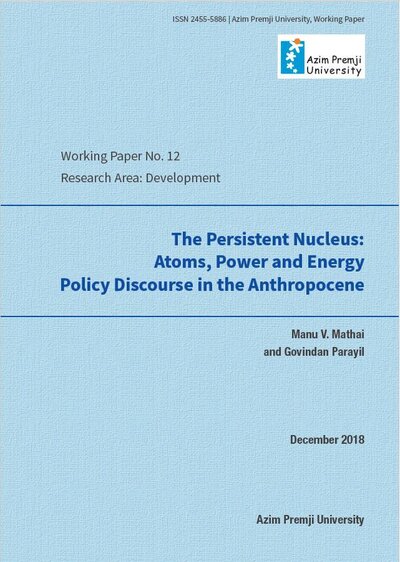
The persistent nucleus: atoms, power and energy policy discourse in the anthropocene
in Azim Premji University

- Published
- Authors
Abstract
Despite economic debacles, recurring “accidents”, reactor core meltdowns in Chernobyl and Fukushima and the cautious academic reflection it has engendered, civilian nuclear power continues to enjoy legitimacy in energy policy discourse. This may not be the case in all countries. But it is so in a number of influential states, such as, prominently, all the permanent members of the UN Security Council. Why does nuclear power persist in these and other key countries, such as India or Iran and Japan? How is it that economic costs, technology risks and weapons proliferation concerns point in one direction while energy policy and technology choice moves in the other? We suggest that for an important set of select countries this divergence can be ascribed to a “discourse of power” that is pegged to domestic concerns and, more importantly, to international relations. This discursive process constructs energy and material abundance as the cornerstone of social stability, political power and ultimately national sovereignty and geopolitical influence. The atom’s energy remains prominent in such imaginaries of abundance, more so in contexts of fossil energy insecurity and climate change. The questioning then of nuclear power by environmental and social concerns has to also question this discourse of power. The latter’s sanguinity vis-a-vis abundant energy needs to be problematised. This is not the case today in international relations. Practitioners focus on the consequences of environmental deterioration. The problem of climate refugees, for example. This paper argues that realist frames of power and self-interest in international relations be acknowledged explicitly as drivers of the discourse of power and in turn the socio-ecological consequences that ensue from this pursuit of cheap and abundant energy. To challenge nuclear power ultimately is to also challenge this medieval yet dominant norm of power play that pervades large swathes of international relations.
Links