
Publications & Resources
Our faculty, students and researchers work together everyday to contribute to a better world by grappling with urgent problems we are facing in India. We conduct rigorous work to produce high quality learning resources and publications to contribute to public discourse and social change. Here, we feature a sample from our work for everyone to access. You can explore featured resources, policies, and the latest publications from the University.
To explore all the work of our University, please visit our publications repository.

- Published
- Authors
Abstract
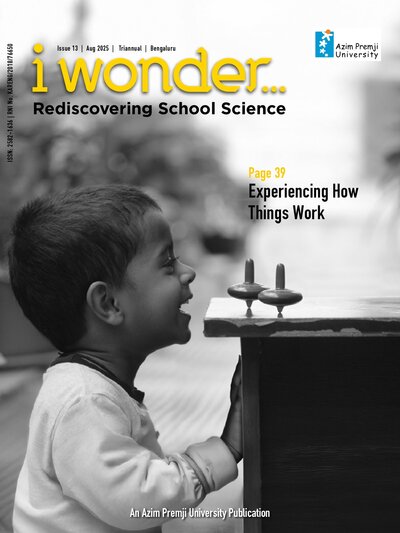
Students learn about the properties of matter in Grade VI and its particulate nature in Grade VIII. But can they connect these concepts with observations and experiences of ‘air’ from their everyday world? Can we use an empty tumbler and an inflated balloon to offer visual evidence of these properties? Explore these questions through the articles and classroom resources in our theme section ‘Materials Around Us’.

- Published
- Authors
Abstract
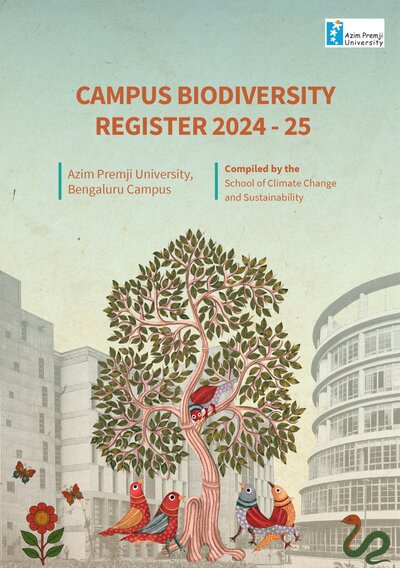
More than just an academic space, the Azim Premji University campus in Bengaluru is fast becoming a thriving ecosystem of its own. Located in Sarjapura, the campus is more than classrooms and labs — it is a habitat shared with birds, reptiles, insects, small mammals, and a growing canopy of trees and plants. This report is a first step in documenting the biodiversity of our campus. From trees and shrubs to spiders and snakes, students of the BSc in Environmental Science and Sustainability, teachers, and other members have come together to observe and record the life that surrounds us. Thus, this is a collective effort that reflects both scientific curiosity and deep care for our environment. As the campus grows, we aim not only to track carbon sequestration and environmental change — but also to nurture a sense of stewardship and belonging in everyone who calls this campus home.
Links
CSE Working Paper Series
Regressive income shocks during COVID-19: Evidence from India
in Azim Premji University

- Published
- Authors
Abstract
Studies based on the Consumer Pyramids Household Survey (CPHS) in India have shown that the impact of the Covid-19 lockdown on household incomes was progressive in nature — richer households suffered more. But several media reports as well as purposive surveys carried out during the pandemic suggest that the poor suffered more than the rich. We use nationally representative panel data for urban India from the official Periodic Labour Force Survey (PLFS) to show that households that were relatively richer prior to the start of the pandemic suffered relatively less during the lockdown compared to households that were poorer. That is, the shock was regressive in nature. We also confirm that, as per CPHS, richer households did indeed experience higher drops in income than poorer ones. But we show that this progressivity is much less than what prevailed prior to the pandemic. Thus the pandemic either disrupted ongoing progressive income changes or was outright regressive in its impacts.
Authors:
Amit Basole, Anand Shrivastava, Jay Kulkarni and Akshit Arora
Links
Article
Contexts and Priorities: Reflections on Developing a Master of Public Health Programme in India
in Azim Premji University

- Published
- Authors
- School of Development
Abstract
While the recent COVID-19 pandemic has accentuated attention to the public health challenges of our times, many of these concerns are certainly not new. There are multiple public health concerns including the rising burden of non-communicable diseases, health risks due to environmental degradation and climate change, and re-emergence of several communicable diseases. Responses to these challenges, including educational responses, have often been reductionist and hence found to be inadequate. There has been an increasing global recognition of the need for transformative education to address the complex health challenges of the 21st century. In this article, we discuss one such effort in designing a public health education programme in India that echoes the sentiment of transformative learning that is contextual, competency-driven, trans disciplinary, reflective, and collaborative. We discuss how these aspects of learning were reflected and considered through a series of internal deliberations within the university and external consultations with different stakeholders. This process involved examining existing gaps in public health education, articulating the core competencies, developing the curriculum, and envisaging students’ contribution to public health practice in India.
Authors:
Arima Mishra, Adithya Pradyumna, Mukta Gundi, Edward Premdas Pinto and Prasanna Saligram
Links
Report
Rural Multidimensional Deprivation in Chhattisgarh | A Data-Driven Analysis
in Azim Premji University


- Published
- Authors
- School of Development
Abstract
Poverty in India has been defined and measured in several different ways over the years. This report presents a unique way to measure rural poverty in Chhattisgarh using data from the Mission Antyodaya Survey of 2019. We construct a rural multidimensional deprivation index (RDI), composed of indicators in the areas of infrastructure, health and education. The index can be decomposed into its different sub-components to understand which of the indicators contribute the most to deprivation and can be analysed at different levels, starting from the block to the taluka, district and state level. From a policy and public action perspective, the RDI is extremely useful because it is composed of public provisioning of amenities at the village level. A high RDI reflects lack of access to public amenities and deprivation in villages. Because India has a decentralised structure where the Panchayats are responsible for taking governance at the grassroot levels. Results from this report can be extremely useful to these institutions as they can identify which villages need provisioning of what amenities and act accordingly.
Editors: Sandhya Krishnan, Prasanna S, Sanket Gharat, Puja Guha, Amalendu Jyotishi, and Neeraj Hatekar.
Links
Magazine
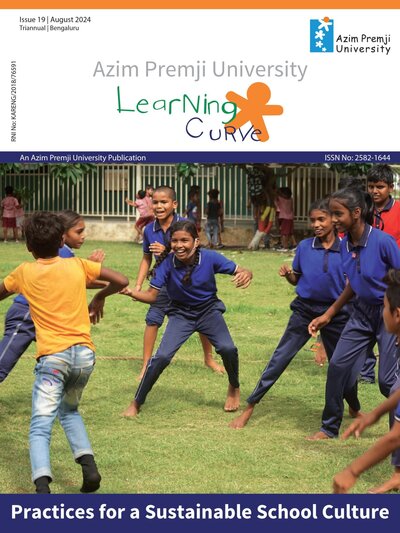
Learning Curve Issue 19 | Practices for a Sustainable School Culture
in Azim Premji University
- Published
- Authors
Abstract
This issue focuses on practices that build a school culture – practices that become so ingrained in the school’s ethos that they come naturally to everyone and do not change if those who helped develop these move out of the school. It includes several aspects of the school culture, such as creating an environment where all students feel safe, valued, and seen; where there is no fear of any subject, where there is a high level of collaboration among teachers and continuous engagement with parents.
Links

- Published
- Authors
Abstract
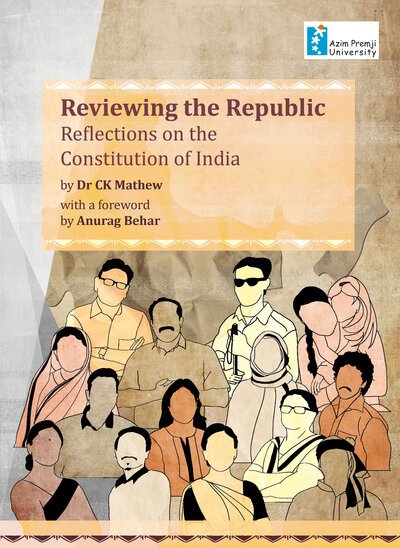
The Constitution of India has been amended over a hundred times in the last seven decades. Yet, its basic principles remain supreme. For young students of India’s growth and progress, a deeper understanding of its Articles is essential. The maturing of our democracy and the deeper social consciousness pervading our people, owes much to the manner in which we have been guided by its timeless precepts. A reading of ‘Reviewing the Republic’ will help any reader appreciate how our Constitution came into being and its powerful impact on the daily life of our citizens.
Links

- Published
- Authors
Abstract
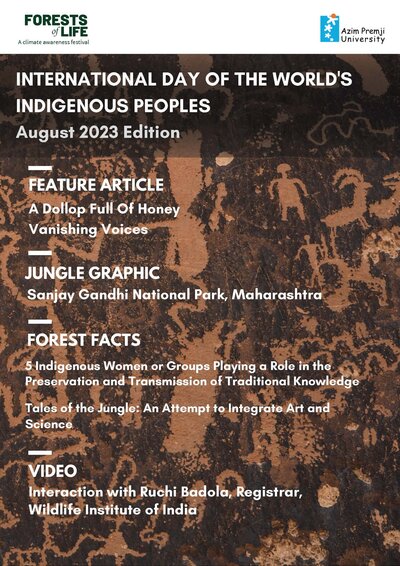
This is a monthly newsletter published by Azim Premji University, as a part of Forests of Life, a climate awareness festival celebrating forests — a quest and yatra of young people from across different parts to engage with the youth of this country. In this edition, we celebrate International Day of the World’s Indigenous Peoples, aiming to raise awareness and protect the rights of the world’s indigenous population. We intend to pay respect to all the Indigenous people who have made significant contribution towards the preservation and transmission of traditional knowledge.
Links
- Published
- Authors
Abstract
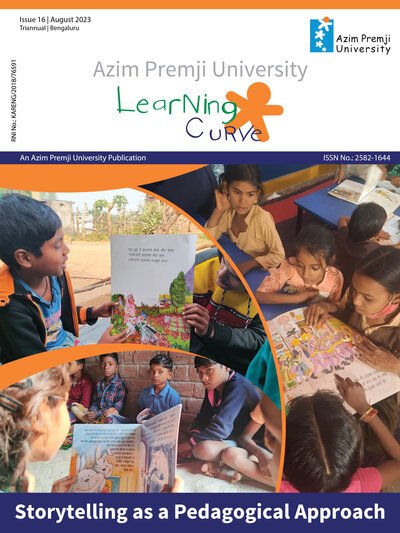
We all know the pure pleasure of listening to stories as children and we have, in this issue, articles that demonstrate how storytelling can be used to great success in subjects as diverse as maths, physics, social studies and inclusion in schools everywhere – urban or rural. There are descriptions of how discussions emerging from a single story can be skillfully used to arrive at some really important understanding. All this adds up to creating a channel of exchange that cuts across age groups and backgrounds and finds common ground in the magical world of stories.
Links

- Published
- Authors
Abstract
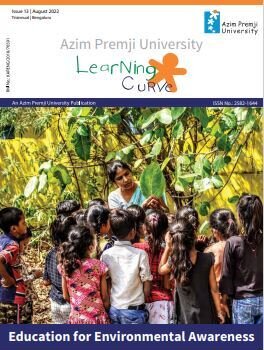
This issue of the Learning Curve tries to answer some hard questions about the present environmental crisis : who can we turn to make the changes required? How can we attempt to restore some of the lost balance? How can we make sure that this planet does not become extinct by the next millennium? Schools across the country are doing their bit, beginning with primary school, to create a well-informed, environmentally-aware generation.
Links
CSE Working Paper Series
Financing Fiscal Support under Alternative Policy Frameworks
in Azim Premji University
- Published
- Authors
Links
CSE Working Paper Series
Improving Survey Quality using Para Data- Lessons from the India Working Survey
in Azim Premji University
- Published
- Authors
Abstract
The efficacy of survey-based policy recommendations is primarily dictated by the quality of data collected in the first place. Is the survey truly representative of the population it claims to characterise? Are respondents voicing their true opinions or are they playing to the gallery? Did enumerator bias creep into the data? These are questions that most users of surveys have, but are typically brushed aside in the race to get the analyses out. While there are no foolproof measures to ensure that survey data are authentic, certain steps can be taken to improve their dependability. One such is the use of what is called ‘para data’ (data about the process of data collection), to streamline enumerator practices, and thereby improve the reliability of the data being collected. This report details our experience of using para data to improve the quality of the India Working Survey (IWS).
Authors:
- Deepti Goel
- Rosa Abraham
- Rahul Lahoti
Links

- Published
- Authors
Abstract
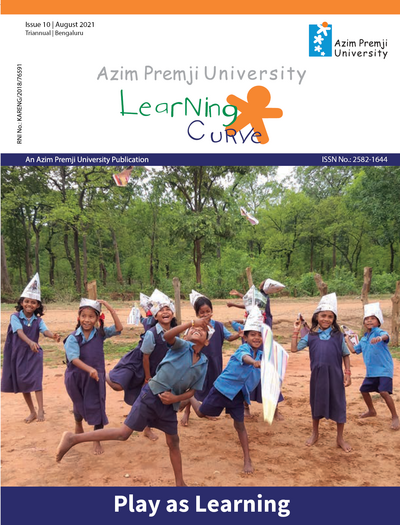
The articles in this issue are broadly based on the two aspects of play in learning – the innumerable lessons that are learnt from play – teamwork, strategy, inclusion, respect, sharing, handling fights, settling arguments, addressing bullying, and second, how play can be used as pedagogy for circular learning as well as structured activities such as educational videos and unstructured ones like pretend play. The idea behind both is to nurture the free spirit with which child must learn.
Report
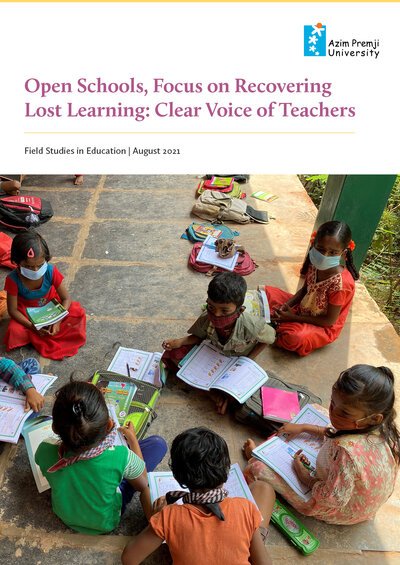
Open Schools, Focus on Recovering Lost Learning: Clear Voice of Teachers
in Azim Premji University
- Published
- Authors
CSE Working Paper Series
Did Employment Rise or Fall in India between 2011 and 2017- Estimating Absolute Changes in the Workforce
in Azim Premji University
- Published
- Authors
Abstract
The recently released data from the 2017 – 2018 Periodic Labour Force Survey have created a controversy regarding the quantity of employment generated in the past few years in India. Estimates ranging from an absolute increase of 23 million to an absolute decline of 15.5 million have been published. In this paper we show that some of the variation in estimates can be explained by the way in which populations are projected based on Census 2011 data. We estimate the change in employment using the cohort-component method of population projection. We show that for men total employment rose but the increase fell far short of the increase in working age population. For women, employment fell. The decline is concentrated among women engaged in part-time or occasional work in agriculture and construction.
Authors:
- Paaritosh Nath
- Amit Basole
Links
CSE Working Paper Series
Income Distribution and Effective Demand in the Indian Economy
in Azim Premji University
- Published
- Authors
Abstract
Does there exist a trade-off between labour’s income share and output growth rate? Or does a reduction in wage share in itself reduce the output growth rate? These questions have returned to the centre stage in the midst of India’s present crisis as the government sought the dilution and suspension of labour laws as a counter-cyclical policy instrument. In the absence of any other stimulus or countervailing factors, the impact of such a policy would hinge on the relationship between income distribution and effective demand. This paper attempts to lay bare this relationship for the Indian economy through an empirical analysis of India’s macro data and a theoretical model on the basis of regression results.
Author:
- Zico Dasgupta
Links

- Published
- Authors
Abstract
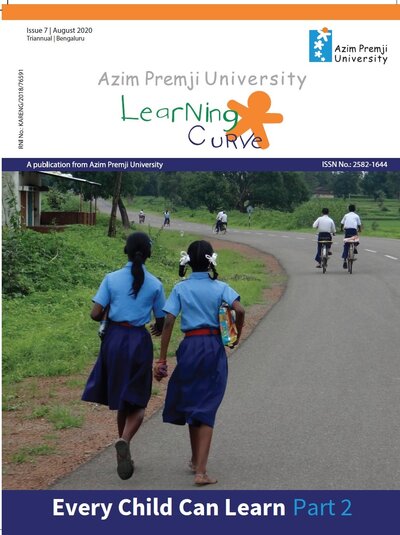
This issue proves that children can, and do, learn, provided they get the encouragement, support, respect and dignity that is due to them during the process and after. The response got for the topic was so overwhelming that it led to the creation of a second part.. It is all about children learning. and enjoying themselves in the process, rather than just getting a formal education.
Links
Report
- Published
- Authors
Abstract
The Karnataka Crime Victimisation Survey report is based on the findings of a crime victimisation survey undertaken by Azim Premji University with the assistance of independent field investigators in 2017. The main objective of the survey was to understand the scope and nature of crime in the state and to analyse the extent to which the National Crime Records Bureau records capture the rate of crime in Karnataka.

- Published
- Authors
Abstract
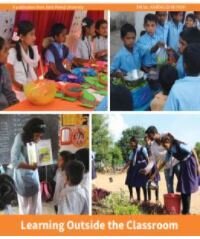
It is certainly a platitude to say that learning can happen everywhere and at all times, at the most unexpected places and moments in our lives. However, that said, we also recognise that the school is a very valuable place of learning: formally and systematically in a graded way,level upon level so that we can tackle end-of-stage examinations which help us to choose our futures. But while all this is happening, a lot of undocumented and stimulating learning is going on simultaneously,
In this issue, articles on experiential learning about the environment, reading as a means of expanding horizons as well as acquiring language skills, the morning assembly as a treasure house of the learning experience- are all here. Other articles have given detailed accounts of science as a dispeller of superstition and an enhancer of a spirit of enquiry and curiosity. Sports do more than just teach the rules of the game, suggests an article: they can internalise values, inculcate inclusion and gender equality. There is an array of perspectives on the learning within learning which, paradoxically, falls outside of it.
All in all, this issue confirms what has long been felt and known — the learning that occurs outside the classroom is as vital as the formal pedagogy which takes place inside.Links

- Published
- Authors
Abstract
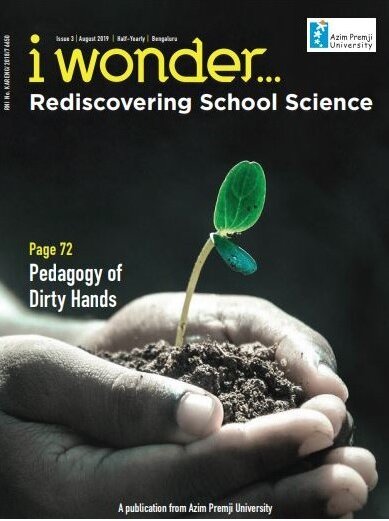
Explore big questions around 4 themes: black holes, the wound healing capacity of the skin, Higgs bosons, and the matrix of life.
Use the activity sheets in ‘A milky way to learn biology’, ‘What do we really see’, and ‘Trees and seasons in a changing world’ to introduce students to thinking like a scientist, the human vision, and neighborhood trees.
Discover how astronomers measure distances in space in our new section ‘How do we know?’ Explore how engaging students in raising an urban terrace farm can strengthen their understanding and involvement with the local environment in ‘Pedagogy of dirty hands’.
Try out the concept builder from ‘Physics for closeted Aristotelians’ to find out how well your students understand motion under gravity.
Read our ‘Research to practice’ section to discover how to create embodied learning experiences for students in the science classroom. Or learn more about the first image of a black hole in our section ‘Hot off the press’.
Looking for more? Enjoy our pull-out poster on human skin and booklet on identifying 10 common trees.
Links

- Published
- Authors
Abstract
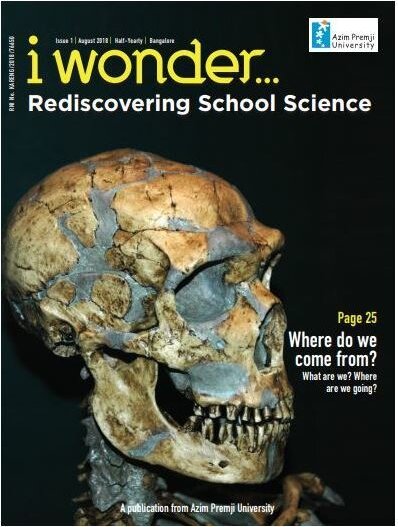
Explore the ‘Evolution’ of stars, the Earth, life, and humans through three articles for our adult readers and one short story written for young adults.
In ‘Annals of History’ relive the contentious process of arriving at the unexpected mathematical pattern that has become key to our understanding of the diversity of life on Earth.
Read ‘Research to Practice’, ‘The Science Educator at Work’ and ‘Teaching as if the Earth Matters’ to see how complex concepts related to energy, evolution and soil can be taught through metaphors, art and real-world experiences.
Learn more about Lynn Margulis’s ‘controversial’ ideas and life in science in ‘Biography of a Scientist’. If you’d like more, try some simple classroom experiments from ‘The Science Lab’ to understand foundational principles in Physics.
Use the seven activity sheets from ‘Life in your Backyard’ to introduce your students to the fascinating world of spiders. Plus, enjoy our nine pull-out posters on themes as diverse as ‘Benthic Fauna’, ‘The Hard Problem of Consciousness’, and ‘Ocean Acidification’.
Links
Magazine
Learning Curve Issue 1 | Innovative Government Initiatives in Education
in Azim Premji University

- Published
- Authors
Abstract
Education initiatives are part of governments all across the globe, guided by a much-deliberated system of principles influencing decisions that are aimed at achieving pre-determined outcomes, which, in turn, are perceived to be beneficial to a particular country’s goals. Much thought goes on behind creating initiatives: they are statements of intent and, equally, the task of implementation is a very complex one. Not just that, innovative education initiatives have the huge additional responsibility of creating and shaping future generations, who, in turn, are any country’s future. The initiatives have to keep in mind the cultural and social norms of the country, while creating the atmosphere for salutary change. Another aspect that has to be taken into account while designing innovative government initiatives in education is the changes in society and its demands, both locally and globally, and rethink their strategies in order to benefit a new and contemporary scenario which will equip children to face and handle challenges of current times.
Links

- Published
- Authors
Abstract
Education policies have resulted in several enduring legacies in keeping with the ever-changing society, as well as its political manifestos. Because of the dynamic nature of society in general, and the speed with which the world changes, bringing with it changes vis-a-vis every aspect of socio-economic-political change, national education policies from 1968 have seen changes in 1986, 1992 and now a draft policy in 2016. It is expected that each policy, when introduced, will take into account the demands of the day while preserving the central core of its goals. National educational policies are, or at least should be, the consequence of a clear understanding of the socio-cultural beliefs of India, and at the same time having clarity in introducing a system that is aligned to the goals enshrined in our Constitution and has the avowed purpose of creating a democratic society of enlightened citizens. In this Issue, we have articles which examine education policies from 1968, which was the starting point chosen for this issue. The draft policy of 2016 has been closely examined, as have the ways in which language and literacy have been addressed. Another article is an examination of the history of educational policy documents. Other articles have been written about specific aspects such as CCE and the Midday Meal Scheme. This is only a sampling and we hope that readers will find this Issue interesting.
Links

- Published
- Authors
Abstract
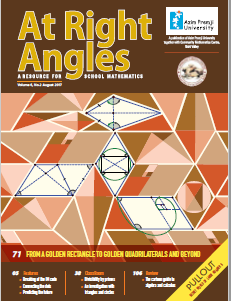
Volume 6 Issue 2: It is a pleasure to share with you, our readers, the collection of articles in this, the July 2017 issue. The (un)popular view of mathematics being a terrifying subject takes a completely new twist with the first article in which a mathematician takes on a terrorist threat! The hunt for answers to a mathematical problem is usually an absorbing one, at least to aficionados of the subject but Arun Vaidya’s fascinating story I M Code makes it a matter of life and death.
Following this, we have an article on another application of mathematics: Interpolation by Sankaran Viswanath. You will see again how mathematics is a tool for prediction, and how data can be fitted into mathematical expressions which then provide a mathematical model. From here, we move on to card tricks; yes, fun and mathematics can go together — and At Right Angles shows you how in Suhas Saha’s Ternary Base Magic Trick. A quick peek behind the magic reveals patterns based on the ternary base, it’s not as complex as it sounds, read on to find out. Our Features section ends with Shailesh Shirali’s exposition on Quadrilaterals with Perpendicular Diagonals, a nice bouquet of Arithmetic, Algebra and Geometry for you.In ClassRoom, we have the second part of the Inequalities series started in the March 2017 issue, again, both Algebra and Geometry are used to first prove the arithmetic mean- geometric mean inequality and then apply it in several situations to illustrate the power of this relationship and also view its implications in graphs, geometric figures, functions.the list of connections seems endless! Moshe Stupel and David Ben-Chaim appear next with their article Three Elegant Proofs, the name says it all, we promise it lives up to its title. CoMaC, as usual, provides an indepth analysis of an often-asked question, now increasingly appearing even in WhatsApp forwards: What’s the next number? Is the answer really unique as the question implies it to be? More on numbers with Swati Sircar and Sneha Titus, writing on the Sums of Consecutive Natural Numbers; mental mathematics becomes visual all of a sudden, and this Low Floor High Ceiling activity is sure to appeal to a variety of learning styles. Vinay Nair takes up the theme of Divisibility by Primes and provides some powerful tests using an ‘osculator’. Students are sure to be intrigued. ClassRoom concludes with a Proof Without Words on a property of the Orthocentre of a triangle.
For some time now, we have been featuring articles by students and we are particularly happy when they write in with their own discoveries. So much so, that from this issue onwards, we have devoted space to Student Corner in the ClassRoom section. Featured this time are Bodhideep of class 6 and Parthiv of class 11, you are sure to be impressed with their discoveries.
Our cover this time, features Golden Quadrilaterals and the illustrations have been provided by Michael de Villiers, who continues his series on constructive defining. These beautiful quadrilaterals have been defined by investigation and are an interesting activity for students who believe that everything in mathematics is pre-defined and that there is nothing new in mathematics to be discovered.
Problem Corner has seen some changes over the last few issues. In a deliberate attempt to avoid a ‘camp’ approach to problem solving and to make this section more inclusive, we have a wide variety to interest our readers. Prithwijit De sets the ball rolling with his article on ProblemPosing. This is followed by Middle and Senior Problems addressed to different age groups. CoMaC presents a theorem about a triangle and a problem about a rational number; the titles are deliberately bland but these are as fun as Shailesh Shirali’s Adventures in Problem Solving.
The Review this time will certainly have you leaping to order this book: The Cartoon Guides to Calculus and Algebra, a series whose name says both all and nothing. Can such a serious subject be illustrated with cartoons? With mathematical rigour? Read the Review and I’m sure you’ll be convinced.
Our issue concludes with the PullOut — Padmapriya Shirali focuses on Large Numbers and how students can grasp this concept. I am sure that adults too will enjoy this refresher course and pick up tips on how to make this topic child- friendly and approachable. So it’s over to you now! Happy reading.…Links

- Published
- Authors
Abstract
In this issue, we have a range of articles recounting personal experiences of teaching with the goal of inclusive learning rather than a random attempt at throwing information at a mixed ability group, only some of whom could lick the system with others falling by the wayside. Readers will find that diverse aspects of assessment have been thoughtfully tried and objectivity is a key theme. Another important aspect of assessment, namely, reflectively constructed rubrics have been given a place in this issue.
Links

- Published
- Authors
Abstract
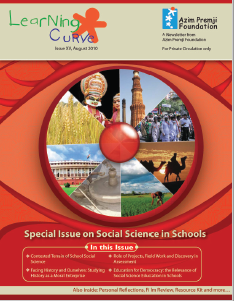
This issue of Learning Curve deliberates on the the purpose of social science in society, what the National Curriculum Framework says about the subject, the many moral conflicts while teaching it, pedagogic dilemmas, and a look at social science education across the world. The effort has been to give our readers an honest and comprehensive view of the nature of social science as a subject.
Links

- Published
- Authors
Abstract
In this issue of the Learning Curve, the pros and cons of the voucher system are discussed and the value of arts in the school curriculum is elaborated upon. The book ‘Escape from Childhood’, in which author John Holt advocates for a broader definition of childhood, inclusive of political and economic rights for children, is also reviewed.
Links