
Publications & Resources
Our faculty, students and researchers work together everyday to contribute to a better world by grappling with urgent problems we are facing in India. We conduct rigorous work to produce high quality learning resources and publications to contribute to public discourse and social change. Here, we feature a sample from our work for everyone to access. You can explore featured resources, policies, and the latest publications from the University.
To explore all the work of our University, please visit our publications repository.
List of Publications & Resources

- Published
- Authors
Abstract
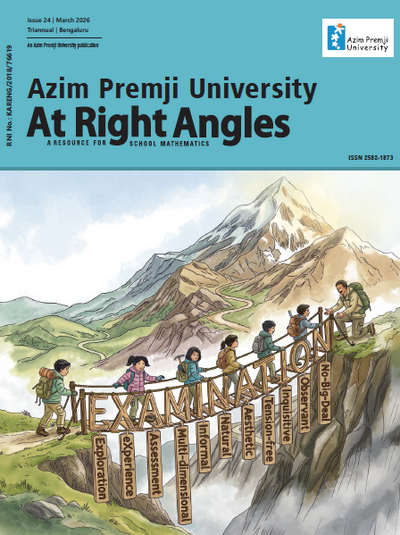
The March 2026 issue takes you on a journey – learning mathematics does have challenges and is all the more valuable because of these, but the role of the teacher is to scaffold this climb and to help students enjoy the view at each peak that they surmount. We discuss the need for, as well as the challenges of, conducting summative assessment at the primary level. But we also give you delightful wayside stops to stare at clocks, at posters of ten-frames, at activities with polyominoes, at interesting websites. Read on and enjoy!
Hybrid Disciplinary Spaces: Navigating Writing in a Science Education Classroom
in Contemporary Education Dialogue
Article
- Published
- Authors
Abstract
Science education is an interdisciplinary field of enquiry with conceptual frameworks drawing from the foundational disciplines of education, besides the multiple sub-disciplines of science. An interdisciplinary understanding has been critical to postgraduate courses in science education. However, students continue to have a conventional understanding of the nature and practices of science, based on predominant experiences at school and undergraduate education. This article analyses two assignments which draw upon philosophical and sociological perspectives in science. It discusses the development of hybrid spaces for students in understanding and navigating the disciplines and their interests. Conceptual and rhetorical elements, particularly emphasising students’ extension of inferences and projection of personae, are illustrated as elements of the forward and backward search strategies. Such assignments are essential to develop a richer understanding of the nature of science and its complex interpretation compared to typical deifications in textbooks and pedagogic approaches. They also support students with diverse interests and backgrounds to navigate different disciplines and unique interests through the development of ‘hybrid spaces’. Such spaces, at the boundaries of disciplines, writing conventions and students’ interests develop and reshape conventional understanding.
Links
State of Working India 2026 : Youth in the Labour Market | Pathways from Learning to Earning
in Azim Premji University

- Published
- Authors
Abstract
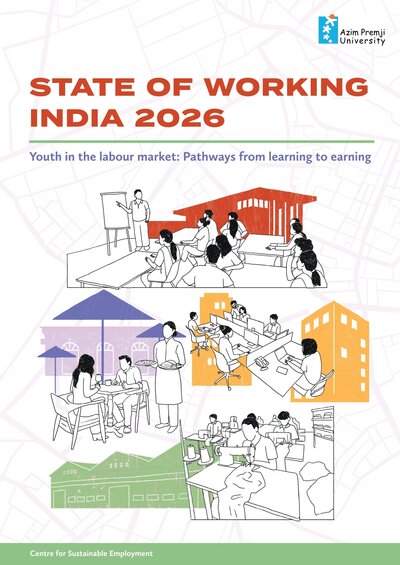
India is nearing the peak of its demographic dividend, with the share of the working-age population expected to begin declining after 2030. On the one hand, higher education in the country has become increasingly democratised with a rapid increase in the number of institutions. Graduate salaried earnings exceed non-graduates both at the time of entry into employment and over their lifetime. On the other hand, financial barriers continue to restrict access, particularly in professional fields such as engineering and medicine. The transition from education to employment remains a major challenge. The rise in the number of graduates has not been matched by commensurate growth in graduate employment. This year’s State of Working India report traces the arc of a young worker’s transition from school or college into employment, and how this has changed in the last forty years.
Report Files
Full Report — download PDF file
Executive Summary (PDF)
Tables (spreadsheet)
Results Appendix (PDF)
All Figures (Figures 1.1−4.7, Figures 4.8−7.10 )
Figures Data(spreadsheet)
Press Release (English | Hindi | Kannada)
Media Coverage (spreadsheet)
Links

- Published
- Authors
Abstract
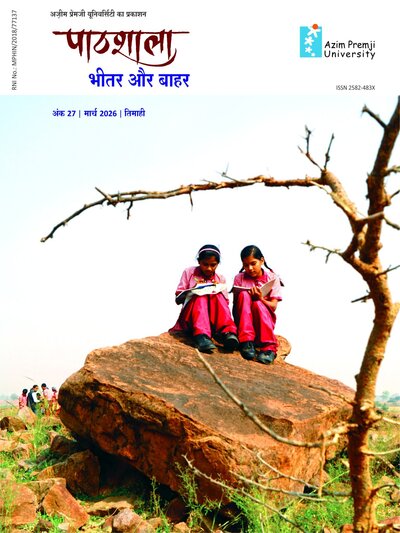
पाठशाला भीतर और बाहर का मार्च अंक शिक्षण के लिए उपयोगी अनुभवजन्य सामग्री को समेटे है। इस अंक में आप पढ़ेंगे कि विद्यार्थी उच्च कक्षाओं में तो पहुँच जाते हैं, लेकिन बहुत सारे विद्यार्थियों की दक्षता का स्तर पिछली कक्षाओं के अनुरूप नहीं बन पाता है। ऐसे में शिक्षकों के सम्मुख जो चुनौती होती है, उसका समाधान कैसे करें? शिक्षण योजना बनाकर शिक्षण करने के अनुभव और इससे बच्चों के सीखने में आए अन्तर को समझना हो या इबारती सवालों की इबारत में उलझे बच्चों की उलझन को सुलझाना, या ऐसे ही अन्य विविध विषयों पर बात करते लेख, सब इस अंक का हिस्सा हैं। हमेशा की तरह शिक्षकों की डायरी, इनसे मिलिए सहित, किताबों से दोस्ती और आइए, करके देखें जैसे सभी स्थाई स्तम्भ भी अंक में शामिल हैं।
Taking Geography Seriously: Exploring Spatial Heterogeneity in Determining Childhood Malnutrition in Rural Maharashtra
in Economics of Development: Looking through Environmental and Behavioural Lens, Routledge

- Published
- Authors
Abstract
Childhood malnutrition is a significant challenge for India. Literature exploring the determinants of malnutrition has emphasised the importance of the local context. Malnutrition is an outcome of the various socio-economic forces that are entwined in local specificities. This makes it very important to keep the context in mind for designing policy and avoid “one-size-fits-all” solutions. In this context, this chapter takes a different route by exploring the spatial heterogeneity in the associations between variables known to impact childhood malnutrition. The variations in associations can be learnt from the data instead of being specified in an ad hoc a priori manner. This can give better insights into the spatiality of the context within which socio-economic processes interact to produce malnutrition. This analysis is performed in the context of rural Maharashtra using Mission Antyodaya and several other databases.
Authors:
Neeraj Hatekar, Amalendu Jyotishi and Puja Guha