
Publications & Resources
Our faculty, students and researchers work together everyday to contribute to a better world by grappling with urgent problems we are facing in India. We conduct rigorous work to produce high quality learning resources and publications to contribute to public discourse and social change. Here, we feature a sample from our work for everyone to access. You can explore featured resources, policies, and the latest publications from the University.
To explore all the work of our University, please visit our publications repository.
Report
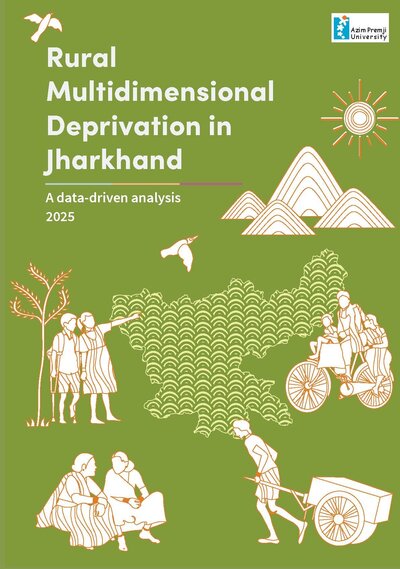
Rural Multidimensional Deprivation in Jharkhand: A Data-Driven Analysis 2025
in Azim Premji University

- Published
- Authors
- School of Development
Abstract
This report constructs a Rural Multidimensional Deprivation Index (RDI) for measuring deprivation in Jharkhand. An important feature of the index is that it is constructed using indicators on provisioning of basic infrastructural amenities at the village level. This is different from the usual poverty indices that are composed of financial indicators such as income or consumption; or indicators measuring development outcomes such as educational or nutritional levels. Observing the provisioning of basic infrastructural amenities, this report makes focused policy suggestions that can be easily implemented by functionaries working on the ground. The data for the index is sourced from the Mission Antyodaya Survey, which was carried out in 2019 at the village level across the country. The survey collects data related to provisioning and outcome of basic amenities in villages, along with demographic and socioeconomic variables. Because this is a periodic survey, it enables us to track the developmental progress of each village, district, state and the country over time. In total, there are about 182 variables that were captured in the 2019 round. The survey covers 31,175 out of 32,620 villages in Jharkhand, which is 95.6 percent of the total number of villages in the state; and 6,48,358 out of 6,67,933 villages in India, or 97.1 percent of the villages in the country.
Editors
Prasanna S, Sandhya Krishnan, Sanket Gharat, Puja Guha, Amalendu Jyotishi, Neeraj Hatekar
Links
Article
- Published
- Authors
- School of Development
Abstract
If one asks a teacher in preschool learning spaces in India, about the most usual story that is narrated to children, what is the most common answer? Will there be unanimity in the fact that the story of Thirsty Crow works just as well in many Indian languages, as it does in Indian Sign Language? Those who engage with early childhood care and learning would often stress upon the need to have a visually rich environment in these learning spaces, full of picture books and enthusiastic teachers who never give up a chance to bring out yet another story. Bringing Indian Sign Language to early childhood learning spaces, creating an immersive experience for children before they enter school years by making available in these spaces Indian Sign Language resources (and then taking such initiatives to schools, colleges, and community spaces) would allow us to slowly move toward the dream cherished by deaf adults.
Article
- Published
- Authors
Abstract
Institutional births increased in India from 39% to 79% between 2005 and 2015. Drawing from 17 months of fieldwork, this article traces the shift from home to hospital births across three generations in a hamlet in Assam in Northeast India. Here, too, one finds that most births have shifted from home to hospital in less than a decade, aided by multiple factors. These include ‘free’ birthing facilities and financial incentives offered by government schemes, idiosyncratic changes within the hamlet, such as the introduction of biomedical practices through home births where oxytocin was used, and changes in cultural belief systems among local people. The exploration reveals significant transitions between (and fluidities of) categories such as local/global, tradition/modernity, past/present and nature/technology, creating a complex and ambivalent narrative of change, in which the voices of mothers should not be ignored.
Links
University Working Paper Series
Exploitative Informal Labour Process in India: a conceptualisation
in Azim Premji University

- Published
- Authors
Abstract
This working paper will focus on conceptualising why informal labour continues to persist in the Indian economy. More specifically, it will try to theorise why, despite generating growth, informal labour has been locked in unequal and exploitative terms of contracts. Crucially, it will try to understand why informal labour processes do not evolve mechanisms for providing security and support to labour in the form of benefits and rights. In this paper, I will focus specifically on highly exploitative and unequal informal labour processes. I categorise under this category those labour processes that do not provide a mechanism to reproduce labour power. These processes are predicated on maximising the appropriation of surplus from labour, without providing any provision to support the workers in ill health, facing work related accidents and injuries, or due to retrenchment. While informal labour is defined as labour without legal rights or contracts, I specifically focus on those processes where there do not exist any norms or mechanisms of providing security to labour within the production process. Hence, I refer to these processes as highly exploitative and unequal labour processes. This paper will be structured in the following manner. Firstly, it will introduce the concept of labour process and argue that highly exploitative informal labour processes in India broadly fall into two distinct labour processes namely: informal coercive accumulation process and petty commodity production. It will then derive concepts from the Paris Regulation School to modify the labour process framework. It will then describe concrete case studies conducted by other researchers, to demonstrate that this framework can be utilised to make sense of field work based research on the informal sector. Lastly, I will assess the questions posed in this paper based on the derived framework and will argue that informality is connected to the nature of capitalist development in India.
Links