
Publications & Resources
Our faculty, students and researchers work together everyday to contribute to a better world by grappling with urgent problems we are facing in India. We conduct rigorous work to produce high quality learning resources and publications to contribute to public discourse and social change. Here, we feature a sample from our work for everyone to access. You can explore featured resources, policies, and the latest publications from the University.
To explore all the work of our University, please visit our publications repository.

- Published
- Authors
Abstract
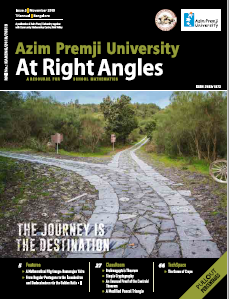
AtRiA, November 2019 focuses on journeys ‑some are enjoyable, some tiresome, some endless. A mathematician’s journey is full of unexpected delight, simply because of unexpected detours, sudden discoveries and interesting alternatives. Have fun as you travel with us. Read all about the young Yatris and their journey of discovery in Features. This section also describes more abstract journeys from the Regular Pentagon to the Icosahedron and the Dodecahedron (Part 2) and from the familiar 2 and 3 dimensions to n dimensions in Extension of the Pythagorean Theorem. In ClassRoom, Simple Cryptography and Triangles with Integer Sides are articles sparked off by previous articles in AtRiA . An Unusual Proof of the Centroid Theorem, Modified Pascal Triangle and Orthocentre of a Triangle may motivate you to write similarly! You will find ideas in our regular columns – How to Prove It, Low Flow High Ceiling and TechSpace which features the simulation of a dice game this time. Our issue is short of 100% without the PullOut, enjoy the learning trajectory on Percentages, defined and illustrated with plenty of examples in this issue. How Craig Barton Wishes he’d Taught Maths is an excellent review by Sir Timothy William Gowers, reprinted from his Weblog.
Links

- Published
- Authors
Abstract
This article analyses relationships between the implementation of state-level industrial policies in India and manufacturing sector economic performance (employment and gross value added), utilising data from the Annual Survey of Industries conducted by the Government of India. I employ panel data fixed-effects regression models to evaluate the associations between the industrial policy and state-industry specific performance over the 2007-08 to 2014 – 15 period, incorporating potential effects of the state government’s political alignment, infrastructure provision and educational expenditure in the state. The results provide evidence of a positive correlation between industrial policy implementation and firm output and employment, by around 12.6 — 14 per cent. However, subsequent introductions of an industrial policy are negatively associated with employment and are uncorrelated with industrial GVA. This analysis has implications for economic policy in light of the Central Government’s plans to implement a revised industrial policy at the national scale.
Author:
- Raavi Aggarwal
Links
- Published
- Authors
Abstract
To contribute to the critical matter of India creating just and sustainable employment, the University has set up the Centre for Sustainable Employment (CSE), which conducts and supports research in areas of work, labour, and employment. The University is attempting to provide empirically grounded, analytical reflections on the state of work and workers in India, as well as to evaluate and propose policies that aim to create sustainable jobs. To this end the University also gives grants to create new knowledge in the above areas. It also hosts a working paper series to which contributions are invited from researchers, policy-makers, civil society actors, and journalists. The University’s CSE website is an important part of this agenda. In addition to research papers and policy briefs, it hosts government reports, as well as data and statistics on the Indian labour market. This also includes executive summary of the report.
State of Working India 2019 consists of labour market trends between 2016 and 2018, and four policy papers around the theme of employment generation.
Release event: Presentation and panel discussion
State of Working India 2019 Release Event Part One — YouTube
State of Working India 2019 Release Event Part Two — YouTube
Links
- Published
- Authors
Abstract
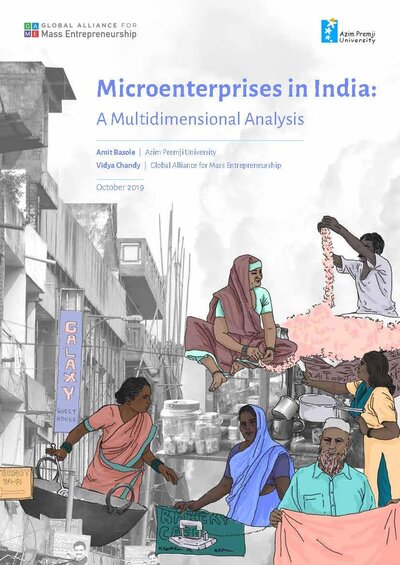
Microenterprises have been the engines of job growth in the majority of dynamic economies. India is home to thousands of microenterprise clusters as well as millions of distributed entrepreneurs who can become job creators. Fostering of such mass-entrepreneurship is key to addressing India’s employment challenge. Case studies of clusters in general, and of women entrepreneurs in particular, show that if key factors such as collective action, infrastructure, credit, and market linkages are in place, returns to entrepreneurship are vastly improved. Inspirational stories are also emerging in the use of fourth industrial revolution technologies to improve access to markets and enter global value chains in a way that awards greater agency to women entrepreneurs.
Links
CSE Working Paper Series
India’s Employment Crisis- Rising Education Levels and Falling Non-agricultural Job Growth
in Azim Premji University
- Published
- Authors
Abstract
Falling total employment is an unprecedented trend seen from 2011-12 to 2017 – 18. Due to a decline of employment in agriculture and manufacturing and slow growth of construction jobs, the process of structural transformation, which had gained momentum post-2004 – 5, has stalled since 2012. Mounting educated youth unemployment, and lack of quality non-farm jobs have resulted in an increase of the disheartened labour force. Though the share of regular and formal employment increased marginally due to growth of formal jobs in the private sectors, the share of informal jobs within government/public sector increased. A dominant share of jobs is still generated by micro and small units of the unorganized sectors without any formal or written job contract. In both government and private sectors the number of contract jobs (with less than a year’s contract) is on the rise post 2011-12. Not surprisingly, real wages have not increased in either rural or urban areas.
Authors:
- Santosh Mehrotra
- Jajati K. Parida
Links
Report
- Published
- Authors
Abstract
The Karnataka Crime Victimisation Survey report is based on the findings of a crime victimisation survey undertaken by Azim Premji University with the assistance of independent field investigators in 2017. The main objective of the survey was to understand the scope and nature of crime in the state and to analyse the extent to which the National Crime Records Bureau records capture the rate of crime in Karnataka.

- Published
- Authors
Abstract
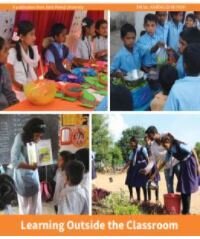
It is certainly a platitude to say that learning can happen everywhere and at all times, at the most unexpected places and moments in our lives. However, that said, we also recognise that the school is a very valuable place of learning: formally and systematically in a graded way,level upon level so that we can tackle end-of-stage examinations which help us to choose our futures. But while all this is happening, a lot of undocumented and stimulating learning is going on simultaneously,
In this issue, articles on experiential learning about the environment, reading as a means of expanding horizons as well as acquiring language skills, the morning assembly as a treasure house of the learning experience- are all here. Other articles have given detailed accounts of science as a dispeller of superstition and an enhancer of a spirit of enquiry and curiosity. Sports do more than just teach the rules of the game, suggests an article: they can internalise values, inculcate inclusion and gender equality. There is an array of perspectives on the learning within learning which, paradoxically, falls outside of it.
All in all, this issue confirms what has long been felt and known — the learning that occurs outside the classroom is as vital as the formal pedagogy which takes place inside.Links


- Published
- Authors
Abstract
Explore big questions around 4 themes: black holes, the wound healing capacity of the skin, Higgs bosons, and the matrix of life.
Use the activity sheets in ‘A milky way to learn biology’, ‘What do we really see’, and ‘Trees and seasons in a changing world’ to introduce students to thinking like a scientist, the human vision, and neighborhood trees.
Discover how astronomers measure distances in space in our new section ‘How do we know?’ Explore how engaging students in raising an urban terrace farm can strengthen their understanding and involvement with the local environment in ‘Pedagogy of dirty hands’.
Try out the concept builder from ‘Physics for closeted Aristotelians’ to find out how well your students understand motion under gravity.
Read our ‘Research to practice’ section to discover how to create embodied learning experiences for students in the science classroom. Or learn more about the first image of a black hole in our section ‘Hot off the press’.
Looking for more? Enjoy our pull-out poster on human skin and booklet on identifying 10 common trees.
Links

- Published
- Authors
Abstract
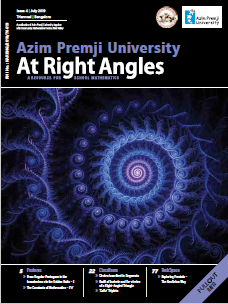
The July 2019 issue features Fractals on the cover — those distant and beautiful and highly mathematical creations have been brought a click away in our TechSpace section. Enjoy creating them and adding to your repertoire. We also take you through the magical tour of the beauty of mathematics starting with an article on Pentagons. Pi enters the ClassRoom section and the primary has plenty of learning — have fun joining the dots and exploring geometrical figures with different lenses. Students share their mathematical findings in two exciting articles. Our pedagogy article helps you to Understand Learners’ Thinking. And the Middle School problem corner is a Do_It_Yourself hands on problem solving section. The PullOut is on Ratio.
Links
CSE Working Paper Series
Inequalities in the Gendered Labour Market- What can be Done
in Azim Premji University

- Published
- Authors
Abstract
Globally, research has shown that, there is a high correlation between the level of per capita income and the rate of female labour force participation. At the same time the agency and autonomy of women in a country improve with the level of female labour force participation.
Authors:
- Santosh Mehrotra
Links
CSE Working Paper Series
How Comparable are India’s Labour Market Surveys- A comparison of NSS, Labour Bureau and CMIE Estimates
in Azim Premji University

- Published
- Authors
Abstract
With the lack of official government data on unemployment and other labour market indicators, the most viable and recent source have been the regular household surveys conducted by the Centre for Monitoring the Indian Economy (CMIE). Given the differences in methods in data collection, it becomes exceedingly important to establish some comparability between the government and the CMIE datasets. This paper attempts to do that using two methods. First we fit a model of employment status on the CMIE data and see how well it predicts outcomes in the older Labour Bureau 2015 – 16 and NSS 2011-12 data. Then we compare state-level estimates of broad labour market indicators from CMIE 2016 and Labour Bureau 2015 – 16 datasets. The broad results are that despite differences in methodologies, the estimates for men are quite comparable between the surveys, while measures of women’s participation in the labour force seem particularly sensitive to the way questions are asked in surveys.
Authors:
- Rosa Abraham
- Anand Shrivastava
Links

- Published
- Authors
Abstract
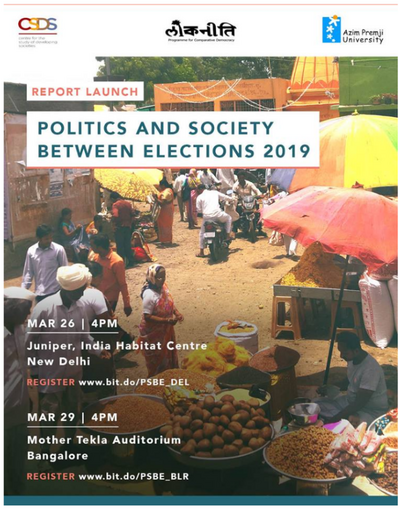
The problems of India’s development and governance are routinely linked to the logic of India’s electoral democracy. As a result, a great deal is known about elections, but paradoxically our knowledge of politics and society between elections is relatively underdeveloped. As much as anything else, development and governance outcomes are shaped by how the government functions between elections; including how it relates to citizens on a regular basis, how it provides routine public services to them, and how public order is maintained. Further, governance processes are nested in the social and political relationships between citizens and government functionaries.
Links

- Published
- Authors
Abstract
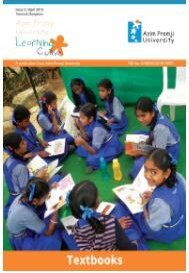
This issue focusses on Textbooks and their significance in learning, how they are created, the ways they have been used and how they can be improved upon. The articles are based on classroom experience and as such are relevant and universal. Much thought has gone into the perceptive analyses by the authors, who have considered the full impact and importance of the power of textbooks.
Links

- Published
- Authors
Abstract
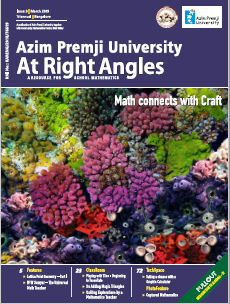
The March 2019 issue is packed with articles for students, teachers and teacher educators of all classes. Striking results are not just reported, they are also explained and justified with proofs. And our sources vary from students to observations from colleagues in mathematics classrooms and mathematical tricks from websites- these are explored and explained.
Links

- Published
- Authors
Abstract
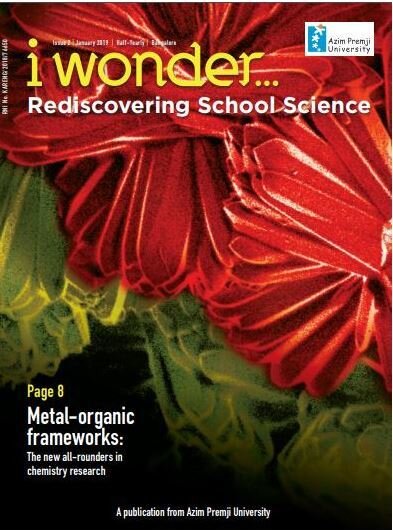
Explore three ‘Emerging Trends in Chemistry’ – new elements, metal-organic frameworks, and fluorescent tags. Read ‘Serendipity’ & ‘Annals of History’ to re-live the exciting jigsaw-puzzle-like process of scientific discovery – whether of a novel protein or the structure of DNA.
Engage with the process of encouraging peer instruction in the science classroom through ‘Students as Teachers’, or use our activity sheet ‘Early Bird Nature Detectives Bingo’ to get students to observe (non-human) life in their backyards.
Use our ‘Science Lab’ section to get your students to calculate their molar masses (!) or understand pressure and volume through simple experiments with easily available low-cost materials.
Discover the chemicals in everyday phenomenon through ‘The Scent Orchestra of Flowers’ & ‘The Chemistry of Life’.
Explore the concept of energy from three very different perspectives with ‘The Mystery of Dark Energy’, ‘Powering (human) Life on Earth’ & ‘Clean Energy’. Plus, enjoy our two pull-out posters on ‘Doppler Effect’ and ‘Some interesting scents of flowers’.
Links
CSE Working Paper Series
Towards higher female work participation in India- what can be done
in Azim Premji University

- Published
- Authors
Abstract
A continuous and sharp decline in the already depressed female labour force participation rate in India post 2005, particularly in the face of its rapid economic growth raises questions about the inclusiveness of the growth process. The paper recommends a set of policies based on the analysis of the nature and trends of female work participation and a brief analysis of the underlying reasons behind such trends. Women are moving out of the low productivity agricultural sector, which necessitates an increase in employment opportunities in the nonagricultural sector, particularly in rural and in semi-urban locations. Improving skills for employability, especially in manufacturing clusters (which is where the jobs are) located close to young girls’ rural homes, would help the females to join the labour force if non-agricultural jobs are growing. To release women from unpaid work in the household to join the paid labour force, it is essential to improve child care facilities and other basic service facilities, which again calls for raising the share of public expenditure in some sectors and specific facilities. For instance, increasing single working women’s housing, making public transport safer, and modifying public programmes to cater to women’s needs can pave the way for more women to engage and remain in the labour force, become active participants in the growth process, and thus achieve greater economic empowerment.
Authors:
- Santosh Mehrotra
- Sharmistha Sinha
Links
CSE Working Paper Series
The Evolving Discourse on Job Quality- From Normative Frameworks to Measurement Indicators- The Indian Example
in Azim Premji University
- Published
- Authors
Abstract
Indians are optimistic. According to the Pew Research Center’s 2017 Global Attitudes Survey, three out of four Indians believe that, “when children today in India grow up, they will be better off financially than their parents” (Pew Global Attitudes Survey, 2017). Families hinge their hopes on the ability of the next generation to work hard, earn a living, and be a source of financial support. For years now, the nation has done the same, pinning its economic ambitions to a demographic advantage, or youth bulge, that is set to continue only for the next two decades. Unless there are pathways to productive and high-quality employment, the nation’s youth will not be able to deliver on these expectations.
Authors:
- Sabina Dewan
- Divya Prakash
Links

- Published
- Authors
Abstract
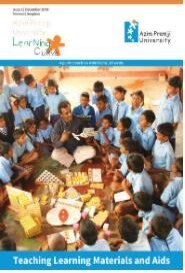
Teaching Learning Materials (TLMs) and Aids, which form the focus of this issue of Learning Curve, an indispensable part of a teacher’s bag of tricks, is a generic term that describes any material that supports and buttresses teachers’ efforts in getting a class of diverse capabilities to understand the basics of any learning. They have to fulfil some basic requirements: simplify concepts, provide the chance of practice, increase interest and motivation, help to explain complexities, concretise abstractions, enrich the course — though, of course, a single TLM may not meet all the above criteria. Thus, they are various kinds of TLMs, starting with the humble, but ever-present, blackboard (which has come in for much adverse criticism) and going all the way up to ‘smart classrooms’, with all the advanced technology they entail. TLMs have the added value of aiding the memory — when children see how a concept/rule of language/experiment works, it is more likely to stay in the active memory than just learning the same thing by heart. This issue presents a wide variety of opinions and experiences with TLMs and Aids.
Links

- Published
- Authors
Abstract
India is one of the world’s fastest growing economies. To be a stable and prosperous democracy, this growth must be accompanied by the creation of meaningful, secure and remunerative employment. Realising this goal requires a grounded and comprehensive overview of the state of labour markets, employment generation, demographic challenges and the nature of growth.
The State of Working India (SWI) is envisioned as a regular publication that delivers well-researched, analytically useful information on India’s labour market, by bringing together researchers, journalists, civil society activists, and policymakers interested in labour and employment issues.
The report is based on the research of CSE staff, as well as on background papers which are available online. SWI conceives of India’s ongoing structural transformation as composed of two processes — movement of workers from agriculture to non-farm occupations (the Kuznets process) and from informal activities to formal ones (the Lewis process). But it adds crucial considerations of social equity and ecological sustainability to this standard framework. In the 21st century, Lewis and Kuznets have to meet Ambedkar and Gandhi.
Report Documents
Figure Data (XLS)
Background Papers
Bijolia’s Harvest of Stone: Conditions of Work Among Quarrying Labour in Rajasthan
Gender Differentials in Expansion of Informal Enterprises
Labour Absorption in Indian Manufacturing: The Case of the Garment Industry
Hard Work, Low Pay : Work Patterns Among Rural Women in West Bengal
Understanding the performance of India’s manufacturing sector: Evidence from firm-level data
The Indian Labour Market: A Fallacy, Two Looming Crises and a Silent Tragedy
Domestic Workers and the Challenges of Collective Action in Informal Work: A comment
Individual Chapters:
Chapter Two : Who Is Looking For Work?
Chapter Three : Where Is the Work?
Chapter Four: How Good Is The Work


- Published
- Authors
Abstract
Volume 7 Issue 3: The November issue has beaten the nay-sayers at their own game with articles that celebrate the joy of doing mathematics through games, stories, applications of mathematics and activities on line and in the classroom.
Links


- Published
- Authors
Abstract
Explore the ‘Evolution’ of stars, the Earth, life, and humans through three articles for our adult readers and one short story written for young adults.
In ‘Annals of History’ relive the contentious process of arriving at the unexpected mathematical pattern that has become key to our understanding of the diversity of life on Earth.
Read ‘Research to Practice’, ‘The Science Educator at Work’ and ‘Teaching as if the Earth Matters’ to see how complex concepts related to energy, evolution and soil can be taught through metaphors, art and real-world experiences.
Learn more about Lynn Margulis’s ‘controversial’ ideas and life in science in ‘Biography of a Scientist’. If you’d like more, try some simple classroom experiments from ‘The Science Lab’ to understand foundational principles in Physics.
Use the seven activity sheets from ‘Life in your Backyard’ to introduce your students to the fascinating world of spiders. Plus, enjoy our nine pull-out posters on themes as diverse as ‘Benthic Fauna’, ‘The Hard Problem of Consciousness’, and ‘Ocean Acidification’.
Links
Magazine
Learning Curve Issue 1 | Innovative Government Initiatives in Education
in Azim Premji University

- Published
- Authors
Abstract
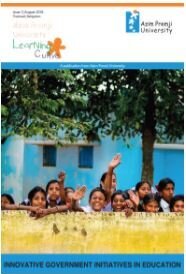
Education initiatives are part of governments all across the globe, guided by a much-deliberated system of principles influencing decisions that are aimed at achieving pre-determined outcomes, which, in turn, are perceived to be beneficial to a particular country’s goals. Much thought goes on behind creating initiatives: they are statements of intent and, equally, the task of implementation is a very complex one. Not just that, innovative education initiatives have the huge additional responsibility of creating and shaping future generations, who, in turn, are any country’s future. The initiatives have to keep in mind the cultural and social norms of the country, while creating the atmosphere for salutary change. Another aspect that has to be taken into account while designing innovative government initiatives in education is the changes in society and its demands, both locally and globally, and rethink their strategies in order to benefit a new and contemporary scenario which will equip children to face and handle challenges of current times.
Links

- Published
- Authors
Abstract
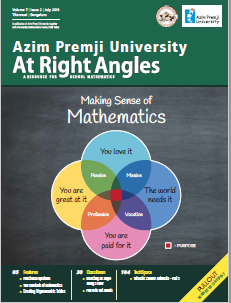
Volume 7 Issue 2: And it’s out! Most of you would have already received your copy of the July issue of At Right Angles, here’s the official announcement and the link with the welcome news that AtRiA is finally a whole school math resource! The shift all the way to Primary is marked with several new sub-sections in ClassRoom: from Sense-Making in Mathematics – the cover says it all- to TearOut- where all a busy teacher has to do is to tear out a ready made worksheet – complete with facilitator notes- and use it to challenge students to think in fun mathematical ways. As always, PullOut shares strategies and tips on a specific theme, this time we continue our series on Algebra.
And to top it all, we have not one but two students contributing articles to the Features section, no less! Enjoy a great read!
Links
CSE Working Paper Series
Labour Absorption in Indian Manufacturing- The Case of the Garment Industry
in Azim Premji University

- Published
- Authors
Abstract
A striking feature of the Indian economy has been the relatively small contribution made by the manufacturing sector to the country’s Gross Domestic Product (GDP) and, more importantly, to employment. In 2013, manufacturing accounted for only 16.5 per cent of India’s GDP, compared to 29.7 per cent of China’s.3 According to the National Sample Survey (NSS) on Employment and Unemployment, India’s manufacturing sector provided employment to 61.3 million in 2011-12, which was only 13 per cent of the country’s total workforce of 472.5 million in that year.
Authors:
- Jayan Jose Thomas
- Chinju Johny
Links
CSE Working Paper Series
Bijolia’s Harvest of Stone- Conditions of Work Among Quarrying Labour in Rajasthan
in Azim Premji University
- Published
- Authors
Links
CSE Working Paper Series
Hard Work, Low Pay — Work Patterns Among Rural Women in West Bengal
in Azim Premji University

- Published
- Authors
Abstract
This study is the outcome of the experience of the Shramajivi Mahila Samity, an independent, non-party mass organisation of mainly rural working women in West Bengal. Shramajivi Mahila Samity works on gender discrimination and rights of women. It does not run any direct income generating programmes. However, in the 28 years of our work in rural Bengal, we have seen women contributing in myriad ways to the economies of their families. They are an irreplaceable element in the survival of their families, often making the difference between starvation and subsistence. We have always been surprised by the official statistics which show West Bengal as having one of the lowest female labour participation rates in the country. It has led us to believe that there is a gross misunderstanding about women’s work and the importance of unpaid work in the economy of a poor household. In the past few decades, we have seen more and more women in rural Bengal joining paid work. We have seen that men are migrating and the agricultural labour force in many areas consists now almost entirely of women. We were therefore surprised to read about a debate on falling female labour particpation rate at the national level. It did not match our own work experiences. It has led us to the present study, which we hope will be able to shed some light on what is actually happening to women from the rural working class in West Bengal.
Author:
- Anuradha Talwar
Links
CSE Working Paper Series
Pride and Prejudice- The Condition of Handloom Weavers in West Bengal
in Azim Premji University

- Published
- Authors
Abstract
In India, the relative importance of the handloom sector, one of the largest employers following agriculture, has been declining for last few decades. The All India Handloom Census data for the year 2009-10 however showed a rather modest decline in the number of weavers in West Bengal, in contrast to a 33% decline at the national level in the same year. But share of handloom income in total household income for the weaver households in the state has decreased significantly pointing to considerable occupational diversification among them. Based on a qualitative field study in three districts of West Bengal — namely, Hooghly, Nadia and Purba Bardhaman — this essay presents findings related to the condition of handloom weavers in West Bengal and in the light of the findings, examines two issues— intra-sector and inter-sector mobility of labour as well as weavers’ response to changing market conditions. The paper argues for a more labour-focused approach in place of currently dominant tradition-focused understanding of the sector.
Authors:
- Rajesh Bhattacharya
- Sarmishtha Sen
Links
CSE Working Paper Series
Changes in Production Regimes and Challenges to Collective Bargaining- A study of the Gurgaon Industrial Belt
in Azim Premji University

- Published
- Authors
Abstract
This study focuses on the Gurgaon-Manesar-Dharuhera-Bawal-Tapukara-Neemrana industrial belt in Haryana and Rajasthan, which is an important ‘node’ or part of Delhi-Mumbai Industrial Corridor (DMIC) and a major destination of capital in the last few decades. The study is based on primary survey work of qualitative nature of over 6 months from September 2017 to March 2018. Primary respondents are workers of different segments, plant-level Trade Union leaders and Trade Union activists of the belt, with some inputs from secondary literature, workers magazine and data published by the companies and the government.
Authors:
- Amit
- Nayanjyoti
Links

- Published
- Authors
Abstract
After independence in 1947, India embarked on an ambitious path of industrialisation, following the standard modern developmental prescription drawn from the experience of the so-called developed countries. Since the inauguration of the reform era in 1991, this model of development, duly globalised, has been reinforced by the decisions made by metropolitan policy elites both within and beyond India.
Author:
- Aseem Shrivastava
Links
CSE Working Paper Series
Domestic Workers and the Challenges of Collective Action in Informal Work
in Azim Premji University
- Published
- Authors
Abstract
Domestic workers (henceforth, DW), are a part of the large ‘informal’ sector of urban economy and society in India.ii According to the NSSO data, over the last two decades, the DW populationiii has emerged as the second largest urban informal workforce (Chen and Raveendran 2011), next only to ‘home based workers’ (artisans and petty commodity producers). According to the NSS 68th round (July 2011- June 2012), it is estimated that 41.3 lakhs workers work in the households of others, and an overwhelming 27.9 lakhs of this total are women.iv An increasing number of studies are emerging about DWs around the world including the phenomenon of international migration of DWs for work. This paper is a critical commentary on the collectivization of DWs, based upon an ongoing empirical study that combines ethnographic and quantitative inquiry among DWs in different parts of Bengaluru, India. Our aim here is to provide readers with general insights into some of the key struggles of and prospects for domestic workers in a particular context – DWs who work in a mega-city and in multiple homes (rather than as live-ins).
Authors:
- Balmurli Natrajan
- Rajesh Joseph
Links