
Publications & Resources
Our faculty, students and researchers work together everyday to contribute to a better world by grappling with urgent problems we are facing in India. We conduct rigorous work to produce high quality learning resources and publications to contribute to public discourse and social change. Here, we feature a sample from our work for everyone to access. You can explore featured resources, policies, and the latest publications from the University.
To explore all the work of our University, please visit our publications repository.
List of Publications & Resources
The Limitations of India’s Census Legislation
in Azim Premji University

- Published
- Authors
Abstract
Most discussions on the quality of government data overlook the legal framework within which data are collected. This paper examines India’s Census Act, 1948, which provides the legal-administrative framework for conducting human population census. The Act stipulates punishment for interfering with the process of enumeration, but the punitive provisions are rarely used and have not been invoked to deal with cases of mass manipulation of the census. Major instances of manipulation were, in fact, reported in 1951 and 2001 after the government introduced additional punitive measures in 1948 and 1994, respectively. This paper compares the Census Act, 1948 with other Indian laws related to the collection of statistics as well as census laws of other common law countries and identifies the structural flaws of the Indian law vis-à-vis manipulation. It uses simple games to explain why the punitive provisions of the Census Act, 1948 are redundant in the event of mass manipulation and suggests that the problem can be addressed without recourse to law. The insights drawn from the games are examined in light of the experience of Nagaland, a state of India where census statistics were manipulated on a large scale in 2001.
Links

- Published
- Authors
Abstract
While following her grandmother’s journey of composting, her involvement and dedication to her garden really stood out to Megha Padubidri. Her grandmother immensely enjoys gardening and has spent a long time making the garden into what it is today. Her garden is filled with various flowering plants, herbs, and fruit trees. She tends to the garden herself and enjoys being there. Although she lives off a busy road, the garden is alive with the sounds of birds, bees and sometimes monkeys. To her, composting isn’t a science but rather an art, something that has to be perfected over time. She documents the composting technique — what goes into it, where and how it happens, and more.
Author: Megha Padubidri, BSc in Environmental Science and Sustainability
Links

- Published
- Authors
Abstract
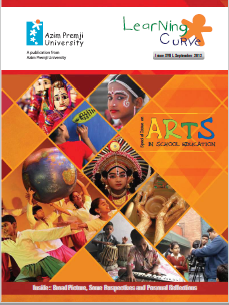
The latest issue of Learning Curve focuses on ‘arts in school education’. The burthen of the collective message of this issue is: in the life of our children, Art is as essential as any other subject. Art sharpens perceptions of the world around us, it increases awareness and sensitivity. It also enhances human relationships as we discover the similarities of the artistic experience. There is a general recognition of the fact that the word ‘art’ encapsulates within itself a wealth of meaning, as witness phrases such as the art of writing, of communication, of social and political exchange.
Links

- Published
- Authors
Abstract
In this issue of the Learning Curve, updates of the Foundation’s programs and research studies are detailed in some length. An article on School Development Planning explores the benefits of training head teachers in devising plans for their schools.
Links