
Publications & Resources
Our faculty, students and researchers work together everyday to contribute to a better world by grappling with urgent problems we are facing in India. We conduct rigorous work to produce high quality learning resources and publications to contribute to public discourse and social change. Here, we feature a sample from our work for everyone to access. You can explore featured resources, policies, and the latest publications from the University.
To explore all the work of our University, please visit our publications repository.
List of Publications & Resources
Rural Transformation in India: What can we learn from village studies?
in Azim Premji University

- Published
- Authors
Abstract
This article examines rural transformation in India through a review of longitudinal village studies conducted over the past three decades. It argues that rural India is not undergoing structural transformation in the classical sense. While labour is steadily moving out of agriculture, this shift has not led to higher productivity in agriculture or the development of a robust rural nonfarm economy. Instead, what unfolds is a process of deagrarianisation, driven by out-migration of male workers to cities where they engage in informal nonfarm employment. This transition is uneven and remains deeply embedded in existing hierarchies of caste, class, and gender, which shape both access to opportunities and outcomes. By identifying common patterns across diverse regional contexts, the article shows how village studies provides a grounded perspective on the nature of rural change.
Author:
C.R. YaduLinks
Social norms and women’s employment in India: A district level analysis
in Azim Premji University

- Published
- Authors
Abstract
Reducing gender disparities in workforce participation is an important policy goal in several developing countries. India, in particular, has historically had low levels of women’s workforce participation as compared to men and as compared to peer economies. Prior research has identified both supply and demand-side explanations for low levels of women’s participation in paid work. On the supply side, social norms constraining women’s mobility and autonomy are commonly invoked as one explanation. We test the relevance of such norms in explaining heterogeneity in women’s employment using district-level data from the National Family Health Survey (NFHS) 2015 – 16 and the Sixth Economic Census (2013). Norms indices are constructed using Principal Components Analysis for 640 districts of India. The findings indicate that less restrictive norms related to decision-making, mobility, and asset ownership are positively correlated with higher levels of women’s employment.
Authors:
Subhapriya Chakraborty and Amit Basole
Links
- Published
- Authors
Abstract
Unemployment is one of the key macroeconomic variables used to assess the performance of an economy. However, there is a bias towards conceptualizing unemployment solely through its predominant measure of rates. Considering that rates alone do not reflect labor market conditions, especially in developing countries, it is crucial to include unemployment duration in analyzing labor market efficacy and the larger economy. This paper utilizes longitudinal data from CMIE to understand the determinants of unemployment duration through an OLS linear regression and survival analysis. It finds that the groups that experience longer spells of unemployment are young and old individuals, the highly educated, and upper caste individuals. Nonparametric survival analysis is also employed to account for censoring through the hazard and survival function. This model also finds that duration dependence is non-monotonic with individuals experiencing high initial re-employment probabilities before experiencing a decline in their hazard rates. However, analysis of re-employmentwages and occupation indicates a positive association with unemployment duration which indicates potential benefits to extended job search.
Author:
Roshan Kannan
Links
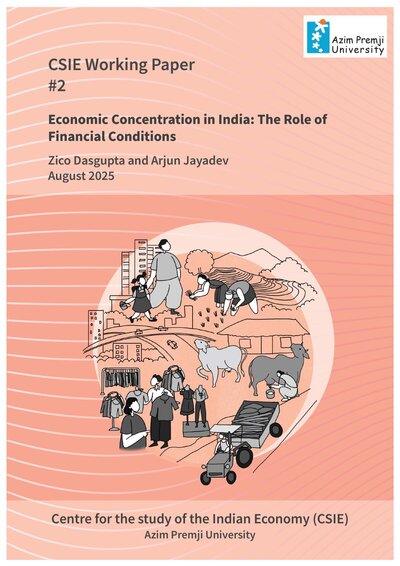
Economic concentration in India: The role of financial conditions
in Azim Premji University

- Published
- Authors
Abstract
This paper examines recent trends in corporate concentration in India’s non-financial sector, with a focus on developments since 2015. Using firm-level data from the CMIE Prowess database we document changes in asset and income distribution across firms. We find that while the overall decline in the public sector’s share of assets and income contributed to a reduction in measured concentration in earlier years, this was accompanied by a steady increase in the share held by large private business groups. By 2023 – 24, the top five business groups — Reliance, Tata, Adani, Aditya Birla, and Bharti — accounted for approximately 24(%) of total assets and 16(%) of total income in the non-financial corporate sector.
Authors:
Links
Cross state comparison of excess deaths during the covid pandemic in India: Some measurement and methodological considerations
in Azim Premji University

- Published
- Authors
Abstract
This paper assesses excess mortality in India during the COVID-19 pandemic, focusing on the year 2021 when the country experienced a substantial surge in deaths. Drawing on newly released official data from the Civil Registration System (CRS) and the Sample Registration System (SRS), and supplemented with estimates based on the National Family Health Survey (NFHS‑5), we construct a range of mortality estimates using multiple baseline comparisons. Excess deaths are calculated in absolute terms, per 1,000 population, and using age-standardised death rates to facilitate cross-state and international comparisons. Particular attention is paid to persistent challenges in India’s mortality data landscape, including regional disparities in death registration completeness, limitations in cause-of-death certification, and inconsistencies between administrative and survey-based sources. The analysis includes alternative projections that adjust for estimated registration completeness, underscoring the sensitivity of mortality estimates to underlying data assumptions. By applying standard demographic techniques such as age standardisation, we attempt to mitigate the effects of India’s heterogeneous age structure and registration coverage. The findings suggest a substantial mortality impact from the pandemic, exceeding officially reported figures, and raise broader questions about the capacity of statistical systems to support real-time health surveillance. We identify correlates in terms of state capacity.These results have implications for public health preparedness, intergovernmental coordination, and the long-term strengthening of civil registration and vital statistics systems in India.
Authors:
B S Bhargav, Dipa Sinha and Arjun Jayadev
Links
And the search goes on: Job search and job-finding rates in urban India
in Azim Premji University
- Published
- Authors
Abstract
The cross-sectional nature of Indian employment surveys limits a true understanding of labour market dynamics. Using innovations in official national-level labour surveys that track urban individuals across four quarters, we study transitions from unemployment to employment — defined as the job-finding rate — to understand whether those seeking employment are able to find suitable work in urban India. Our analysis reveals significant weaknesses in the urban Indian economy over the period 2017 to 2023. On an average, only 17 per cent of unemployed individuals in any quarter find a job in the next quarter. Job-finding rates are the lowest for women, the young and the highly educated. Hazard-rate analyses reveals that the same cohorts take the longest time to find jobs, with a majority remaining unemployed even after four quarters of job search. We demonstrate the impact of the pandemic on urban labour markets in two ways. Not only are job-finding rates significantly lower in the post-lockdown period relative to pre-lockdown, there has also been a shift in the nature of jobs created, with casual work rising and regular wage and self-employment falling post-lockdown. Our analysis has important policy implications for understanding labour market dynamics and for the design of urban employment schemes.
Authors:
Rahul Menon & Paaritosh Nath
Links