
Publications & Resources
Our faculty, students and researchers work together everyday to contribute to a better world by grappling with urgent problems we are facing in India. We conduct rigorous work to produce high quality learning resources and publications to contribute to public discourse and social change. Here, we feature a sample from our work for everyone to access. You can explore featured resources, policies, and the latest publications from the University.
To explore all the work of our University, please visit our publications repository.
List of Publications & Resources

- Published
- Authors
Abstract
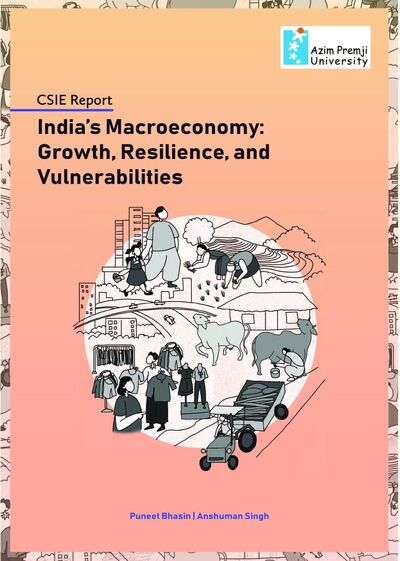
The Indian economy has been growing at a robust rate by most conventional metrics and appears resilient as of now in the face of several geo-economic headwinds. Real GDP growth continues to hover around 7 – 8 percent according to official estimates, inflationary pressures are subdued, corporate balance sheets appear healthy, and the banking system is largely clear of non-performing assets. The rise of digital payments as well as Systematic Investment Plans (SIPs) has brought millions of households into formal channels of modern finance. The services trade surplus is growing, and strong remittance flows continue to anchor the external account. Overall, having weathered demonetisation, the twin balance sheet crisis, a global pandemic, and waves of geopolitical disruptions, the Indian economy is certainly not stagnant and appears reasonably stable.
Stability, to be sure, is not the same as invulnerability. Aggregate growth can hide vulnerabilities that become clear when we look more closely at the economy. This report does exactly that. Drawing on financial data on trade, capital flows, banking and credit, public finance, sectoral flow of funds, and capital markets, it ‘follows the money’ to develop nine financial insights. Each highlights a pressure point that headline growth numbers can miss. Taken together, they point to three broad structural vulnerabilities that need attention, despite an otherwise reasonably healthy macroeconomic picture.
First, there is a structural demand shortfall, such that no single engine of aggregate demand is firing strongly enough. This weakness in demand is increasingly a constraint on private investment and thus calls for an active policy response. Second, financialisation is likely advancing faster than the productive base of the economy, bringing millions of households and institutions into financial markets but also making household wealth and macroeconomic stability more exposed to financial market conditions. Effective regulation of “high finance” is therefore critical. Third, external vulnerabilities are becoming more important in a changing global order. India’s trade remains highly concentrated in its relationships with the US and China, while its persistent goods trade deficit reflects, in part, the weakness of its manufacturing base. A geopolitically astute trade policy, combined with a robust industrial policy to make Indian goods — not just services — globally competitive, is increasingly important for both economic and national security.
Importantly, none of these vulnerabilities implies an impending crisis or “moment of doom.” But together they suggest that resilience should not be taken for granted, and that prompt policy action is needed to strengthen the foundations of India’s growth before vulnerabilities become crises.
Authors: Puneet Bhasin, Anshuman Singh
Links
State of Working India 2026 : Youth in the Labour Market | Pathways from Learning to Earning
in Azim Premji University

- Published
- Authors
Abstract
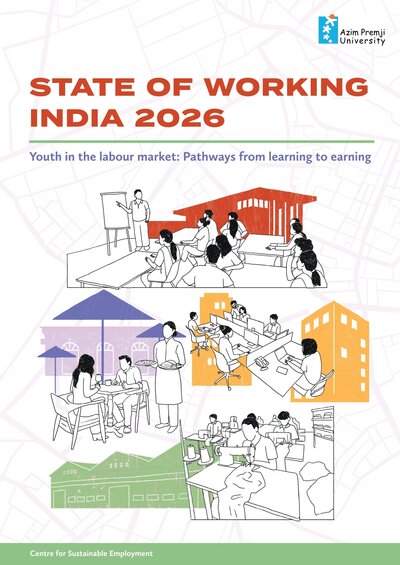
India is nearing the peak of its demographic dividend, with the share of the working-age population expected to begin declining after 2030. On the one hand, higher education in the country has become increasingly democratised with a rapid increase in the number of institutions. Graduate salaried earnings exceed non-graduates both at the time of entry into employment and over their lifetime. On the other hand, financial barriers continue to restrict access, particularly in professional fields such as engineering and medicine. The transition from education to employment remains a major challenge. The rise in the number of graduates has not been matched by commensurate growth in graduate employment. This year’s State of Working India report traces the arc of a young worker’s transition from school or college into employment, and how this has changed in the last forty years.
Report Files
Full Report — download PDF file
Executive Summary (PDF)
Tables (spreadsheet)
Results Appendix (PDF)
All Figures (Figures 1.1−4.7, Figures 4.8−7.10 )
Figures Data(spreadsheet)
Press Release (English | Hindi | Kannada)
Media Coverage (spreadsheet)
Links