
Publications & Resources
Our faculty, students and researchers work together everyday to contribute to a better world by grappling with urgent problems we are facing in India. We conduct rigorous work to produce high quality learning resources and publications to contribute to public discourse and social change. Here, we feature a sample from our work for everyone to access. You can explore featured resources, policies, and the latest publications from the University.
To explore all the work of our University, please visit our publications repository.
List of Publications & Resources
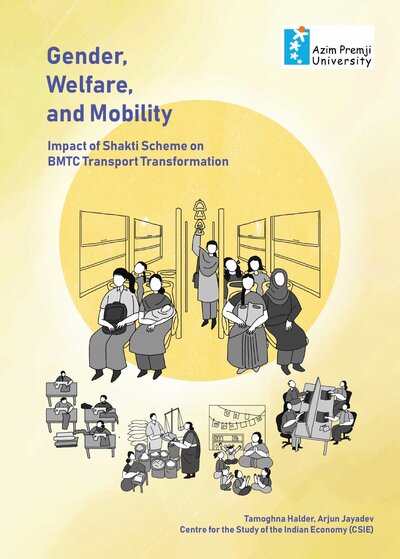
Gender, Welfare, and Mobility: Impact of Shakti Scheme on BMTC Transport Transformation
in Azim Premji University

- Published
- Authors
Abstract
The Shakti scheme, launched by the Government of Karnataka in June 2023, represents one of the most ambitious efforts in India to reimagine welfare by providing free public transport for women. Unlike welfare programmes based on targeted cash transfers, this scheme redefines inclusion through the provision of a universal, non-cash public service mobility. This report is an assessment of the evolution of the scheme with specific regard to the BMTC’s experience. In the period studied– January 2023 to March 2025, covering both pre- and post-implementation phases – the scheme generated a significant surge in bus usage across the state. With more than 2.89 crore trips recorded, a striking transformation in mobility patterns was observed. Importantly, women riders quickly outnumbered men on many of the busiest routes– especially in the Central Business District, reflecting a major shift in access to and usage of public transport. The ridership gains were particularly sharp in the first six months following the scheme’s launch and have since stabilised, indicating a sustained and regular usage pattern among women. The report is divided into three sections. In the first, the researchers discuss state-level free travel schemes. They address certain questions about Karnataka’s experience within wider debates about universalism versus targeting in social policy. In the second, they discuss the report, its methods and findings. In the final section, they discuss some potential paths forward.

- Published
- Authors
Abstract
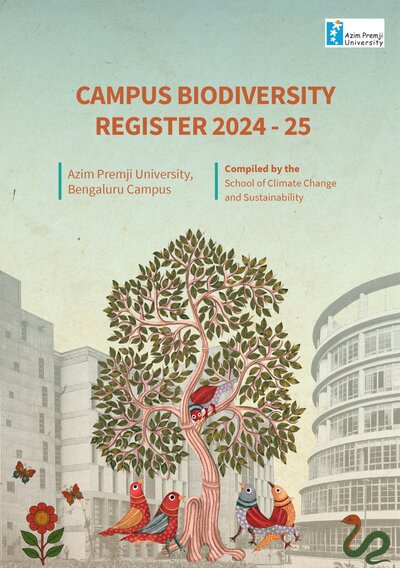
More than just an academic space, the Azim Premji University campus in Bengaluru is fast becoming a thriving ecosystem of its own. Located in Sarjapura, the campus is more than classrooms and labs — it is a habitat shared with birds, reptiles, insects, small mammals, and a growing canopy of trees and plants. This report is a first step in documenting the biodiversity of our campus. From trees and shrubs to spiders and snakes, students of the BSc in Environmental Science and Sustainability, teachers, and other members have come together to observe and record the life that surrounds us. Thus, this is a collective effort that reflects both scientific curiosity and deep care for our environment. As the campus grows, we aim not only to track carbon sequestration and environmental change — but also to nurture a sense of stewardship and belonging in everyone who calls this campus home.
Links
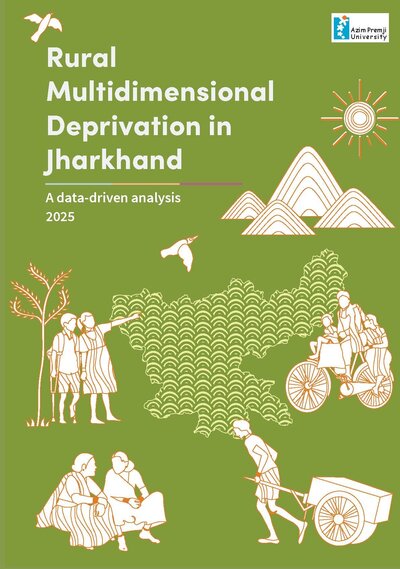
Rural Multidimensional Deprivation in Jharkhand: A Data-Driven Analysis 2025
in Azim Premji University

- Published
- Authors
- School of Development
Abstract
This report constructs a Rural Multidimensional Deprivation Index (RDI) for measuring deprivation in Jharkhand. An important feature of the index is that it is constructed using indicators on provisioning of basic infrastructural amenities at the village level. This is different from the usual poverty indices that are composed of financial indicators such as income or consumption; or indicators measuring development outcomes such as educational or nutritional levels. Observing the provisioning of basic infrastructural amenities, this report makes focused policy suggestions that can be easily implemented by functionaries working on the ground. The data for the index is sourced from the Mission Antyodaya Survey, which was carried out in 2019 at the village level across the country. The survey collects data related to provisioning and outcome of basic amenities in villages, along with demographic and socioeconomic variables. Because this is a periodic survey, it enables us to track the developmental progress of each village, district, state and the country over time. In total, there are about 182 variables that were captured in the 2019 round. The survey covers 31,175 out of 32,620 villages in Jharkhand, which is 95.6 percent of the total number of villages in the state; and 6,48,358 out of 6,67,933 villages in India, or 97.1 percent of the villages in the country.
Editors
Prasanna S, Sandhya Krishnan, Sanket Gharat, Puja Guha, Amalendu Jyotishi, Neeraj Hatekar
Links