
Publications & Resources
Our faculty, students and researchers work together everyday to contribute to a better world by grappling with urgent problems we are facing in India. We conduct rigorous work to produce high quality learning resources and publications to contribute to public discourse and social change. Here, we feature a sample from our work for everyone to access. You can explore featured resources, policies, and the latest publications from the University.
To explore all the work of our University, please visit our publications repository.
List of Publications & Resources

- Published
- Authors
Abstract
To contribute to the critical matter of India creating just and sustainable employment, the University has set up the Centre for Sustainable Employment (CSE), which conducts and supports research in areas of work, labour, and employment. The University is attempting to provide empirically grounded, analytical reflections on the state of work and workers in India, as well as to evaluate and propose policies that aim to create sustainable jobs. To this end the University also gives grants to create new knowledge in the above areas. It also hosts a working paper series to which contributions are invited from researchers, policy-makers, civil society actors, and journalists. The University’s CSE website is an important part of this agenda. In addition to research papers and policy briefs, it hosts government reports, as well as data and statistics on the Indian labour market. This also includes executive summary of the report.
State of Working India 2019 consists of labour market trends between 2016 and 2018, and four policy papers around the theme of employment generation.
Release event: Presentation and panel discussion
State of Working India 2019 Release Event Part One — YouTube
State of Working India 2019 Release Event Part Two — YouTube
Links
- Published
- Authors
Abstract
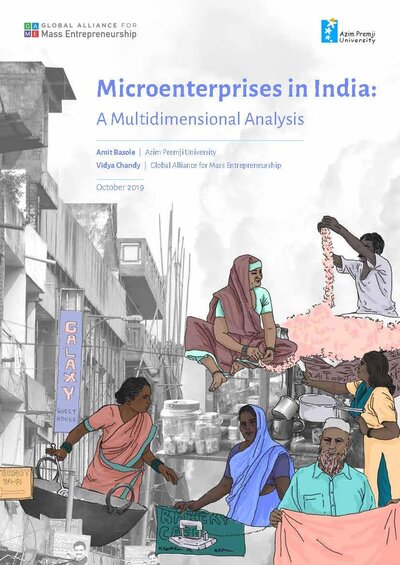
Microenterprises have been the engines of job growth in the majority of dynamic economies. India is home to thousands of microenterprise clusters as well as millions of distributed entrepreneurs who can become job creators. Fostering of such mass-entrepreneurship is key to addressing India’s employment challenge. Case studies of clusters in general, and of women entrepreneurs in particular, show that if key factors such as collective action, infrastructure, credit, and market linkages are in place, returns to entrepreneurship are vastly improved. Inspirational stories are also emerging in the use of fourth industrial revolution technologies to improve access to markets and enter global value chains in a way that awards greater agency to women entrepreneurs.
Links
Report
- Published
- Authors
Abstract
The Karnataka Crime Victimisation Survey report is based on the findings of a crime victimisation survey undertaken by Azim Premji University with the assistance of independent field investigators in 2017. The main objective of the survey was to understand the scope and nature of crime in the state and to analyse the extent to which the National Crime Records Bureau records capture the rate of crime in Karnataka.

- Published
- Authors
Abstract
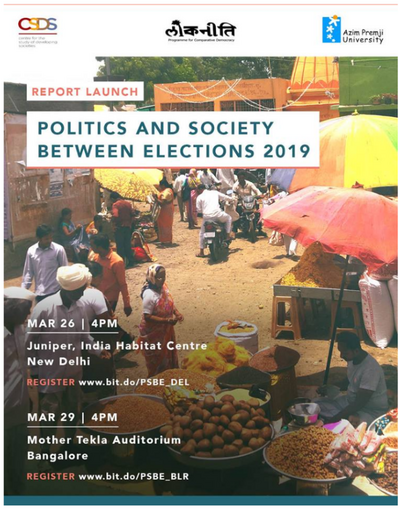
The problems of India’s development and governance are routinely linked to the logic of India’s electoral democracy. As a result, a great deal is known about elections, but paradoxically our knowledge of politics and society between elections is relatively underdeveloped. As much as anything else, development and governance outcomes are shaped by how the government functions between elections; including how it relates to citizens on a regular basis, how it provides routine public services to them, and how public order is maintained. Further, governance processes are nested in the social and political relationships between citizens and government functionaries.
Links