
Publications & Resources
Our faculty, students and researchers work together everyday to contribute to a better world by grappling with urgent problems we are facing in India. We conduct rigorous work to produce high quality learning resources and publications to contribute to public discourse and social change. Here, we feature a sample from our work for everyone to access. You can explore featured resources, policies, and the latest publications from the University.
To explore all the work of our University, please visit our publications repository.
List of Publications & Resources

- Published
- Authors
Abstract
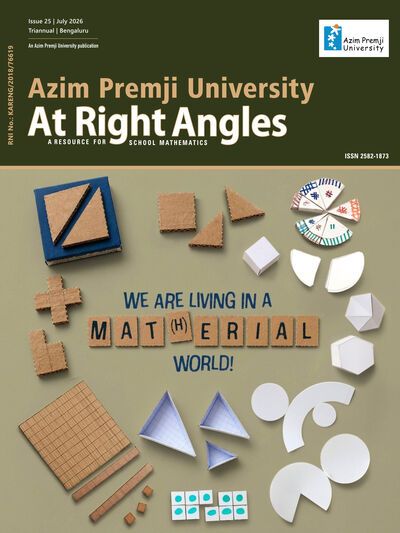
The July 2026 issue talks of the joys of Living in a Mat(h)erial World – there is mathematics and material to teach it all around us. But the process of learning has to be facilitated skilfully, a delicate dance of exploration choreographed by the teacher who understands both the strengths and the needs of the student.


- Published
- Authors
- Climate Change and Sustainability
- School of Climate Change and Sustainability
Abstract
In May 2026, a team of glaciologists went on an expedition to the trekker’s paradise of Satopanth glacier in the upper Alaknanda basin of the Himalaya. The trek offered a harsh reality check. They encountered frequent rockfalls from the steep slopes of the Neelkanth mountain in the Garhwal Himalaya. They also witnessed retreating ice, expanding infrastructure near the pilgrimage centre of Badrinath and plastic waste-littered mountain glacial lakes. All of this pointed to a Himalayan landscape altered by pressures beyond rapid glacial melts.
Authors: Remya S N, Sunil Singh Shah
Links
Hybrid Disciplinary Spaces: Navigating Writing in a Science Education Classroom
in Contemporary Education Dialogue
Article
- Published
- Authors
Abstract
Science education is an interdisciplinary field of enquiry with conceptual frameworks drawing from the foundational disciplines of education, besides the multiple sub-disciplines of science. An interdisciplinary understanding has been critical to postgraduate courses in science education. However, students continue to have a conventional understanding of the nature and practices of science, based on predominant experiences at school and undergraduate education. This article analyses two assignments which draw upon philosophical and sociological perspectives in science. It discusses the development of hybrid spaces for students in understanding and navigating the disciplines and their interests. Conceptual and rhetorical elements, particularly emphasising students’ extension of inferences and projection of personae, are illustrated as elements of the forward and backward search strategies. Such assignments are essential to develop a richer understanding of the nature of science and its complex interpretation compared to typical deifications in textbooks and pedagogic approaches. They also support students with diverse interests and backgrounds to navigate different disciplines and unique interests through the development of ‘hybrid spaces’. Such spaces, at the boundaries of disciplines, writing conventions and students’ interests develop and reshape conventional understanding.
Links
Policy Evaluation in the Absence of Survey Data: Customised Border Designs With Satellite Data
in Journal of Agricultural Economics
Article
- Published
- Authors
Abstract
Developing country governments often launch new agricultural programmes without collecting pre-implementation survey data, making it difficult to evaluate the effects of such programmes. Leveraging the flexibility of granular pixel-level satellite panel data and a well-developed quasi-experimental policy evaluation design, we study a programme where pre-implementation data is unavailable. We estimate the effect of cash transfers on agricultural productivity in Telangana, India. Treatment and control regions are within 10 km on either side of the state border. They are identical in all respects except for the difference in exposure to policy treatment. Agricultural productivity increased in the major monsoon cropping season due to the cash transfer programme. The findings also reveal that cash transfers helped reduce productivity gaps between irrigated and rainfed agricultural areas. Our results are robust to two different sources of satellite data, three alternative indicators of productivity, two rounds of full-scale resampling, 100 rounds of small-scale resampling and three alternative border designs. Placebo regressions of two previous years also confirm our results. This approach to policy evaluation is applicable anywhere satellite data are available in the world.
Authors: Muddasir Ahmad Akhoon, Abhishek Shaw, Vidya Vemireddy
Links
Agrarian Change and Accumulation in Central India: Revisiting the Agrarian Question of Capital
in Journal of Agrarian Change
Article
- Published
- Authors
Abstract
In this paper, the researchers revisit the relevance of the agrarian question of capital and provide evidence of the dynamism in agriculture based on an empirical enquiry. They study the possibilities, channels and patterns of agrarian accumulation and its spillover on the nonagrarian accumulation dynamics in an agriculturally advanced region lying in central India. Based on this empirical study, they posit that the agrarian question of capital remains important at a regional scale in India. By bringing the focus back on the question of capital, the paper maps the contemporary agrarian change processes as being linked to the process of generation of agrarian surplus and contributes to the debate on the relevance of the agrarian question of capital in the Global South.
Authors: Sunit Arora, Deepak K Mishra
Links
Article
- Published
- Authors
Abstract
Biological invasions pose substantial economic threats globally, yet detailed cost assessments for many Global South nations, especially in Africa, remain scarce. This study presents the first comprehensive breakdown of the potential economic costs of biological invasions in Morocco. The researchers identified 343 invasive alien species, comprising approximately 1.11 percent of the country’s biodiversity. Using the InvaCost database, they retrieved cost estimates for 137 species with available records. They calculated the mean annual cost per species, adjusted these values both socio-economically (using World Bank Purchasing Power Parity) and climatically (via Köppen climatic regions), and extrapolated them based on species prevalence in Morocco. This yielded an estimated annual economic impact ranging from USD 1.14 billion (conservative adjusted value) to USD 5.13 billion (maximum scenario). Across all estimations, damage costs consistently exceeded management costs by one or two orders of magnitude. Despite challenges in extrapolating cost data from other regions, this study underscores the urgent need for more research and for targeted management and policy interventions to minimise the spread of invasive species and reduce their economic toll. Proactive measures in Morocco, coupled with international collaboration, will be critical to mitigating this socio-ecological crisis and ensuring long-term sustainability.
Authors: Jazila El Jamaai, Ahmed Taheri, Liliana Ballesteros-Mejia, Danish A. Ahmed, Alok Bang, Christophe Diagne, Franck Courchamp and Elena Angulo
Links
Introduction to the Special Issue on Managing and Understanding Synanthropic Primates
in Springer Nature
Article
- Published
- Authors
Abstract
This Special Issue arises from the 2023 International Primatological Society symposium “Abundant Primate Populations: Challenges & Strategies for Coexistence.” The motivation for organising the symposium was to share information and stimulate discussion on how primatologists defined and understood “overabundance” in primate populations, the factors contributing to it, and methods for accurately estimating and modeling populations. This symposium contributed to the growing body of work showing that human-primate coexistence is a global challenge and perceived as problematic by some people who live alongside primates. In this Special Issue, the researchers explore key aspects of synanthropy, including cases where communities view primates as kin and actively engage with them, case studies of sites where a long history of coexistence has recently increased in conflict, the physiological and behavioral changes primates experience from living in close association with people, and strategies designed to foster sustainable coexistence. In this Special Issue, the researchers examine four key topics associated with synanthropy: 1) The dynamics that emerge when humans and synanthropic primates share spaces; 2) Sites with a long history of human-primate coexistence that has recently become conflict; 3) Primate physiological and behavioural change as a result of living alongside humans; and 4) Strategies to promote coexistence.
Authors:
Pebsworth, P. A., Dore, K. M., Hansen, M., Anand, S., & Zinner, D.
Links