
Publications & Resources
Our faculty, students and researchers work together everyday to contribute to a better world by grappling with urgent problems we are facing in India. We conduct rigorous work to produce high quality learning resources and publications to contribute to public discourse and social change. Here, we feature a sample from our work for everyone to access. You can explore featured resources, policies, and the latest publications from the University.
To explore all the work of our University, please visit our publications repository.
List of Publications & Resources

- Published
- Authors
Abstract
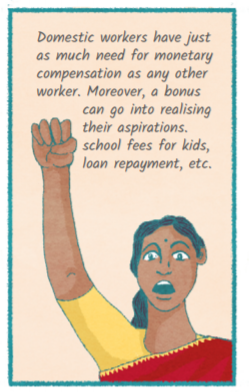
This booklet is based on a two-year study of domestic workers conducted by faculty at Azim Premji University.
Please share it with friends and family so that more people and employers are aware that domestic workers need to be accorded their due rights and be treated with dignity.
The focus of the research is the work and lives of ‘domestic workers’ (henceforth, DW) in Bangalore, especially their struggles to form collectives as part of their attempt to transform their subjectivities from ‘servant’ to ‘worker’, and improve their life and work situations. Domestic work is precarious work constituting a large part of India’s informal economy. It exists within a political economic context signaled by rising incomes of urban middle and upper classes and the existence of a steady supply of working-class women (from mostly stigmatised castes but across all religions) ready for domestic work. It is also enabled by a cultural-ideological context signaled by the preference to engage DWs as a normalised cultural marker for upward mobility. Our research demonstrates the struggles of DWs, the dilemmas and obstacles they negotiate for their empowerment. It focuses on the collective actions of DWs in their workplaces, their families and neighborhoods, and within unions and labour-NGOs engaged in organising DWs for “formalisation” of work, demands for a ‘decent’ wage and work conditions, and innovations in the form and content of their collective rights.
Pandemic, informality, and vulnerability- Impact of COVID-19 on livelihoods in India
in Azim Premji University

- Published
- Authors
Abstract
We analyze findings from a large-scale survey of around 5000 respondents across 12 states of India to study the impact of COVID-19 pandemic containment measures (lockdown) on employment, livelihoods, food security and access to relief measures. We find a massive increase in unemployment, an equally dramatic fall in earnings among informal workers, large increases in food insecurity, depletion of savings and patchy coverage of relief measures. Two-thirds of our respondents lost work. The few informal workers who were still employed during the lockdown experienced more than a fifty percent drop in their earnings. Even among regular wage workers, half received either no salary or reduced salary during the lockdown. Almost eighty percent of surveyed households experienced a reduction in their food intake and a similar percentage of urban households did not have enough money to pay next month’s rent. We also use a set of logistic regressions to identify how employment loss and food intake varies with individual and household level characteristics. We find that migrants and urban Muslims are significantly worse off with respect to employment and food security. Among employment categories, self-employed workers were more food secure. The Public Distribution System (PDS) system was seen to have the widest reach among social security measures. However, even under PDS, 16 percent of vulnerable urban households did not have access to government rations. Further, half of the respondents reported not receiving any cash transfers (state or central). We conclude that much more is needed in the way of direct fiscal support that has been announced thus far by state and central governments in India.
Authors:
- Surbhi Kesar
- Rosa Abraham
- Rahul Lahoti
- Paaritosh Nath
- Amit Basole
Links