
Publications & Resources
Our faculty, students and researchers work together everyday to contribute to a better world by grappling with urgent problems we are facing in India. We conduct rigorous work to produce high quality learning resources and publications to contribute to public discourse and social change. Here, we feature a sample from our work for everyone to access. You can explore featured resources, policies, and the latest publications from the University.
To explore all the work of our University, please visit our publications repository.
List of Publications & Resources
The Evolving Discourse on Job Quality- From Normative Frameworks to Measurement Indicators- The Indian Example
in Azim Premji University

- Published
- Authors
Abstract
Indians are optimistic. According to the Pew Research Center’s 2017 Global Attitudes Survey, three out of four Indians believe that, “when children today in India grow up, they will be better off financially than their parents” (Pew Global Attitudes Survey, 2017). Families hinge their hopes on the ability of the next generation to work hard, earn a living, and be a source of financial support. For years now, the nation has done the same, pinning its economic ambitions to a demographic advantage, or youth bulge, that is set to continue only for the next two decades. Unless there are pathways to productive and high-quality employment, the nation’s youth will not be able to deliver on these expectations.
Authors:
- Sabina Dewan
- Divya Prakash
Links

- Published
- Authors
Abstract
Empirical research in economics and, to a lesser extent, in other social sciences is largely dependent upon government statistics. It is generally assumed that governments are committed to collecting and disseminating correct statistics. As a result, the mutually constitutive relationship between politics, economy, and statistics, and the possibility of systematic manipulation of statistics-driven by the structural features of this relationship, has received insufficient attention within economics. This paper examines the implications of the absence of shared preferences over the quality of statistics within a government. It explores the multiplicity of conflicting maps of the State of Nagaland issued by different tiers and wings of the government to underscore the lack of attention paid to a statistic as crucial as area. The paper situates the cartographic-statistical confusion in its political and economic contexts, and suggests that political-geographic arguments are being used to advance political-economic interests along contested borders. It argues that the confusion is not amenable to a technical resolution as it is linked to the dispute over Nagaland’s place within the Union of India and the border disputes between Nagaland and its neighbouring states.
Links
Social and Environmental Transformation in the Indian Peri-Urban Interface – Emerging Questions
in Azim Premji University
- Published
- Authors
Abstract
Urban spaces emerging as nodes and drivers of global capital are recognized as centres of economic growth; while the rest of the geography is consigned to the residual category commonly referred to as ‘rural’. Diversity and increasing numbers of urban centres do not seem to alter this dichotomous perception of urban-rural landscapes and this dichotomy extends to policies and institutions. Nevertheless, the diversity in expansion and extraction pattern of the urban core is reflected in the way it transforms and interacts with its peripheries, fostering types of interfaces that depict urban and rural characteristics and processes to various extents.
Links

- Published
- Authors
Abstract
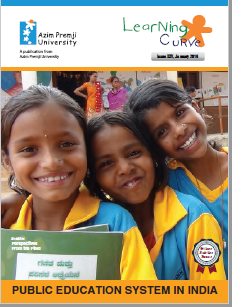
The theme of public education is one that affects every society across the globe. All over, there has been fundamental dissatisfaction with the systems, though the idea itself is intimately linked with a democratic society: one in which the individual is taught her place in the larger society. In India there has been disaffection with both public and private schooling, especially in urban centres, where private schooling flourishes at exorbitant cost, many times with inadequate space, facilities and less than adequate teaching. Every single person in the country is crucially involved in what form education takes, since it matters to us what the future of our society is going to be. It reveals too the tremendous hope that we all have that there are solutions, elusive perhaps, but they exist and it is for us, and others who follow, to find these solutions. This hope is all the more attenuated when we hear stories, as we do, of our public schools in the remotest of places, where teachers are doing a wonderful job, coming to school braving the weather, working under very challenging circumstances, their enthusiasm unabated.
Links