
BSc in Information Sciences
To understand digital technology and its potential for benefiting society
Details
We live in a world saturated with digital information and technology. The technology landscape is constantly changing and the power and potential of digital technology are only going to increase. On the one hand, there is a lot of scope for creatively using this potential to address challenges faced by citizens and society at large. On the other hand, indiscriminate use of digital technology is likely to have negative consequences. The world of the future needs young and sensitive minds capable of understanding and exploring information systems and technology and to harness them in public interest.
The information sciences programme at Azim Premji University provides rigorous exposure to the fundamentals of computing and digital technology along with opportunities for using technology in the public sphere. We encourage students to develop a holistic understanding of technology and its ramifications for society. Graduating students would not only be skilled at using technology tools, but also have a critical understanding of technology.
Given the rapid pace at which technology is evolving, we place emphasis on independent learning. We focus on fundamentals and prepare students to become proficient at using new technology tools on their own. At the same time, we encourage students to view themselves as public problem solvers and not just experts in particular technologies.
Why study with us?
We offer Interdisciplinary Openness
Our programmes encourage you to explore and follow your interests. We design our courses to ensure that you can specialise in a subject of your choice while learning various subjects across disciplines.
A Common Curriculum for all students
You will meet all your classmates at the beginning of your programme to build all the tools you need for the four years of study. This includes foundational courses, an understanding of India, interdisciplinary studies, and courses in creative expressions.
We provide Academic Assistance
Our consistent academic assistance through language support, peer tutoring, faculty mentorship etc., ensures that you meet the programme’s academic requirements.
We ensure Financial Support
We extend need-based financial assistance to students that includes tuition and accommodation expenses.
Programme Structure
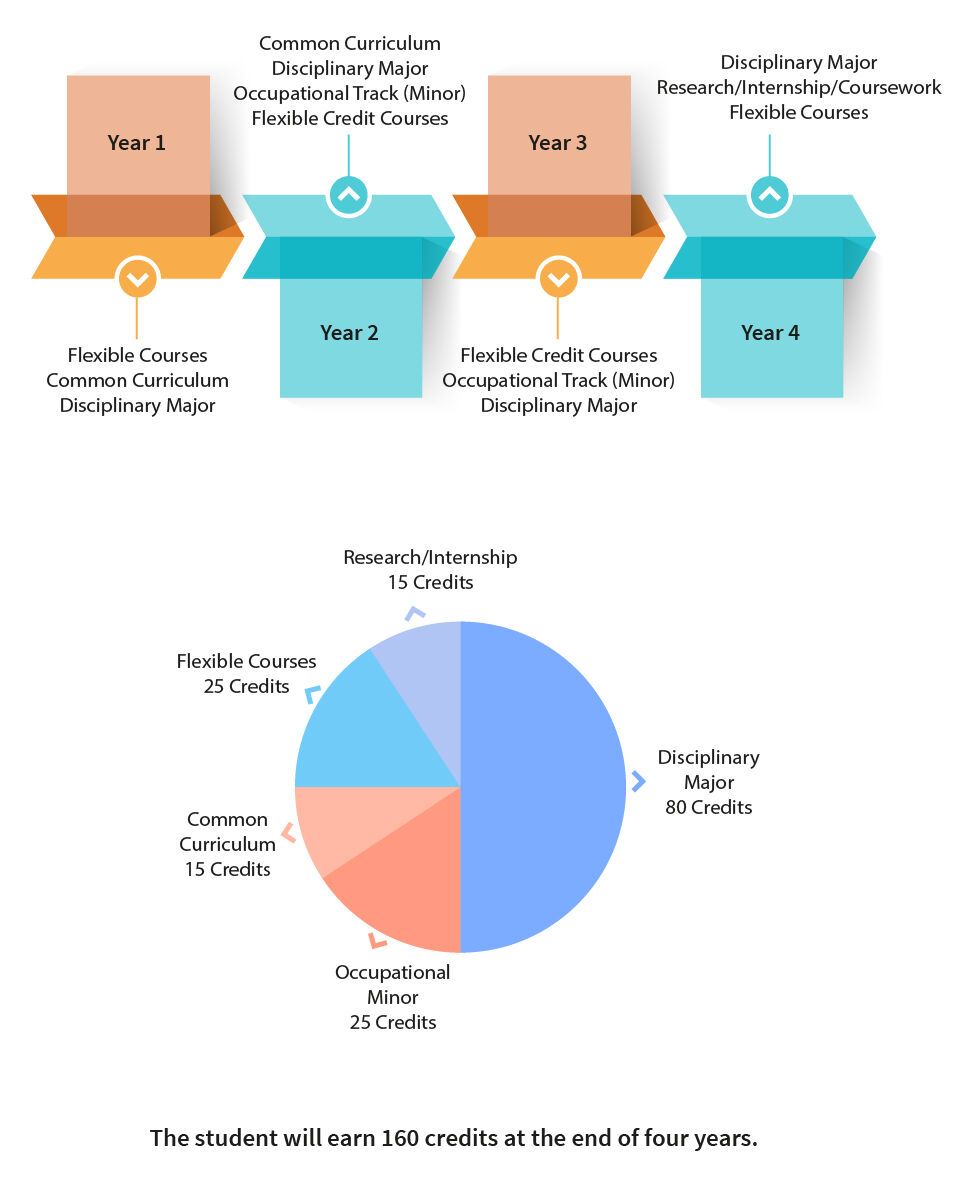
Course Structure
As with other disciplinary majors, students will be required to complete 12 courses to qualify for a degree. Of these, 10 will be core courses which will build foundations in mathematics and computer science and a critical understanding of technology. The core courses will also provide a rigorous exposure to programming and problem-solving skills. The remaining two courses will constitute a track that will enable students to gain more specialised skills. For the degree with honours, students will have the option of doing a project in their 7th semester under the guidance of a faculty member. These students will also take additional elective courses in their eighth semester.
The Common Curriculum will introduce students to the study of the themes and areas that emphasise and build critical and analytical abilities, and sensibilities for dialogue, reflection and cooperative learning. The Common Curriculum has four sub-components organised as below:
Academic Reading and Writing: Introduces students to domain specific reading and writing skills
Creative Expressions: Students are empowered to participate with meaningful social connection, fostering a community of active and responsible citizens
Public Reasoning/The World of Computing: The students will do one of the two courses.
- Public Reasoning: Introduces students to the practices of understanding as well arguing for claims in the public realm.
- The World of Computing: This enables students to explore the potential of computing devices and computational reasoning
Understanding India: India’s history, society and possible future.
The information sciences curriculum has 10 core courses. These are divided into four themes:
- Computer science and mathematical foundations (three courses): The craft of computing, Discrete structures, Mathematics for information science
- Critical perspectives on technology (two courses): Becoming a reflective information scientist, Algorithms in our lives (also part of the problem-solving theme)
- Programming and Computing Systems (four courses): Imperative programming, Computing internals and low-level programming, Data and storage structures, Software tools and practices
- Problem-solving (two courses): Introduction to operations research, Algorithms in our lives (also part of the critical perspectives theme)
Apart from the core courses, students will be required to take a track consisting of two courses. The tracks will allow students to engage with current technology in the context of addressing public challenges. By opting for a suitable track, students can develop specialised technology skills in an area of their interest.
The Craft of Computing
Disciplinary Major
Become a skilled user of computers through playful exploration
Becoming a Reflective Information Scientist
Disciplinary Major
Develop a broader and critical view of technology through discussion and introspection
Mathematics for Information Science
Disciplinary Major
Learn mathematics required for a wide range of computing applications
Discrete Structures
Disciplinary Major
Become familiar with formal reasoning in the context of computer science
Imperative Programming
Disciplinary Major
Learn fundamental programming constructs and techniques
Computing Internals and Low Level Programming
Disciplinary Major
Appreciate how your computer works and how to program it at the hardware level
Introduction to Operations Research
Disciplinary Major
Identify constraints and solve optimisation problems
Data and Storage Structures
Disciplinary Major
Learn object oriented programming and efficient ways of organising data in memory
Algorithms in our Lives
Disciplinary Major
Understand different approaches to problem solving and appreciate how algorithms impact our lives
Software tools and practices
Disciplinary Major
Become familiar with current practices in professional contexts
Students must be prepared for the world of work at the end of the programme should they choose to enter it. We aim to provide the required skills and competencies for this through a Minor featuring courses in an Occupational or Interdisciplinary theme. These sets of courses are aimed to provide both conceptual understanding and skills and tools that will allow students to contribute through work and further study.
Students can opt for a Minor in any one of the indicative areas listed below.
The selection of these indicative areas is based on the availability of courses and our evaluation of the student’s interests and academic needs. For each cohort, a final list of available courses will be announced at the end of their second semester.
Biodiversity Conservation
Biodiversity conservation, management, and habitat restoration requires a multi-pronged approach, and an interdisciplinary understanding is essential. This OT will acquaint students with the rich biodiversity of the Indian subcontinent and the associated threats to them, and provide the students with the lens to identify pertinent questions such as — what to conserve, why to conserve, when to conserve, and how to conserve. The field of conservation binds the need for species and ecosystem conservation with the requirements for human well-being, livelihood, and rights. Through this curriculum, the students will be aware of the interdisciplinary approach in this field and will…Climate Studies
These courses will help you develop the knowledge necessary to understand the earth’s climate systems. You will examine and analyse the role of human activity on the earth’s climate and its effects on the present and future climate scenarios, and identify the effects of climate change on biodiversity through the lens of historical changes in the Holocene. We hope you will apply systems thinking to examine the origins of the climate crisis and proposed solutions and grow comfortable with civic engagement and transfer of knowledge and resources for climate solutions at different levels.Data, Democracy and Development
The set of courses will orient you to think about data as an essential part of building empathy and democratic values. We ensure you have the requisite tools for data collection, analysis, presentation, and dissemination so that you can construct the right platforms and build technologies that embody democratic principles. These courses will foster a culture of investigation with data, keeping in mind questions of ethics and politics.Design for Communities
Design concerns itself with envisioning, planning and creating objects, spaces or interactive systems to address a need or a problem. It attempts to meet the needs of a variety of users with responses that are aligned with their specific contexts. It aims to understand situations and create holistic, appropriate solutions. While design is a large discipline with many domains, this Occupational Track will look at the design of products, the practical use of technology in various enterprises and the design of spaces for accessibility and interaction. It includes the process of ideating, developing and refining products that meet specific market…Disability, Accessibility and Inclusion
The Occupational Track (Minor) prepares students to understand disability as a social, political, and rights-based issue while building the practical skills needed to create more inclusive environments. Rooted in contemporary disability studies, the programme explores the shift from a medical model of disability to a social model that focuses on removing barriers and ensuring dignity, participation, and equal opportunity.Students engage with the realities of disability in India, where access is shaped by intersections of caste, class, gender, poverty, and geography. The track introduces learners to disability rights frameworks, including the United Nations Convention on the Rights of Persons with Disabilities…Education
The Occupational Track (OT) in Education at Azim Premji University leverages the liberal arts tradition by fostering a deep understanding of human society and its relationship with education. This program delves into psychology, sociology, politics, and philosophy, revealing how these disciplines influence how individuals and societies approach learning. Additionally, the arts, humanities, and diverse philosophical perspectives enrich our understanding of educational thought and practice.The OT in Education recognizes the importance of analysing educational processes and systems at various levels, from individual student experiences to national and international trends. By examining different perspectives – personal, communal, organisational, national, and international –…Financial Management for the Social Sector
This Occupational Track (Minor) is designed to prepare students to address the financial and governance needs of social sector organisations. Rooted in the liberal arts tradition, it combines conceptual understanding with practical skills to help students engage with the financial realities of nonprofits, community institutions, cooperatives, foundations, and mission-driven enterprises.Students learn the fundamentals of accounting, budgeting, financial planning, internal controls, and statutory compliance while also examining how finance can promote equity, accountability, and sustainability. The programme pays special attention to the role of financial systems in communities, including access to savings, credit, insurance, pensions, and other services for low-income households.Through…Heritage Studies
This Occupational Track (Minor) prepares students to engage with heritage as a dynamic field of study and practice. Moving beyond monuments and museums, the programme recognises heritage as something continuously created, interpreted, documented, and sustained through communities, institutions, and public engagement.Students explore diverse forms of heritage in India and beyond, including cultural traditions, neighbourhood histories, archives, scientific collections, technological knowledge, landscapes, and digital records. The track combines perspectives from the humanities, social sciences, and sciences to help students understand how heritage is shaped by history, ethics, policy, and everyday practice.Through a strongly applied learning model, students develop practical skills in…Media and Journalism
These courses will introduce you to the critical and conceptual tools involved in media texts. This course is based on research and practice, and you will study how media texts are created and their social, historical and political contexts. This course is for students who wish to prepare for careers in journalism, communications, and social work.Music Education
The undergraduate Occupational Track programme in Music Education is designed in collaboration with SaPa, the Subramaniam Academy of Performing Arts. SaPa is on a mission to make quality music education accessible to all. A large part of this involves creating enough music teachers to build the ecosystem for music education, and creating certifications and knowledge sets to make music teachers employable, both in schools and at music institutions.The Music Education OT aligns with this objective and aims to offer students an understanding of music itself, and how music may be taught in different environments. This will help students be employable,…Public Health
This Occupational Track (Minor) combines critical perspectives on health with practical skills that prepare students to contribute meaningfully to public health in diverse work settings. Rooted in the liberal arts tradition, the programme helps students understand health not only as a biological condition, but as a social phenomenon shaped by economic, political, environmental, and cultural factors.Students explore key public health challenges in India and globally, while examining how governments, communities, and non-state actors respond to them. The track introduces foundational analytical skills in epidemiology to understand disease burden, patterns of illness, and population health outcomes. It also develops the ability…Sports and Fitness
We believe that a regimen of physical activity can have a powerful effect on an individual’s physical, mental, and emotional well-being. Sport can be used as an effective tool to help an individual learn crucial life skills and also to build an empathetic, equitable community. In these set of courses, we want you to have a powerful experience of sport not just as a physical activity but as a way to build yourself and your social surroundings. We also want to teach you ways in which you can create these transformational experiences for others.Technology for Social Good
The Technology for Social Good occupational track has been designed based on the Azim Premji Foundation’s extensive experience in working with social sector organizations. Many of these organizations are addressing long-standing social problems through utmost dedication and a strong desire to improve the society we live in. There is a lot of scope for facilitating the work of these organizations through the use of digital technology. While accomplishing social change is a slow process requiring long-term engagement, digital technology can assist these organizations in making their operations more effective and by permitting better utilization of scarce resources. At present, these…

Students can craft their own educational experience by selecting courses in the following ways:
- Students will have the option to take additional courses in their Disciplinary Major.
- Interdisciplinary Minor that will enable them for their further higher studies or career pathways.
These courses could also be selected to enhance and broaden their
- Language skills and Quantitative reasoning capacities/programming skills.
- Understanding of themes outside their Major subject.
Classroom Practices
All our courses are taught with a student-centric approach. Students will experience a range of pedagogical approaches in their curriculum. These include lectures and discussions, debates, lab activities, use of case studies and group work. We identify the pedagogy and assessment scheme that would be most suitable for each course. Most courses are designed to have a tight integration between presentation of concepts and hands-on lab activities.
We recognise the structural disadvantages that exist in higher education in India. In this regard, our faculty is committed to creating an inclusive environment and ensuring that a diverse body of students can flourish in the programme. To the extent possible, courses will employ inclusive pedagogic techniques. The information sciences programme will also have a robust and sustainable system for academic support.
The curriculum of the B.Sc. programme in Information Sciences will inculcate the following capacities and dispositions:
Strong Computing-Science Foundations
The field of computing is dynamic with a high tempo of change. Within four decades, we have seen four major revolutions: the internet, digital, social-networking, and emergent artificial intelligence (AI).
Students need a well-founded base in the science and mathematics of computing that can outlive and support the high tempo of technology and cultural shifts that the world is going through. Only a deep grounding in scientific foundations can provide a substrate for a stable mindset amidst these movements.
Towards this, we have identified several “ways of thinking” and “ways of doing” that will be essential for students to acquire. This includes becoming adept with programming, having the ability to reason formally about problems, and being comfortable with abstractions and thinking about digital systems spanning multiple levels (from hardware components to high-level code).
Technical competence
Students graduating from the programme should be comfortable with identifying, adopting and customising appropriate technological tools. In other words, the programme will bring about expertise in the use of computational techniques in general and also current technology skills — some through teaching, some through labs, and a lot through an ambient culture that supports self-learning.
Sensitivity to social issues
Students need to be aware of the challenges that the country needs to address and develop an understanding of how digital technology can assist in mitigating these challenges. The common curriculum in the first year prompts students to engage with social issues in India in a multi-faceted way. The perspectives built through the common curriculum will provide the foundation for students to look at technology in the context of addressing public issues. Sensitivity to social issues coupled with a dovetailing of computational attitude in a pervasive way through the entire curriculum will bring a precision and an algorithmic approach towards formulating and proposing solutions to these challenges.
Flexible and constructive attitude
Students will be encouraged to identify creative solutions to problems and to come up with working implementations of these solutions (thinking “outside the box”). When it comes to adopting technology, we would like our students to tinker with and explore the “internals” (thinking “inside the box”).
Students should be open to evaluating and learning new technological tools while having the keenness to understand how they work and the persistence to engage with these tools even in the face of challenges. At the same time, we would like to inculcate some pragmatism and make students recognise that implementing any technological solution requires grappling with tradeoffs.
Professional work ethic
We want our students to work with integrity and become accustomed to professional norms. This includes adopting professional standards for documentation and version control, becoming used to working in teams and navigating the challenges that come with shared ownership of responsibilities, and being cognisant of licensing terms and adhering to them.
Critical outlook towards technology
Students should be aware of the limitations of technological tools and have the ability to question “established” wisdom and resist polemical arguments (which are quite common in the technology space). An appreciation of the limits and limitations of machines should put in perspective the value of human thought and intelligence about what machines can deliver.
Reflective practice and self-directed learning
The ability to learn new tools is a professional necessity in the technology space. The curriculum will nudge students to become more aware of how they learn and will require them to learn new tools with limited guidance from faculty.
We also want students to view technological solutions as human creations (even if they are constructed using software tools) and want them to be aware of their design aesthetic and notions of elegance. In particular, we want students to gain a sensibility for when a “hack” or a “quick” solution is sufficient and when a more reasoned and elegant approach is warranted.
Effective communication
Students should be able to communicate technical ideas in various forms to both expert and lay audiences. Explaining how digital technologies work without resorting to jargon will not be treated as secondary to the ability to implement the technology.
Explore

Faculty
5 of 5 All Programme faculty →