
News
List of News
Exploring Science through commonly available materials
A good teaching-learning practice involves conducting interesting activities that bring scientific phenomena into the classroom and enable children to see science in action, writes H R Madhusudhan, in Learning Curve.
Three pitfalls that social sector workers need to guard against
Surrendering to money, power or praise can send people and organisations off their original goal, writes Anurag Behar, in Mint.
Magazines as learning tools
Vinatha Viswanathan and Ruchi Shevade, in Learning Curve, highlight how children’s magazines can play a role in the classroom learning process and how Chakmak has been used as supplementary reading material.
Mathematical Doodling using the“what-if-not” approach
Haneet Gandhi and Neha Varma, in At Right Angles (AtRiA), illustrate an approach through which students can be involved in making and solving many problems generated from the basic problem in the textbook.
Destructive state-making at the heart of violence
The state government in Manipur, in the wake of the current crisis, should not reduce the complexities of social relations among diverse ethnicities and fix them in temporary, unstable, and provisional ways, writes K C Adaina, in Deccan Herald.
Why India needs a museum for its fossils
We are losing invaluable palaeontological history because we have neither a legal framework nor the awareness to protect fossils, writes Nandita Jayaraj, in Frontline.
Lockdown, demonetisation to CAA, farm laws: How hasty policies have killed Indians
The costs of these measures have been high but their benefits are contested or unknown. Instead of accountability for deaths, there is authoritarian arrogance, write Anjor Bhaskar and Rajendran Narayanan, in Scroll.
Equipping school teachers for a menstruation-friendly world
Mukta Gundi, in The Times of India, highlights the need for knowledgeable and competent health educators who can engage with adolescents from diverse backgrounds in an empathetic way.
Asset thinking: The mindset for inclusion
A closer examination of the issue of compulsion on inclusion reveals a fundamental flaw in the way we approach inclusion and highlights the need to celebrate diversity before embracing inclusion, writes Jwairia Saleem, in Hindustan Times.
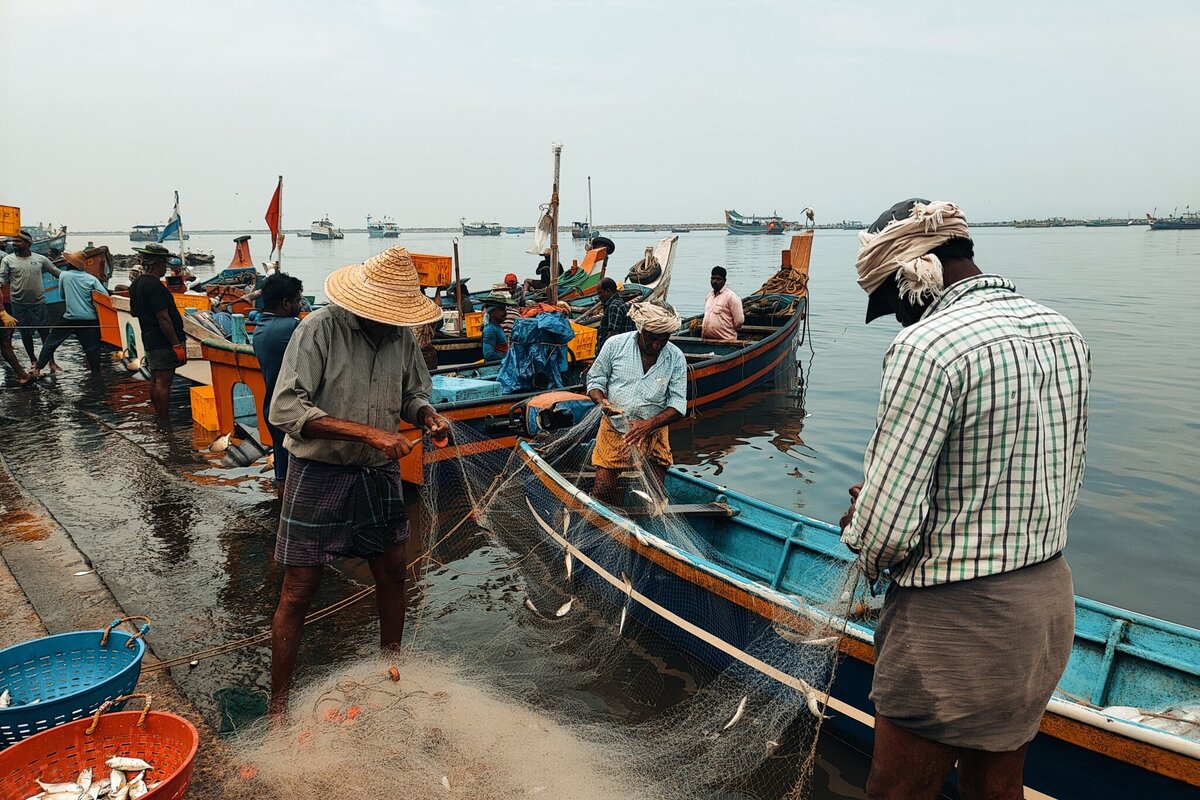

Sardine loads are falling in Vadakara
Growing unpredictability in the catch of oil sardines is impacting the lives of people who do daily-wage loading work in Kozhikode district, Kerala, writes Mufeena Nasrin M K, in People’s Archive of Rural India (PARI).
Environment first, dear new government
In a city (Bengaluru) that always seems to be reactively scrambling to deal with environmental challenges, it will be critical for the new government to take sustainability seriously, writes Harini Nagendra, in Deccan Herald.
Patient rights in Rajasthan’s new law are key to fundamental right to health care
Edward Premdas Pinto, in Citizen Matters, elaborates upon the broader implication of the Rajasthan Right to Health Care (RRTH) Act.
Chasing Soppu: A guide to wild edible plants in Bengaluru
Seema Mundoli, in Citizen Matters, writes about urban foraging of edible plants in Bengaluru.
BJP’s formula to counter anti-incumbency falls flat
The people have always decided on the assembly elections by considering state issues and evaluating the state leadership. And, the people once again stood by this model of politics, writes Narayana A, in The Times of India.
Congress victory in Karnataka polls indicates shift in voter preferences
Madhavan Narayanan, Narayana A, and Mohandas Pai, in Economic Times, highlight that the scale of the victory is notable because Karnataka has traditionally had a delicate balance of politics between communities and issues.
Keep up the spirit among those who work in India’s social sector
Anurag Behar, in Mint, writes about people in the social sector — about what they should be careful with in their lives. This is the first in a series on this matter.
Morning assembly as a learning experience
Manoj Kumar Tripathy and Shiv Kumar, in Learning Curve, explain how chetana satra (morning assembly) provides scope for children to learn individually and collectively, and share their learning and experiences.
Textbook controversies and the missing voice of the teacher
Although textbooks can change with every changing political regime, history cannot be wiped out. Teachers are thus one of the most important players here, writes Rupamanjari Hegde, in The Wire.
A day in an anganwadi centre
Yogesh G R, in Learning Curve, writes about the practice at the anganwadi in Sangareddy, which aligns with the National Education Policy (NEP) 2020 and emphasises providing opportunities for free and guided play to children.
Tragedy of the commons: In Karnataka, small-scale fishers are losing their foothold
Governance of the ocean in the Blue Economy regime could pose serious challenges for those who have traditionally depended on the ocean for livelihoods, writes Amalendu Jyotishi, in The News Minute.
Women foragers hold India’s ethnoecological data on natural remedies
Nature itself often provides remedies to many ailments. Seema Mundoli and Dhruthi Somesh, in Times Evoke, write about a book researching women seeking medicinal wild greens in a megacity (Bengaluru).
A right step towards health for all
The demand for repealing the Rajasthan Right to Health Care Act would be tantamount to thwarting patient rights, in what is the first attempt in India at protecting them, writes Edward Premdas Pinto, in Deccan Herald.

Delhi’s Kathputli Artists: Puppeteers in Limbo
The kathputli artists of Delhi have been struggling to regain momentum after they were moved out of their homes to a transit camp in 2017, writes Himanshu Pargai, in People’s Archive of Rural India (PARI).
The misconceptions of donors are hobbling civil society work
Donors’ misplaced notions hurt funding and hamper Civil Society Organisations (CSOs) that need firm commitments of support, writes Anurag Behar, in Mint.

Where are all the fireflies?
Sharda CSR, an ecologist and student, Azim Premji University, in Nature inFocus, ruminates about the bioluminescent insects and the reasons for their drastic population decline.
Maths from simple grids
Gowri Satya, Ashwin, Shravan, Shivkumar, in At Right Angles (AtRiA), present some interesting problems centred around the humble and modest grid.
A letter rides on the train of subjects
Chandrika Soni, in Learning Curve, demonstrates how learning becomes an immensely enjoyable experience when the boundaries of subjects are removed.
Inclusion, special needs and reflective teachers
Preservice teacher preparation should consider the multidimensional roles during teacher training as a preparation for inclusion, writes Anuradha Naidu, in Learning Curve.
Why is the Adani – Hindenburg matter a public interest issue?
Neeraj Grover, faculty member, Azim Premji University, at an event by Alternative Law Forum, highlights the role of the State in managing financial markets, which either exacerbates or reduces the wealth inequality in the country, writes Sarah Thanawala, in The Leaflet.
Life lessons on a Lambretta
It is not about speed but striking a balance, whether on a bike or in life, writes Sharoon Sunny, faculty member, Azim Premji University, in Deccan Herald.