
Publications & Resources
Our faculty, students and researchers work together everyday to contribute to a better world by grappling with urgent problems we are facing in India. We conduct rigorous work to produce high quality learning resources and publications to contribute to public discourse and social change. Here, we feature a sample from our work for everyone to access. You can explore featured resources, policies, and the latest publications from the University.
To explore all the work of our University, please visit our publications repository.
List of Publications & Resources

- Published
- Authors
Abstract
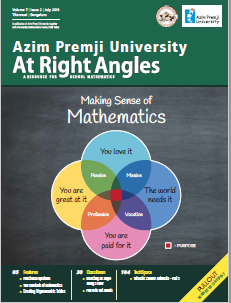
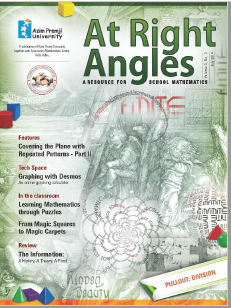
Volume 7 Issue 2: And it’s out! Most of you would have already received your copy of the July issue of At Right Angles, here’s the official announcement and the link with the welcome news that AtRiA is finally a whole school math resource! The shift all the way to Primary is marked with several new sub-sections in ClassRoom: from Sense-Making in Mathematics – the cover says it all- to TearOut- where all a busy teacher has to do is to tear out a ready made worksheet – complete with facilitator notes- and use it to challenge students to think in fun mathematical ways. As always, PullOut shares strategies and tips on a specific theme, this time we continue our series on Algebra.
And to top it all, we have not one but two students contributing articles to the Features section, no less! Enjoy a great read!
Links

- Published
- Authors
Abstract
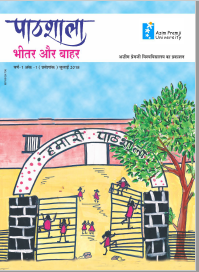
पाठशाला भीतर और बाहर का यह पहला अंक है। इस अंक में कक्षा और शिक्षकों से जुड़े विभिन्न विषयों पर कई लेख केन्द्रित हैं जो इनसे जुड़ी चिंताएँ और सवाल उठाते हैं। क्या कक्षा में सीसीटीवी कैमरों का उपयोग करना उचित है; क्या शिक्षक पेशेवर है और पेशेवर शब्द का मायने क्या है, जैसे सवाल इसमें शामिल हैं। अन्य लेख जिन मुद्दों से सम्बन्धित हैं, वे हैं- बोर्ड परीक्षाओं के प्रति हमारा दृष्टिकोण क्या होना चाहिए; हमें पर्यावरण अध्ययन की कक्षा में बातचीत कैसे शुरू करनी चाहिए; बच्चों की उच्चारण सम्बन्धी गलतियों पर प्रतिक्रिया कैसे देनी चाहिए; क्या एक ‘अच्छी कक्षा’ गणित की ‘सफ़ल कक्षा’ भी हो सकती है? आदि।
The first issue of “Pathshala ..” covers matters of classroom and teachers through many articles and raises a few areas of concern and questions. This includes appropriateness or otherwise of using CCTV cameras in classrooms, whether the teacher is a professional and what does the word professional mean. Other articles deal with what should be our attitude to board examinations, how should we begin to have a dialogue in an environmental studies class, how should we react to pronunciation mistakes of children and whether a mathematics class perceived to be ‘good’ is also a useful learning class.
Links
Exploitative Informal Labour Process in India: a conceptualisation
in Azim Premji University

- Published
- Authors
Abstract
This working paper will focus on conceptualising why informal labour continues to persist in the Indian economy. More specifically, it will try to theorise why, despite generating growth, informal labour has been locked in unequal and exploitative terms of contracts. Crucially, it will try to understand why informal labour processes do not evolve mechanisms for providing security and support to labour in the form of benefits and rights. In this paper, I will focus specifically on highly exploitative and unequal informal labour processes. I categorise under this category those labour processes that do not provide a mechanism to reproduce labour power. These processes are predicated on maximising the appropriation of surplus from labour, without providing any provision to support the workers in ill health, facing work related accidents and injuries, or due to retrenchment. While informal labour is defined as labour without legal rights or contracts, I specifically focus on those processes where there do not exist any norms or mechanisms of providing security to labour within the production process. Hence, I refer to these processes as highly exploitative and unequal labour processes. This paper will be structured in the following manner. Firstly, it will introduce the concept of labour process and argue that highly exploitative informal labour processes in India broadly fall into two distinct labour processes namely: informal coercive accumulation process and petty commodity production. It will then derive concepts from the Paris Regulation School to modify the labour process framework. It will then describe concrete case studies conducted by other researchers, to demonstrate that this framework can be utilised to make sense of field work based research on the informal sector. Lastly, I will assess the questions posed in this paper based on the derived framework and will argue that informality is connected to the nature of capitalist development in India.
Links


- Published
- Authors
Links

- Published
- Authors
Links

- Published
- Authors
Links

- Published
- Authors
Links

- Published
- Authors
Abstract
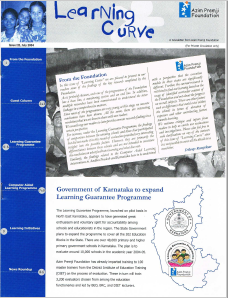
In this issue of the Learning Curve, the utility of researches in the development sector is discussed along with the outcomes of two such research studies, namely, ‘Factors differentiating the successful schools from others in the Learning Guarantee Program’ and ‘Impact of Computer Aided Learning on Learning Achievements’.
Links