
Publications & Resources
Our faculty, students and researchers work together everyday to contribute to a better world by grappling with urgent problems we are facing in India. We conduct rigorous work to produce high quality learning resources and publications to contribute to public discourse and social change. Here, we feature a sample from our work for everyone to access. You can explore featured resources, policies, and the latest publications from the University.
To explore all the work of our University, please visit our publications repository.
University Working Paper Series
Exploitative Informal Labour Process in India: a conceptualisation
in Azim Premji University

- Published
- Authors
Abstract
This working paper will focus on conceptualising why informal labour continues to persist in the Indian economy. More specifically, it will try to theorise why, despite generating growth, informal labour has been locked in unequal and exploitative terms of contracts. Crucially, it will try to understand why informal labour processes do not evolve mechanisms for providing security and support to labour in the form of benefits and rights. In this paper, I will focus specifically on highly exploitative and unequal informal labour processes. I categorise under this category those labour processes that do not provide a mechanism to reproduce labour power. These processes are predicated on maximising the appropriation of surplus from labour, without providing any provision to support the workers in ill health, facing work related accidents and injuries, or due to retrenchment. While informal labour is defined as labour without legal rights or contracts, I specifically focus on those processes where there do not exist any norms or mechanisms of providing security to labour within the production process. Hence, I refer to these processes as highly exploitative and unequal labour processes. This paper will be structured in the following manner. Firstly, it will introduce the concept of labour process and argue that highly exploitative informal labour processes in India broadly fall into two distinct labour processes namely: informal coercive accumulation process and petty commodity production. It will then derive concepts from the Paris Regulation School to modify the labour process framework. It will then describe concrete case studies conducted by other researchers, to demonstrate that this framework can be utilised to make sense of field work based research on the informal sector. Lastly, I will assess the questions posed in this paper based on the derived framework and will argue that informality is connected to the nature of capitalist development in India.
Links
University Working Paper Series
Role of voluntary teacher forums (VTFs) in continuous teacher professional development in India: experiences from Rajasthan, Karnataka and Puducherry
in Azim Premji University

- Published
- Authors
Abstract
The quality of education depends largely upon the teacher. Hence building teacher capacity through continuous professional development of teachers is critical to the quality of education. Systems and programs for continuous professional development for school teachers in the formal educational system in India are inadequate and often ill-conceived. Apart from other lacunae, they often do not recognize the professional identity and agency of the teacher. Voluntary Teacher Forums (VTFs) that are facilitated by Azim Premji Foundation in different locations of India, as part of an integrated and multimodal approach to continuous professional development, try to address this central issue. This study shows that VTFs are evolving as very useful platforms for collaboration and peer learning amongst teachers in various locations. It shows that given an environment that allows for easy access to meaningful opportunities, teachers will commit their time, talents and resources to their own professional development. The study further recognizes however, that the real issue is to understand how such forums can be made to happen in different locations in a context as complex as the Indian public education system. While this study highlights certain crucial dimensions of the VTFs – including what happens within these forums and the efforts that go behind it – these continue to be subjects for our future research works.
Links

- Published
- Authors
Abstract
Economic reforms sought to replace the Indian statedominant economy with a liberal, competitive market economy. However, a plethora of recent scams indicate that collusive rentsharing arrangements between business and policy makers are prevalent. A nexus has developed, linking politicians and business, as well as the bureaucracy. These trends signal a breakdown of competitive markets and the accumulation of wealth via corruption. This paper explains crony capitalism within a framework of interaction between four stakeholder groups whose motives and behaviour have altered in the recent context. These are political executives, political parties, business entities and the bureaucracy. Using the coal mine block allocation controversy as a case study, we examine the modus operandi of crony capitalism as a capture of the policy process. We examine the limitations of the present corrective political and legal processes.
The paper concludes with a set of recommendations for curbing crony capitalism via reform of :
(a) the political funding system,
(b) the policy process,
© the audit institution and
(d) the business environmentLinks

- Published
- Authors
Abstract
Empirical research in economics and, to a lesser extent, in other social sciences is largely dependent upon government statistics. It is generally assumed that governments are committed to collecting and disseminating correct statistics. As a result, the mutually constitutive relationship between politics, economy, and statistics, and the possibility of systematic manipulation of statistics-driven by the structural features of this relationship, has received insufficient attention within economics. This paper examines the implications of the absence of shared preferences over the quality of statistics within a government. It explores the multiplicity of conflicting maps of the State of Nagaland issued by different tiers and wings of the government to underscore the lack of attention paid to a statistic as crucial as area. The paper situates the cartographic-statistical confusion in its political and economic contexts, and suggests that political-geographic arguments are being used to advance political-economic interests along contested borders. It argues that the confusion is not amenable to a technical resolution as it is linked to the dispute over Nagaland’s place within the Union of India and the border disputes between Nagaland and its neighbouring states.
Links
University Working Paper Series
An intervention into the debates on ‘work-in-education’ and skill development in India
in Azim Premji University
- Published
- Authors
Abstract
The paper analyses the debates surrounding ‘work’ as part, or as an outcome, of school education in India and argues that these have not reckoned adequately the socioeconomic reality of the corresponding times. The outcome of education depends on ideas and resources shaping its provisioning, and the use by the people. Colonial rulers provided a liberal schooling which did not aim at ‘schooling for all’ or imparting skills as part of schooling. Such an education was attractive to those children who were not working in agriculture or artisanal occupations for their livelihood or who belonged to a ‘rentier’ class. The lower opportunity cost of time for these children and the probability of getting a job in the colonial administration enabled this small section of society to opt for such a liberal schooling. It is in this context that Gandhi wanted to use work (or agricultural and artisanal skills) as a pedagogical tool for education. However, the majority of children who were bound to do such work then did not view formal schooling, which aimed at imparting these ‘skills’, attractive.
Links
Survey
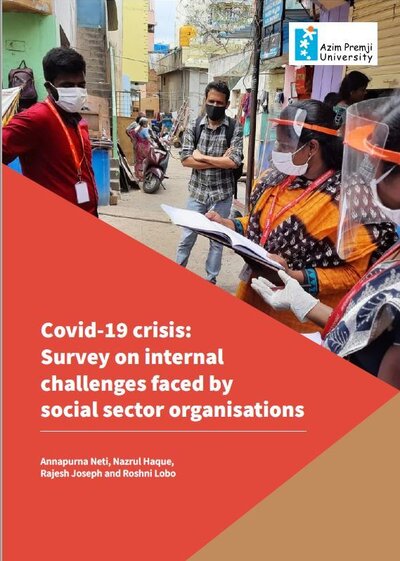
Report: Covid-19 crisis: Survey on internal challenges faced by social sector organisations
in Azim Premji University

- Authors
Abstract
This report is based on a study to understand how the Social Sector Organisations (SSOs) are adapting their operations and resources to the challenges posed by the pandemic and the kind of changes they anticipate in the social sector in the next few years as they adjust to a post-Covid world. The study specifically focuses on the internal organisational changes of SSOs both in the short-term and medium-term.
The situation assessment study was carried out over five months during January-May 2021. The study was carried in two parts: (a) A survey of SSOs followed by (b) qualitative in-depth interviews with senior management of select organisations.
Of the 107 organisations that responded to the survey, we identified 28 respondents for the qualitative interviews, covering small, medium and large organisations operating in different states and domains such as livelihoods, health, education, human rights and gender.
The findings are organised into the following categories:
a. Humanitarian work carried out by SSOs
b. Impact of the pandemic on the existing programmes of SSOs
c. Impact of the pandemic on the workforce of SSOs
d. Impact on funding to SSOs