
Publications & Resources
Our faculty, students and researchers work together everyday to contribute to a better world by grappling with urgent problems we are facing in India. We conduct rigorous work to produce high quality learning resources and publications to contribute to public discourse and social change. Here, we feature a sample from our work for everyone to access. You can explore featured resources, policies, and the latest publications from the University.
To explore all the work of our University, please visit our publications repository.
Book
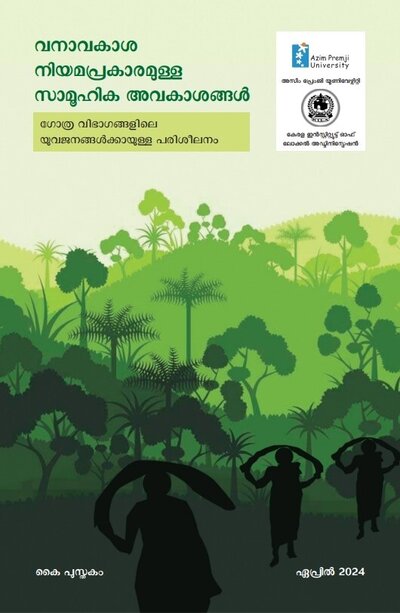
വനാവകാശ നിയമപ്രകാരമുള്ള സാമൂഹികഅവകാശങ്ങൾ: ഗോത്ര വിഭാഗങ്ങളിലെ യുവജനങ്ങൾക്കായുള്ള പരിശീലനം
in Azim Premji University

- Published
- Authors
- School of Development
Abstract
Hand book for a course on Community Forest Rights for the tribal youth in Kerala Azim Premji University’s FRA initiative, in collaboration with the Kerala Institute of Local Administration (KILA), launched a two-months long course on Forest Rights Act (2006), focusing on the Community Forest Rights (CFR). The course was tailor made for the tribal youth in the state of Kerala, following case studies[1][2][3] and orientation workshops conducted between 2020 and 2022. This handbook is the basic resource for this training. Students are expected to be informed and equipped for initiating the vesting of CFR working with their gram sabhas. Course Content and Delivery: The pedagogical approach is a blend of class room and hands-on learning, including field visits and computer lab sessions. There are three weeks of classroom interactions and five weeks of hands-on learning. The course has four units: the first unit, ‘Tribals and forests – a historical perspective,’ examines the historical context of tribal issues both globally and within the regional landscape. Second unit, ‘Understanding FRA,’ covers the history of FRA and comprehensively unpacks the Act, Rules, and the implementation challenges. Unit 3,‘Skills & competencies for Community Forest Resource Management (CFRM)’ imparts specific skills including accountancy, communication and mobilization skills as well as biodiversity management, necessary for effective implementation of CFR. The fourth unit ‘Individual field project’ is to be carried out by each student in two phases: (a)identification of the challenges and opportunities for implementation of FRA — for 2 weeks (b) finding responses to address the specific challenges identified during the first phase of 2 weeks. [1]https://practiceconnect.azimpremjiuniversity.edu.in/implementation-of-forest-rights-act-observations-from-keralas-attappadi-block/ [2]https://practiceconnect.azimpremjiuniversity.edu.in/implementation-of-forest-rights-act-lessons-from-vazhachal-division-of-kerala/ [3]https://practiceconnect.azimpremjiuniversity.edu.in/implementation-of-forest-rights-act-observations-from-wayanad-district-of-kerala/
Links
Article
Impact of Interventions Supporting Girls’ Education on Early Marriage, Pregnancy and Work Participation: Evidence Synthesis
in Indian Journal of Human Development
Article
- Published
- Authors
- Mukta Gundi
- Radhika Dayal
Abstract
This article synthesises the evidence on the impact of interventions supporting adolescent girls’ and young women’s education on delaying marriage, childbearing and improving work participation. A total of 13 studies (eight from sub-Saharan Africa and five from South Asia) during the years 2000 – 2020 met our inclusion criteria. A major focus of the included studies was to reduce the schooling cost, with limited focus on strategies such as supplementary coaching, making schools girl-friendly, monitoring performance and sensitising communities about educating girls. Most studies that measured the effects on marriage and childbearing showed a positive impact. However, interventions were less successful in influencing work participation. Although a majority of studies reported positive effects on educational outcomes, fewer measured or reported positive effects on other social and health outcomes. This evidence synthesis suggests a need for studying long-term effects of such interventions on girls’ and women’s families, work and social life to inform policy. Studies that explore the varying impacts of such interventions on girls and women from different sociocultural settings are needed. Our evidence synthesis underscores the importance of making comprehensive efforts to support girls’ education in order to meet the global development commitments of ensuring equitable life opportunities for adolescent girls and young women.
Links
University Working Paper Series
One Part Farmers: Villages two decades after land acquisition for the Bengaluru International Airport
in Azim Premji University


- Published
- Authors
Abstract
Constitutional measures to ensure fair compensation and livelihood security to the land losing refugees of development processes, overlook the complexity of ‘public purpose’ — the dominant rationale behind operationalizing ‘eminent domain’ of the state. Popular perception of public purpose as urbanization muffles the de facto social citizenship around plural values of agricultural landscapes. Ignoring the enduring public purposes served by agrarian landscapes aids in underestimating the longterm welfare impacts on displaced farmers.
Links
University Working Paper Series
The ordinary city and the extraordinary city : the challenges of planning for the everyday
in Azim Premji University
- Published
- Authors
Abstract
Recent work on informal urbanism argues that ‘informality’ is a strong force in determining and shaping how cities in the global south grow, and hence needs to be a part of emergent urban theory. This paper uses this argument as a starting point, drawing upon the work of scholars who suggest that urban informality may have an organizing logic, a system of norms that emerge from the economic conditions and the social needs of people. Specifically, this paper examines informality in the urban space as an outcome of spatial and economic changes in a market precinct in Bangalore. It finds that activities in the street are temporal in nature. In this paper, the ordinary city encapsulates how people use urban spaces on an everyday basis and the extraordinary city reflects how urban spaces are transformed during a periodic, religious and cultural festival. The paper makes two key contributions, one, to show through an in-depth spatial ethnographic study how the ‘ordinary – extraordinary’ might help us understand informal urbanism and two, to propose that it may be useful to have intermediate levels of planning that incorporate the conditions of the ‘ordinary’ city as well as the ‘extraordinary’ city, thereby contributing to both theory and practice.
Links

- Published
- Authors
Abstract
Economic reforms sought to replace the Indian statedominant economy with a liberal, competitive market economy. However, a plethora of recent scams indicate that collusive rentsharing arrangements between business and policy makers are prevalent. A nexus has developed, linking politicians and business, as well as the bureaucracy. These trends signal a breakdown of competitive markets and the accumulation of wealth via corruption. This paper explains crony capitalism within a framework of interaction between four stakeholder groups whose motives and behaviour have altered in the recent context. These are political executives, political parties, business entities and the bureaucracy. Using the coal mine block allocation controversy as a case study, we examine the modus operandi of crony capitalism as a capture of the policy process. We examine the limitations of the present corrective political and legal processes.
The paper concludes with a set of recommendations for curbing crony capitalism via reform of :
(a) the political funding system,
(b) the policy process,
© the audit institution and
(d) the business environmentLinks