
Publications & Resources
Our faculty, students and researchers work together everyday to contribute to a better world by grappling with urgent problems we are facing in India. We conduct rigorous work to produce high quality learning resources and publications to contribute to public discourse and social change. Here, we feature a sample from our work for everyone to access. You can explore featured resources, policies, and the latest publications from the University.
To explore all the work of our University, please visit our publications repository.
Report
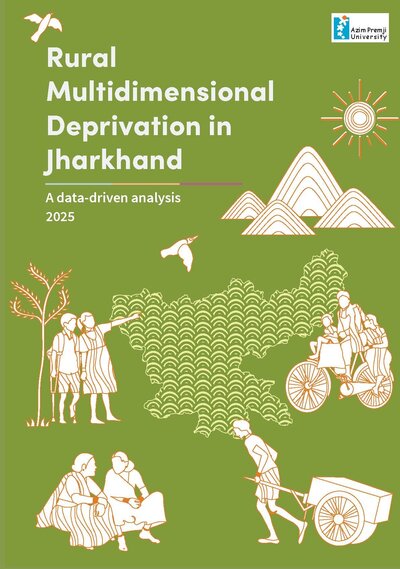
Rural Multidimensional Deprivation in Jharkhand: A Data-Driven Analysis 2025
in Azim Premji University

- Published
- Authors
- School of Development
Abstract
This report constructs a Rural Multidimensional Deprivation Index (RDI) for measuring deprivation in Jharkhand. An important feature of the index is that it is constructed using indicators on provisioning of basic infrastructural amenities at the village level. This is different from the usual poverty indices that are composed of financial indicators such as income or consumption; or indicators measuring development outcomes such as educational or nutritional levels. Observing the provisioning of basic infrastructural amenities, this report makes focused policy suggestions that can be easily implemented by functionaries working on the ground. The data for the index is sourced from the Mission Antyodaya Survey, which was carried out in 2019 at the village level across the country. The survey collects data related to provisioning and outcome of basic amenities in villages, along with demographic and socioeconomic variables. Because this is a periodic survey, it enables us to track the developmental progress of each village, district, state and the country over time. In total, there are about 182 variables that were captured in the 2019 round. The survey covers 31,175 out of 32,620 villages in Jharkhand, which is 95.6 percent of the total number of villages in the state; and 6,48,358 out of 6,67,933 villages in India, or 97.1 percent of the villages in the country.
Editors
Prasanna S, Sandhya Krishnan, Sanket Gharat, Puja Guha, Amalendu Jyotishi, Neeraj Hatekar
Links

- Published
- Authors
Abstract
This article presents a historical account of emergence and development of the territorial power of Jats in Punjab through analysing three elements. First, their historical appropriation of the village as their agrarian territory, which was often perpetuated under the discourse of ‘village community’/clans and the monopolisation of the peasant identity. Second, the often-benevolent administration in Punjab during the colonial rule. Third, the development of a discourse of caste-progressiveness of Jats. The Punjab experience in this regard is significant to understand similar processes in other states and to make appropriate strategies for social movements and policy advocacy regarding agrarian/social reforms.
Résumé
Cet article présente un compte rendu historique de l’émergence et du développement du pouvoir territorial des Jats au Pendjab en analysant trois éléments. Premièrement, leur appropriation historique du village en tant que territoire agraire, qui s’est souvent perpétuée sous le discours de la « communauté villageoise »/clans et de la monopolisation de l’identité paysanne. Deuxièmement, l’administration souvent bénévole du Pendjab pendant la période coloniale. Troisièmement, le développement d’un discours sur la progressivité de la caste des Jats. L’expérience du Pendjab à cet égard est importante pour comprendre des processus similaires dans les autres États et pour élaborer des stratégies appropriées pour les mouvements sociaux et le plaidoyer politique concernant les réformes agraires/sociales.
University Working Paper Series
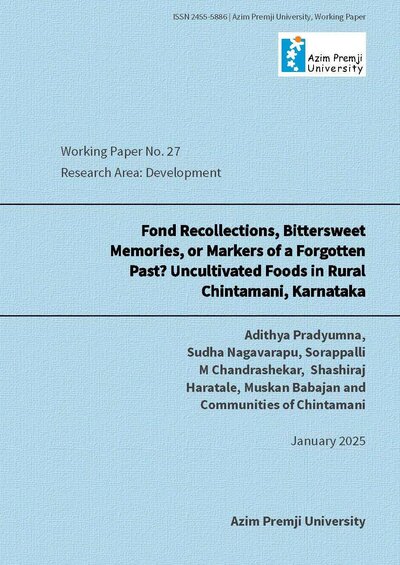
Fond recollections, bittersweet memories, or markers of a forgotten past? uncultivated foods in rural Chintamani, Karnataka
in Azim Premji University

- Published
- Authors
Abstract
Some experts consider “food” as the most critical issue of the 21st century. Countries such as India are experiencing what has been described as a triple burden of malnutrition – characterised by high prevalence of undernutrition, obesity, and micro-nutrient deficiency. These are a result of inadequate access to healthy foods, increased use of highly processed foods, and low dietary diversity, besides factors related to sanitation. Changes in the practice of agriculture has resulted in a reduction in agrobiodiversity. The challenges to accessing food during shocks such as the COVID-19 pandemic and conflicts in various parts of the world demonstrated the importance of local food security and reminded people of the importance of local food sources, including uncultivated or wild foods.
Authors:
Adithya Pradyumna,
Sudha Nagavarapu,
Sorappalli M Chandrashekar,
Shashiraj Haratale,
Muskan Babajan and
Communities of ChintamaniLinks
Article
Accumulation by Dispossession: Evidence of Shrinking Space for Small-scale Fishers of Karnataka Coast
in Springer Nature

- Published
- Authors
Abstract
Small-scale fisheries play an important economic, social and cultural role in coastal Karnataka even today despite being subjected to several natural and anthropogenic stressors for a long time. They are neglected or even outright discouraged in the state’s fisheries policymaking, and their contributions to the state’s fish supply and their role in livelihood creation do not receive the due recognition. This paper is premised on the recognition of emerging stressors that pose a threat to the viability of small-scale fisheries. The impacts of these stressors have implications not only for the environment but also for nutrition, particularly among vulnerable populations, and the overall socio-economic stability of coastal communities that rely on fishing as a livelihood. The goals of this paper are to provide a thorough review of literature around these stressors, and to describe how these are being played out in coastal Karnataka. Among these stressors, we delve in depth on the new Blue Economy policy of India since it is likely to have severe antagonistic effects in combination with other anthropogenic stressors. Our opinion is, Karnataka has already started witnessing many of these ramifications of interventions/stressors and the coastal landscape of the state is set to be transformed over the next couple of decades or so. Small-scale fisheries of the state are likely to be some of the most impacted communities from these interventions.
Authors: Shruthi Suripeddi, Prasanna Surathkal, Amalendu Jyotishi, and Ramachandra Bhatta
Links