
Publications & Resources
Our faculty, students and researchers work together everyday to contribute to a better world by grappling with urgent problems we are facing in India. We conduct rigorous work to produce high quality learning resources and publications to contribute to public discourse and social change. Here, we feature a sample from our work for everyone to access. You can explore featured resources, policies, and the latest publications from the University.
To explore all the work of our University, please visit our publications repository.
List of Publications & Resources
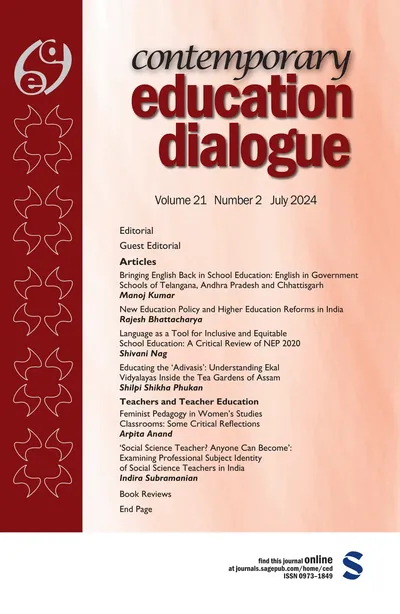
Schooling and Constructions of Citizenship: Some Reflections on Student Agency and Choice
in Contemporary Education Dialogue

- Published
- Authors
Abstract
A national system of education in modern nation-states is usually geared towards nation-building and schools play a significant role in grooming children as future citizens. While the dominant and powerful usually emerge as the ‘ideal citizen’ in the national imagination, the marginalised are constructed as the ‘other’, vilified, and stigmatised. The school, with its overt and hidden curriculum, operates as a major site for the reproduction of dominant ideology while at the same time creating opportunities for exercising human agency. This article, an ethnographic study conducted in a government co-educational school in Delhi, examines how it sought to mould the students into ‘ideal’ citizens and how this was received by them. Belonging to a relatively lower socio-economic background compared to the teaching community, did they give their acquiescence? Or were they able to exercise their agency to challenge the entrenched power structures in society? Were their responses shaped by their specific social locations and the unfolding of ‘cultural politics’? Moreover, when the nature of ‘official knowledge’ itself has undergone radical shifts and the idea of citizenship has been redefined with the introduction of the National Curriculum Framework 2005, were the students able to leverage the epistemological shifts embodied in the textbooks to reimagine and construct ideas of citizenship regarding marginalised communities? These are some questions that the present article seeks to address.
Impact of Interventions Supporting Girls’ Education on Early Marriage, Pregnancy and Work Participation: Evidence Synthesis
in Indian Journal of Human Development
Article
- Published
- Authors
- Mukta Gundi
- Radhika Dayal
Abstract
This article synthesises the evidence on the impact of interventions supporting adolescent girls’ and young women’s education on delaying marriage, childbearing and improving work participation. A total of 13 studies (eight from sub-Saharan Africa and five from South Asia) during the years 2000 – 2020 met our inclusion criteria. A major focus of the included studies was to reduce the schooling cost, with limited focus on strategies such as supplementary coaching, making schools girl-friendly, monitoring performance and sensitising communities about educating girls. Most studies that measured the effects on marriage and childbearing showed a positive impact. However, interventions were less successful in influencing work participation. Although a majority of studies reported positive effects on educational outcomes, fewer measured or reported positive effects on other social and health outcomes. This evidence synthesis suggests a need for studying long-term effects of such interventions on girls’ and women’s families, work and social life to inform policy. Studies that explore the varying impacts of such interventions on girls and women from different sociocultural settings are needed. Our evidence synthesis underscores the importance of making comprehensive efforts to support girls’ education in order to meet the global development commitments of ensuring equitable life opportunities for adolescent girls and young women.
Links


- Published
- Authors
Abstract
The article argues that industry is coming alive to its social purpose, with considerations like equity, environmental impact and ethics. It starts with the history of industrial revolutions from 0.0 to 4.0, detailing their impact on society. It goes on to introduce the concept of Industry 5.0, which is built on the principles of human centricity, sustainability and resilience. The author explains the implications of Industry 5.0 to society, leadership, and HR. He argues that Industry 5.0 is not a revolution but an evolution of the manufacturing process, which is characterised by the integration of various technologies such as artificial intelligence, the Internet of Things, and robotics. He concludes by discussing how individuals can adapt to the requirements of Industry 5.0. The article points to Industry 5.0 becoming more humane with greater responsibility for equity, justice, and sustainability.
Adivasi migrant labour and agrarian capitalism in southern India
in Journal of Agrarian Change
Article
- Published
- Authors
- School of Development
Abstract
This paper looks at a case of rural-to-rural movement of agrarian capital in southern India and the ways in which capital-labour relations are reworked to maintain oppressive forms of exploitation. Faced with an agrarian crisis, capitalist farmers from affluent communities of Wayanad, Kerala, take large tracts of land for lease in the neighbouring state of Karnataka and grow ginger based on price speculation. Landless Adivasis from Wayanad have served as labourers on these ginger farmlands for the past three decades. Recently, farmers have shifted to employing labourers from a Scheduled Caste (SC) from Karnataka. The change happened not just because of the lower wages the SC labourers were willing to work for, but also because of the farmers’ inclination to move away from Adivasis who have been resisting the poor working conditions on the farm. The story resonates with broader dynamics of agrarian-labour relations amidst capitalist expansion and highlights the centrality of socio-political factors at play.
Article
- Published
- Authors
Abstract
At the time when Saussure or Pierce were propounding and formulating their ideas about the relationship between a concept and the multiple ways they can be referred to, the world was still going through the extended effects of the industrial revolution. The world was still connecting and finding out that there could be multiple ways of referring to most concepts around us. But fast forward a hundred years and the world has changed a lot. Concepts have changed and we now live on an earth that is more connected than ever and new ‘languages’ keep cropping up once in a while. The concept of sign propounded has had a big role to play in the structure of language, at least from a theoretical point of view. The idea of sign has evolved over time and this paper presents a discussion of the relationships between signifiers and signifieds.