
Publications & Resources
Our faculty, students and researchers work together everyday to contribute to a better world by grappling with urgent problems we are facing in India. We conduct rigorous work to produce high quality learning resources and publications to contribute to public discourse and social change. Here, we feature a sample from our work for everyone to access. You can explore featured resources, policies, and the latest publications from the University.
To explore all the work of our University, please visit our publications repository.
List of Publications & Resources
Schooling and Constructions of Citizenship: Some Reflections on Student Agency and Choice
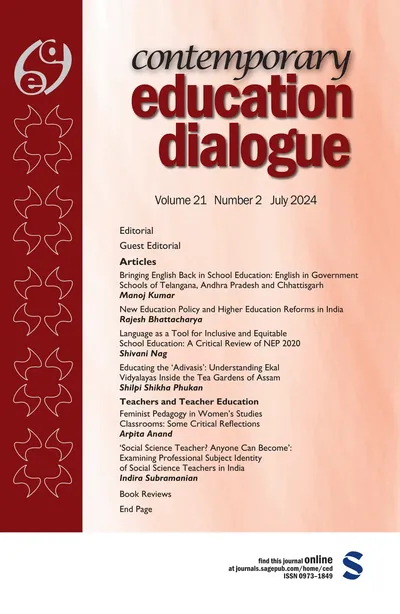
in Contemporary Education Dialogue

- Published
- Authors
Abstract
A national system of education in modern nation-states is usually geared towards nation-building and schools play a significant role in grooming children as future citizens. While the dominant and powerful usually emerge as the ‘ideal citizen’ in the national imagination, the marginalised are constructed as the ‘other’, vilified, and stigmatised. The school, with its overt and hidden curriculum, operates as a major site for the reproduction of dominant ideology while at the same time creating opportunities for exercising human agency. This article, an ethnographic study conducted in a government co-educational school in Delhi, examines how it sought to mould the students into ‘ideal’ citizens and how this was received by them. Belonging to a relatively lower socio-economic background compared to the teaching community, did they give their acquiescence? Or were they able to exercise their agency to challenge the entrenched power structures in society? Were their responses shaped by their specific social locations and the unfolding of ‘cultural politics’? Moreover, when the nature of ‘official knowledge’ itself has undergone radical shifts and the idea of citizenship has been redefined with the introduction of the National Curriculum Framework 2005, were the students able to leverage the epistemological shifts embodied in the textbooks to reimagine and construct ideas of citizenship regarding marginalised communities? These are some questions that the present article seeks to address.
Impact of Interventions Supporting Girls’ Education on Early Marriage, Pregnancy and Work Participation: Evidence Synthesis
in Indian Journal of Human Development
Article
- Published
- Authors
- Mukta Gundi
- Radhika Dayal
Abstract
This article synthesises the evidence on the impact of interventions supporting adolescent girls’ and young women’s education on delaying marriage, childbearing and improving work participation. A total of 13 studies (eight from sub-Saharan Africa and five from South Asia) during the years 2000 – 2020 met our inclusion criteria. A major focus of the included studies was to reduce the schooling cost, with limited focus on strategies such as supplementary coaching, making schools girl-friendly, monitoring performance and sensitising communities about educating girls. Most studies that measured the effects on marriage and childbearing showed a positive impact. However, interventions were less successful in influencing work participation. Although a majority of studies reported positive effects on educational outcomes, fewer measured or reported positive effects on other social and health outcomes. This evidence synthesis suggests a need for studying long-term effects of such interventions on girls’ and women’s families, work and social life to inform policy. Studies that explore the varying impacts of such interventions on girls and women from different sociocultural settings are needed. Our evidence synthesis underscores the importance of making comprehensive efforts to support girls’ education in order to meet the global development commitments of ensuring equitable life opportunities for adolescent girls and young women.
Links