Annual Research Forum 2026: A Day of Research and Conversation Across Disciplines
A full day of short talks and poster presentations offered a window into questions and ideas shaping research at the University, as highlighted by Meryl Garcia.
Campus
Bengaluru
Details
What happens when a primate comes to stay in a human-modified landscape? At this year’s Annual Research Forum, Shaurabh Anand explored this question through his study of the behaviour of Bonnet Macaques.
What does it mean to assess a child’s holistic development? Manoj Khadka shared his reflections on contextualising holistic progress cards in Sikkim.
These were just two of the many ideas explored during the Annual Research Forum, held at the Bengaluru campus, which brought together researchers from across the university to share their work.
Highlights
- 20 Short presentations
- 80 Poster presentations
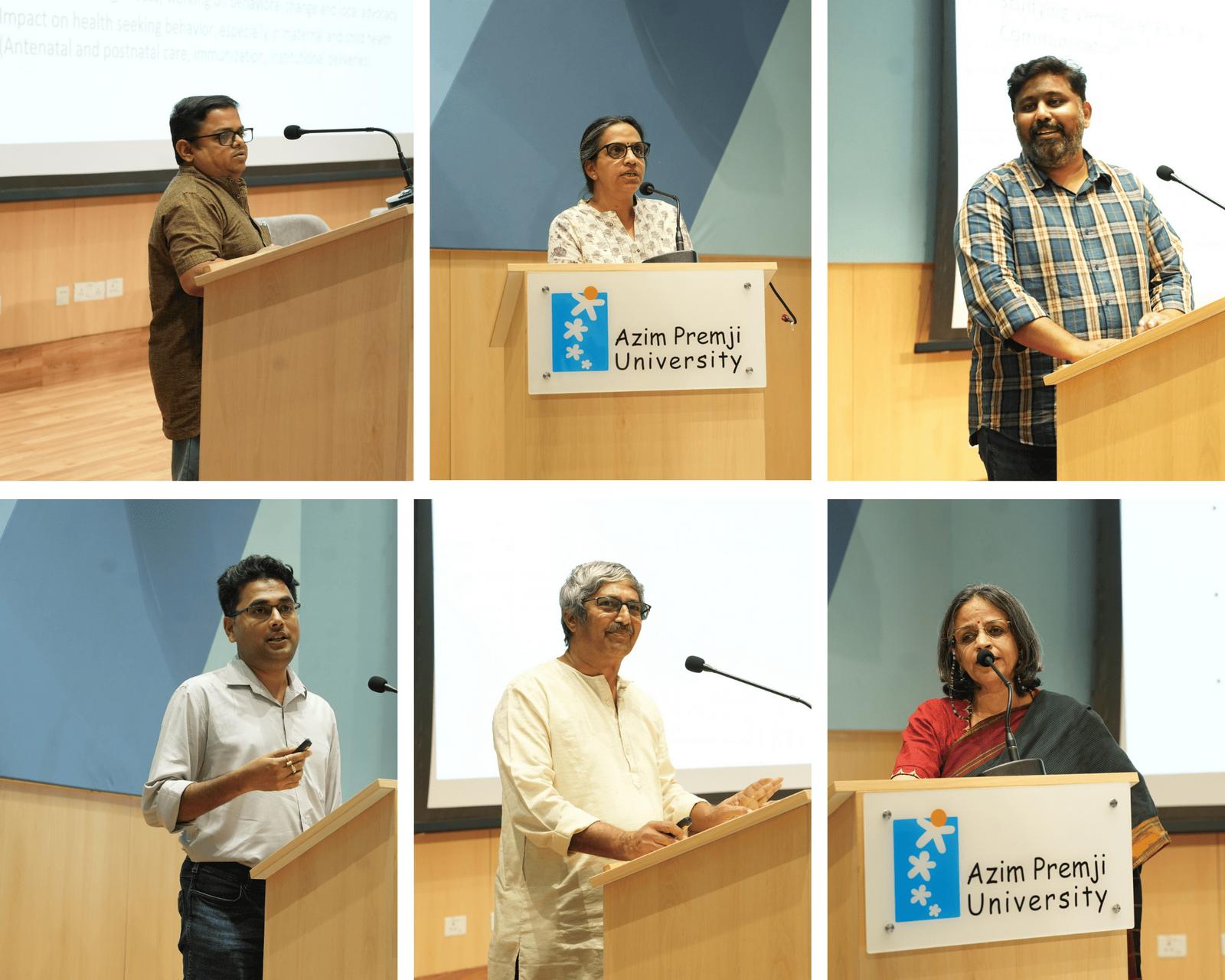
The full-day event featured around 20 short presentations, putting the spotlight on the breadth of research taking place at the university.
The talks ranged from a Boolean multi-game model of compromise to a visual exploration of the indigenous belief systems in Karnataka; from building a framework for measuring sustainability in agriculture to exploring community-based conservation in Arunachal Pradesh; and from studying the trade-off between growth and reproduction in the freshwater invertebrate hydra to examining hashtags and memetic videos to study vernacular political communication. The forum also featured 80 poster presentations, giving researchers an opportunity to share their work with the wider university community.
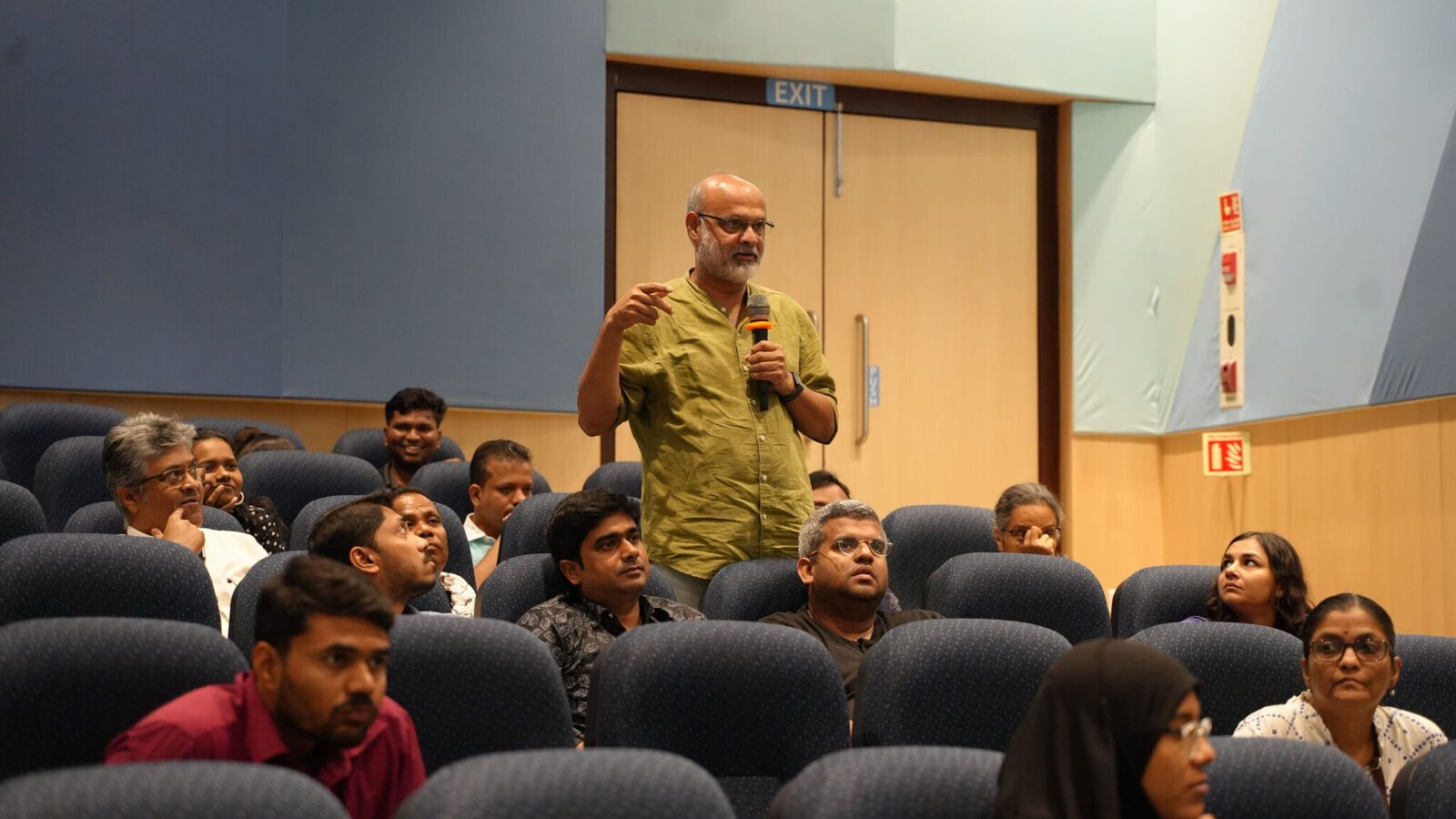
Amalendu Jyotishi poses a question during one of the short talks at the Annual Research Forum.
First held in 2023 as the Annual Research Conclave, the event was renamed as Annual Research Forum this year. Since its inception, it has brought together members from across disciplines to share their research and learn from each other.
In her opening remarks, Divya Uma, who heads the research centre, highlighted how the Annual Research Forum showcases the university’s interdisciplinary approach to research. “Azim Premji University is a collaborative space. We celebrate each other’s research,” she said. This was the sentiment that ran through the day, with researchers taking a keen interest in each other’s work and engaging in spirited conversations.
From the classroom to the lab and the field
The short talk series opened with Sham N Kashyap, who spoke about how frontline healthcare workers navigate the equity-equality dilemma in the tribal areas of India. “Tribal health outcomes are relatively low compared to other communities. Most schemes don’t necessarily differentiate in terms of the treatment protocols for tribal and non-tribal communities. It only depends on how much local implementation authorities prioritise tribal households,” he said, elaborating on the crucial role of Accredited Social Health Activists (ASHAs) in connecting communities to public healthcare infrastructure and services.
Several presentations focused on the different aspects of education. Shantha Bhushan spoke about an interactive workbook for college maths that she has developed with her colleagues. It is designed to help students of Grade XI and XII explore whether they would like to pursue maths at an undergraduate level and ease the transition for those who have already chosen to study the subject in college.
Prakash Iyer introduced Understanding the Constitution of India, a book he’s developing for teachers and teacher educators to help them engage with the Constitution and bring its ideas into the classroom.
Ankur Madan spoke about her research on inclusive education and the importance of listening to the voices on the ground. “You cannot have consideration of inclusive education and its practice in the Indian context without consideration of aspects of intersectionality and the impact that all of this has on disabled children’s experiences of education,” she said.
The short talks also turned to questions of climate change. Nihar Paul discussed upwelling in the Arabian sea, while Mohammad Irshad Rather explored algal distribution and the trophic state of high-altitude Ramsar Wetland. Megha K Prasad had the audience hooked with her talk on the Glacial Lake Outburst Flood (GLOF) hazard at Kali Kund lake in Himachal Pradesh.
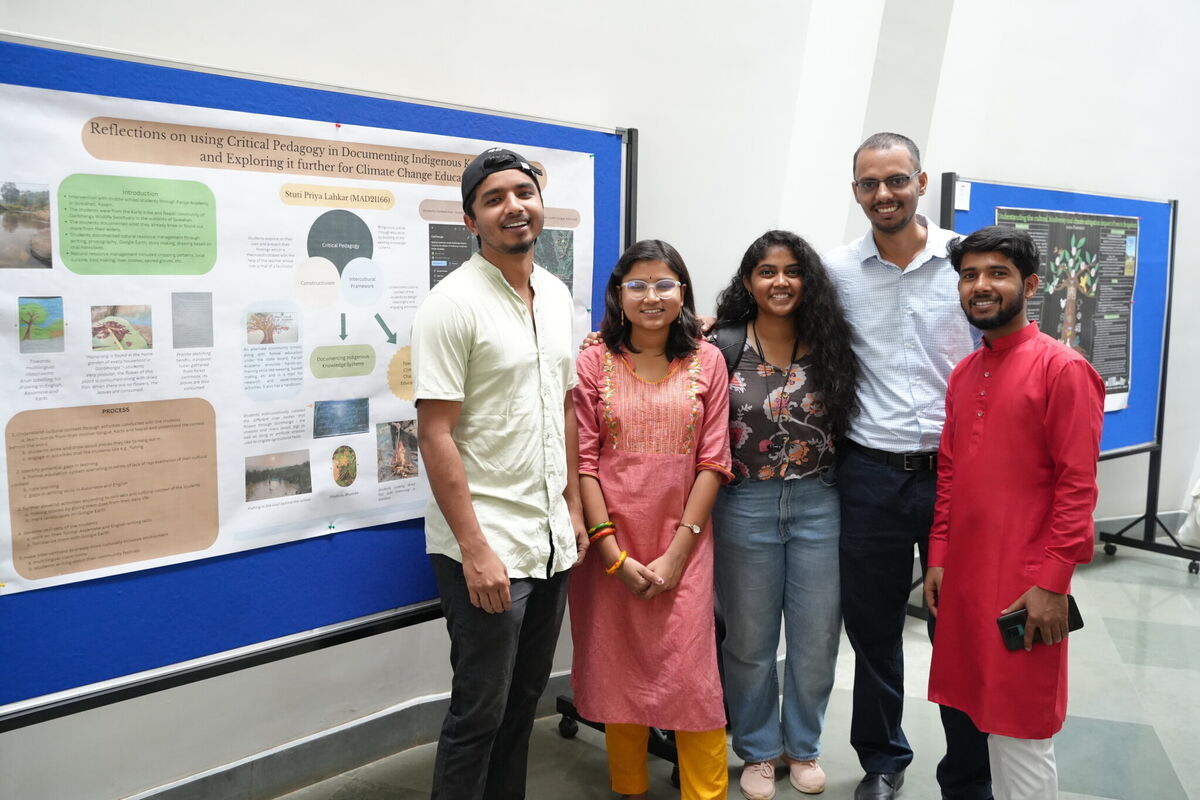
The conversations continued outside the auditorium, where the poster presentations provided an opportunity to pause and delve a little deeper. Curious groups gathered in twos and threes around researchers discussing their work, asking questions, and lingering over the topics that caught their attention.
Some of the posters were accompanied by interactive material. People could explore mathematics using kolam tiles, while an AI corner invited the university’s research community to mark their responses to questions on how they were using AI in research.
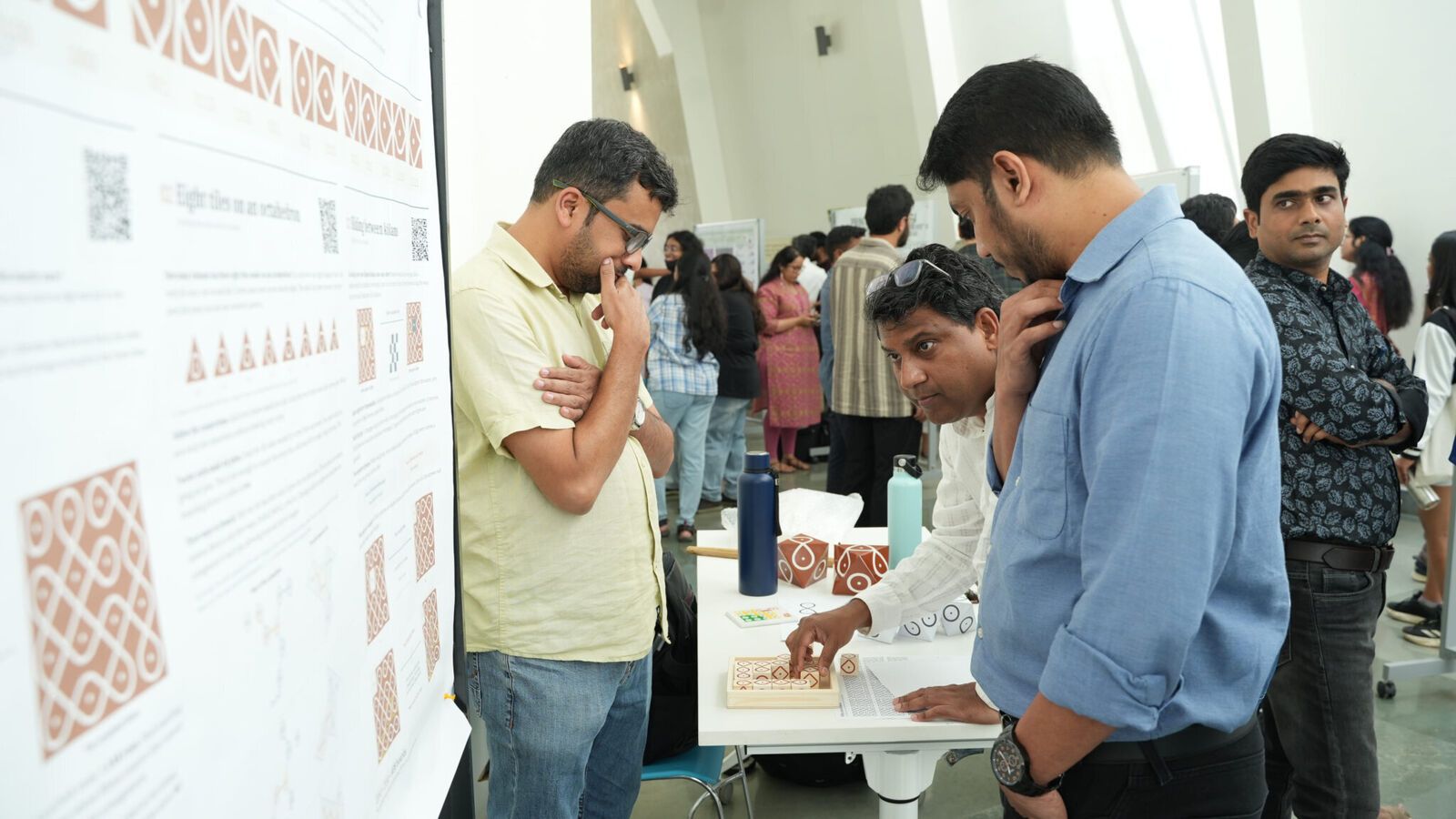
Participants exploring maths using kolam tiles
A poster exploring why India’s villages are empty caught many an eye. “When we looked into the data, we found that there are zero-population villages all over the country,” said Sandhya Krishnan, one of the collaborators. The project maps these villages and characterises them by factors like deprivation, remoteness, and elevation, offering a closer look at the patterns behind why people are leaving these villages.
Dechamma C S and her colleagues showcased a community-based system to support children with developmental delays and disabilities in Anekal taluk, as part of their work in the Community Engagement Initiative. Their goal is to strengthen early identification and intervention for children at risk and establish an early intervention centre.
Other posters explored topics across a range of disciplines including a book on the history of economic thought; science teachers’ attitudes on teaching reproductive health education; the porous markets in Jharkhand’s Chotanagpur; AI-integrated realistic mathematics education; and the reading practices of women in contemporary India.
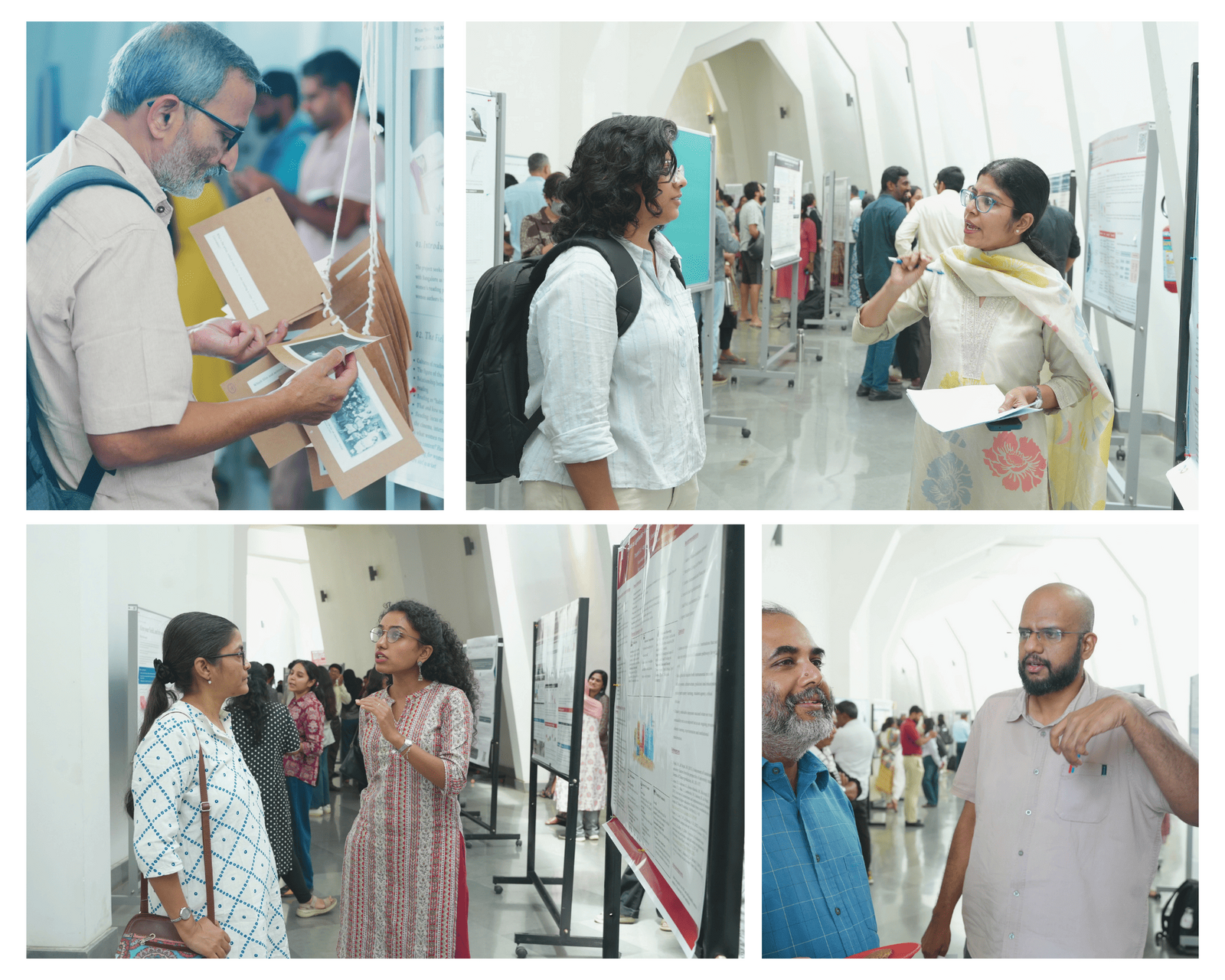
The poster presentations provided an opportunity to take a closer look at the research
“I am learning things from the campus and replicating them outside. In that sense, I feel campuses can be lighthouses.”
Thrupthi G N, a research fellow, offered an interesting take on sustainability with her poster titled ‘Campus as Lighthouses — A case study for Azim Premji University’. Just as a lighthouse helps ships navigate, a campus can demonstrate sustainable practices that can be carried into the wider community, she proposed. “I am learning things from the campus and replicating them outside. In that sense, I feel campuses can be lighthouses.”
From how organisms grow to how communities navigate climate change, research presented at the Annual Research Forum covered very different grounds. It was also a chance for researchers to step outside of their own areas, engage with new ideas from other disciplines, and perhaps even leave with a few new things to think about.
About the author
Meryl Garcia is a consultant with Azim Premji University’s Research Centre. She spends her time exploring research projects across the social sciences and uncovering the stories hidden within them.