
Publications & Resources
Our faculty, students and researchers work together everyday to contribute to a better world by grappling with urgent problems we are facing in India. We conduct rigorous work to produce high quality learning resources and publications to contribute to public discourse and social change. Here, we feature a sample from our work for everyone to access. You can explore featured resources, policies, and the latest publications from the University.
To explore all the work of our University, please visit our publications repository.
List of Publications & Resources

- Published
- Authors
Abstract
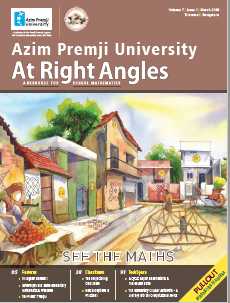
Volume 7 Issue 1: This issue of AtRiA welcomes you to the Math Village. Where house numbers, rangoli patterns, piles of fruit and even a child’s amusement device speaks to the instictive mathematician in each of us.
Read about these in Triangular Numbers in Features and the House Number Problem in ClassRoom. Appropriately, many of these problems were prompted by Ramanujan in his village. The Review is of a book which was used to teach a pre-course at the School of Arts and Sciences, Azim Premji University and it syncs perfectly with the theme of finding mathematics in the most unexpected places.
Hone up on how to create a Conjecturing ClassRoom or generate Elementary Cellular Automata! Misconceptions in Fractions and an analysis of common errors in Algebra give an insight into students’ struggles with mathematics and the PullOut, too, focuses on Algebra and how to make a seamless move from Arithmetic to Algebra.
Links
Lakes of Bengaluru : the once living, but now endangered peri-urban commons
in Azim Premji University

- Published
- Authors
Abstract
Cities of the Global South are expanding both spatially and demographically. While urbanization may contribute to economic growth and employment generation, the impacts of urbanization on sustainability of cities is manifold. One area that is witnessing rapid land use change as a result of urbanization is the peri-urban interface of cities in India. This is especially true in the case of natural spaces that are also common pool resources. In this working paper, we examine the transformation of lakes in the peri-urban interface of Bengaluru city in the south Indian state of Karnataka. Based on GPS observations and interviews, we found that lakes in our study area varied in status and use: ranging from those in a good condition that served multiple uses to those converted to other forms of land use, resulting in loss of all services. We also accessed archival information to underscore the role that one of the lakes in the study area played in serving as a source of water during a time of scarcity. Using the example of lakes in Bengaluru, this paper presents the threats faced by commons in the peri-urban interface of rapidly expanding cities in the Global South. These threats are not restricted to changes to land use alone, but also concern their transformation into recreational sites at the cost of users who depend on them for livelihood and subsistence. We argue for management of the lakes in the peri-urban interface not only as ecosystems that supports ecological and economic uses, but as commons that are a reflection of the diversity and heterogeneity that cities such as Bengaluru represent.
Links


- Published
- Authors
Abstract
It is different for each one of us which is why when people reminisce about their school, opinions can differ about the same subject or teacher. The teacher, for her part, also has unique relationships with the class she goes to. It is a dynamic, organic process. The same concern, involvement and thoughtfulness that was evident in the experiences recounted in the first part are present in the narratives of this Issue too.
Links
The Evolution of India’s Industrial Labour Share and its Correlates
in Azim Premji University


- Published
- Authors
Abstract
There has been substantial recent interest in the decline of labour shares across countries. For the most part, attention has been focused on developed countries. We examine the evolution of India’s labour share in its formal industrial sector from 1983- 2016. Using two datasets corresponding to sectoral aggregate data and plant-level data respectively, we document a secular decline in the labour share across all sectors from 1983, with a stabilisation at very low levels (around 8 to 10 percent) starting around 2005. We then use the plant-level data to identify correlates that illuminate reasons for the overall decline in the labour share. We find strong evidence to support multiple causes: increased capital intensity, greater informalisation, greater privatisation, and productivity increases in larger firms. As such, we suggest that the declines in labour share experienced are due to a composite set of factors. Conversely, other potential explanations (e.g. regional variation in the labour share) have less explanatory power.
Authors:
- Arjun Jayadev
- Amay Narayan
Links
An Approach to the Problem of Employment in India
in Azim Premji University
- Published
- Authors
Abstract
The challenge of employment in the Indian economy, especially after it growth acceleration since the mid-1980s, relates to its quality rather than its quantity. While employment growth has kept pace with the labour force over the long run, what has grown is informal employment. The coexistence of rapid capital accumulation, robust output growth and lack of growth of formal employment can be understood using the well-known Harris-Todaro model of a dual economy. This framework highlights the key role of the wage gap between the modern and traditional sectors as a determinant of urban informal employment. Hence, one of the most effective and egalitarian ways to address the employment problem is to adopt policies to increase agricultural productivity and income, which can reduce the wage gap. Since crop yields in India are far lower than many other countries in the world, including China, Brazil, and Bangladesh, there is ample scope for land-augmenting and labour-absorbing technological change in Indian agriculture. Efforts to ramp up industrialization should be taken up in earnest only after the wage gap has been narrowed significantly.
Author:
- Deepankar Basu
Links
Understanding the Performance of India’s Manufacturing Sector- Evidence from Firm Level Data
in Azim Premji University

- Published
- Authors
Abstract
India’s overall economic performance over the last fifteen years has been outstanding, with the economy growing at an average of over 7% p.a. Growth has been service-led with the services sector accounting for over 60% of GDP growth over the period. Importantly, India’s structural transformation has been marked by a shift straight from agriculture to services led growth, leapfrogging manufacturing. The problem with this pattern of growth has been that it has generated relatively fewer opportunities of employment generation. The role of the manufacturing sector, ordinarily considered to be an important engine of growth and job creation for low and middle income countries, has been rather limited. Its share in total GDP and employment has continued to hover around 15% and 12% respectively for the last three decades.
Author:
- Radhicka Kapoor
Links
Women Workers in India – Labour Force Trends, Occupational Diversification, and Wage Gaps
in Azim Premji University

- Published
- Authors
Abstract
Understanding the nature of work performed by women in India requires rest of all that we broaden our understanding of what is work, and recognize the different kinds of socially necessary as well as other work. The nature of work and how to capture it in empirical data have indeed been among the most complicated and debated issues in social sciences. This is particularly so in societies where much work occurs in informal, often even very private, settings that can be very hard to identify, let alone measure. The fact that international de nations of work and of economic activity have themselves been changing over time only adds to the complexity.
Authors:
- Bidisha Mondal
- Jayati Ghosh
- Shiney Chakraborty
- Sona Mitra
Links

- Published
- Authors
Abstract
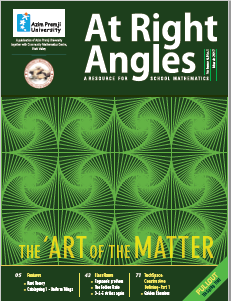
Volume 6 Issue 1: The Art of the Matter — can a picture be a powerful pedagogical tool? At Right Angles believes it can, and if you read the write up on the facing page, I’m sure you will agree with us. Going to the heart of the art is key to mathematics and there’s more of the same inside this issue. We begin with Ramya Ramalingam, a sixteen-year-old school girl, unravelling the mysteries of Knot Theory for us. And Haneet Gandhi picks up where her series on Tessellations stopped, with a fascinating article on tiling and the pictures we can create with different combinations and permutations of polygons.
In the Classroom section, Khushboo Awasthi opens up the Square Root Spiral with a series of investigative questions; Ujjwal Rane proves Fagnano’s Theorem in several innovative ways. CoMaC describes an unusual way to bisect an angle and also manages to pull yet another 3−4−5 triangle which has long connected math with art pops up in Kepler’s triangle — read more about it in Marcus Bizony’s article. And in How To Prove It, Shailesh Shirali uses Ptolemy’s theorem to reveal all kinds of fascinating relationships in cyclic quadrilaterals.Tech Space features the first part of a two-part series on constructive definitions; Michael de Villiers shows you how to do so with a GeoGebra activity centered on the golden rhombus. Truely cutting edge math pedagogy!
Our review this time is by Kamala Mukunda who shares her views on Liping Ma’s classic Knowing and Teaching Elementary Mathematics. This is a must-have for every school library and a must-read for mathematics teachers of all classes.
Finally, it’s Time — this Pull Out by Padmapriya Shirali will give you several new ideas to introduce this all important concept and help students quantify something which impinges on their consciousness long before they come to school.Links


- Published
- Authors
Links

- Published
- Authors
Abstract
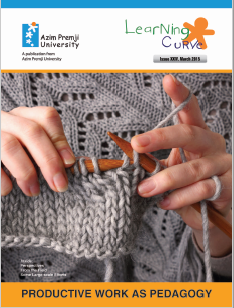
The starting point of this Issue is Mahatma Gandhi’s Nai Talim which he envisaged over many years and made available in 1937. Children learn by making and doing, and it is by relating these two to the larger context that the understanding of the whole picture emerges. It is this larger picture that this issue has attempted to present. This issue also explores the relevance of Nai Talim in the India of today. The explorations are on the idea of Nai Talim and the overall visions of a ‘good society’, rethinking Nai Talim in the light of the NCF of 2005, as well as in the present context.
Links


- Published
- Authors
Abstract
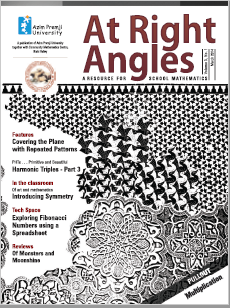
Volume 4 Issue 1: The lead feature in the March 2015 issue of AtRiA is based on the theme Proof Without Words. In the Review section, Mark Kleiner discusses Edward Frenkel’s Love and Math — the Heart of Hidden Reality. Thomas Lingefjard, in his article Learning Math with a DGE system, addresses a pressing need of teachers using technology in the classroom. This issue features a new author Ali Hussen whose article weaves in algebra, geometry and arithmetic. It also introduces a new series on Low Floor High Ceiling activities.The pullout continues on the Teaching of Geometry (part ii).
Links

- Published
- Authors
Links

- Published
- Authors

- Published
- Authors
Abstract
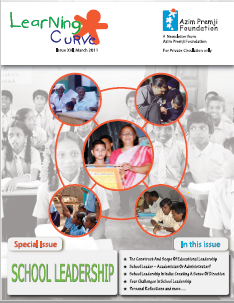
This issue of Learning Curve centres attention on the subject of ‘school leadership’. It defines the construct and scope of educational leadership, ruminates on whether a school leader ought to be an academician or an administrator, reflects on the challenges of school leadership and explores the forms of school leadership in India.
Links

- Published
- Authors
Abstract
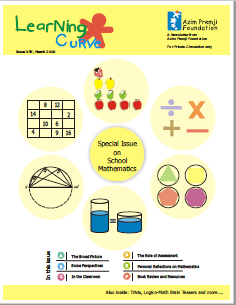
This issue of Learning Curve is cantered on the subject of Mathematics. While one article discusses the very nature of Mathematics, the other traces the history of the subject; similarly while one describes the pedagogy of the subject the other shares insights and the practical perspective of the teacher.
Links

- Published
- Authors
Abstract
In this issue of the Learning Curve, the tricky exercise of measuring learning is addressed by experts in the field and the much neglected area of Mathematics Education Research is discussed for its utility in diagnosing the difficulties students face in assimilating Mathematics.
Links