
Publications & Resources
Our faculty, students and researchers work together everyday to contribute to a better world by grappling with urgent problems we are facing in India. We conduct rigorous work to produce high quality learning resources and publications to contribute to public discourse and social change. Here, we feature a sample from our work for everyone to access. You can explore featured resources, policies, and the latest publications from the University.
To explore all the work of our University, please visit our publications repository.
CSE Working Paper Series
Gender Differentials in Expansion of Informal Enterprises
in Azim Premji University


- Published
- Authors
Abstract
The policy framework in India has provided support to the micro and small enterprises. In 2006, the Micro, Small and Medium Enterprises (MSME) Act 2006 came into existence (msme.gov.in). This Act aimed at promoting and developing micro, small and medium enterprises. In India, the MSME sector’s contribution to GDP was 17 percent of GDP during 2004-05 to 2009-10. More recently, a comprehensive policy called the National Policy for Skill Development and Entrepreneurship 2015 came into existence. This policy supersedes the National Skill Development Policy of 2009. The vision statement of the policy is “To create an ecosystem of empowerment by Skilling on a large Scale at Speed with high Standards and to promote a culture of innovation based entrepreneurship which can generate wealth and employment so as to ensure Sustainable livelihoods for all citizens in the country.” Recent policies such as demonetization and implementation of the Goods and Services Tax (GST) have created a setback for the micro enterprises that operated in the informal economy based mainly on cash transactions.
Authors:
- Jeemol Unni
- Ravikiran Naik
Links
CSE Working Paper Series
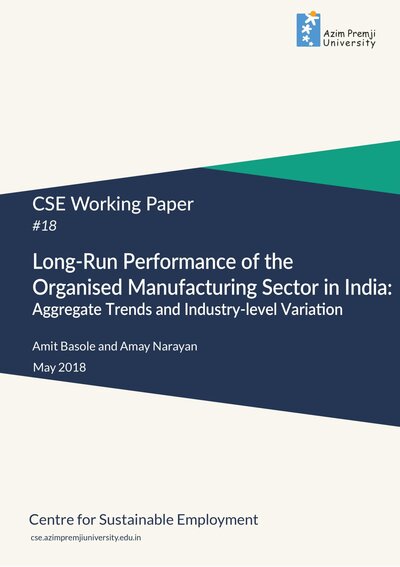
Long-Run Performance of the Organised Manufacturing Sector in India- Aggregate Trends and Industry-level Variation
in Azim Premji University
- Published
- Authors
Abstract
Despite its weak performance in terms of job creation in recent years, the organised manufacture sector remains vital to employment policy. This paper investigates the aggregate trends in this sector, in employment, output, labour-capital ratio, as well as wage share and wage rates at the three-digit NIC level over a long period from 1983 to 2016 using the Annual Survey of Industries data. We show that three distinct sub-periods can be identified within the overall period. Further, using shift-share decomposition we show that most of the decline in the L/K ratio can be explained by within industry changes. Finally, we analyze industries with respect to their capacity to deliver job growth as well as wage growth.
Authors:
- Amit Basole
- Amay Narayan
Links

- Published
- Authors
Abstract
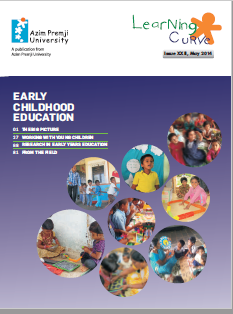
This issue of the Learning Curve focuses on one of the most important periods in any individual’s life — early childhood. Whatever differences there may be on any other aspect of education, this is one area on which everyone agrees: that the years between birth and eight are the most significant and can make or break a life. So universal is this that it is equally true in all cultures. You will find focus articles by some of the most well-known and much respected educationists in the country, followed by very practical and hands-on approaches to Early Childhood Education (ECE).
Links

- Published
- Authors
Abstract
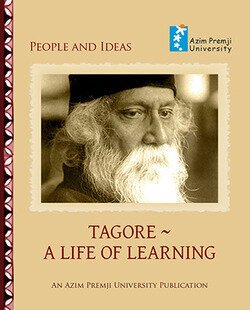
Azim Premji University attempts to explore ideas, lives and work of many social reformers, writers, thinkers and philosophers who have influenced us deeply, and fundamentally shaped our vision and philosophy. This graphic novel is on Rabindranath Tagore’s ideas and philosophy of education. Tagore is an educator for all times and his ideas are as relevant today, as they were when he lived. Tagore expresses in all his writings, that he experienced no joy while being taught by a series of teachers, or shifting from one conventional school to another. His approach to teaching grew from his life experiences. The school he set up in Santiniketan was ‘conceived to free the students’ minds and lead them to a state of creative unity where they would respect human beings, irrespective of caste or creed’. Tagore tried to inculcate the joy of learning among his students by integrating the classroom with nature. The myriad celebrations at Visva Bharati were envisaged to educate his students about the natural and human world around them, about collective action and community involvement. The dream was to foster complete human development where the unique potential of each child could flower in a happy and secure environment.
Note: Best viewed as two pages with the cover separate

- Published
- Authors
Abstract
In this issue of the Learning Curve, the importance of community participation in education is explored and we read about Bindooben, a highly remarkable teacher in Gujarat. Paulo Freire’s ‘Pedagogy of the Oppressed’, in which the author delineates the incredible potency of education as a tool for liberation (genuine revolution of the people) and its capacity to dominate people, is reviewed.
Links