
Publications & Resources
Our faculty, students and researchers work together everyday to contribute to a better world by grappling with urgent problems we are facing in India. We conduct rigorous work to produce high quality learning resources and publications to contribute to public discourse and social change. Here, we feature a sample from our work for everyone to access. You can explore featured resources, policies, and the latest publications from the University.
To explore all the work of our University, please visit our publications repository.

- Published
- Authors
Abstract
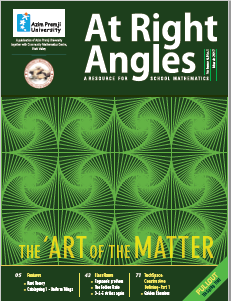
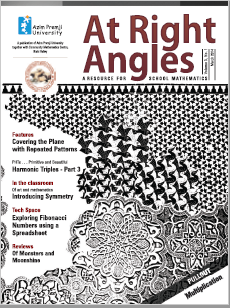
Volume 6 Issue 1: The Art of the Matter — can a picture be a powerful pedagogical tool? At Right Angles believes it can, and if you read the write up on the facing page, I’m sure you will agree with us. Going to the heart of the art is key to mathematics and there’s more of the same inside this issue. We begin with Ramya Ramalingam, a sixteen-year-old school girl, unravelling the mysteries of Knot Theory for us. And Haneet Gandhi picks up where her series on Tessellations stopped, with a fascinating article on tiling and the pictures we can create with different combinations and permutations of polygons.
In the Classroom section, Khushboo Awasthi opens up the Square Root Spiral with a series of investigative questions; Ujjwal Rane proves Fagnano’s Theorem in several innovative ways. CoMaC describes an unusual way to bisect an angle and also manages to pull yet another 3−4−5 triangle which has long connected math with art pops up in Kepler’s triangle — read more about it in Marcus Bizony’s article. And in How To Prove It, Shailesh Shirali uses Ptolemy’s theorem to reveal all kinds of fascinating relationships in cyclic quadrilaterals.Tech Space features the first part of a two-part series on constructive definitions; Michael de Villiers shows you how to do so with a GeoGebra activity centered on the golden rhombus. Truely cutting edge math pedagogy!
Our review this time is by Kamala Mukunda who shares her views on Liping Ma’s classic Knowing and Teaching Elementary Mathematics. This is a must-have for every school library and a must-read for mathematics teachers of all classes.
Finally, it’s Time — this Pull Out by Padmapriya Shirali will give you several new ideas to introduce this all important concept and help students quantify something which impinges on their consciousness long before they come to school.Links

- Published
- Authors
Links

- Published
- Authors
Abstract
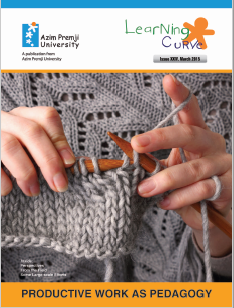
The starting point of this Issue is Mahatma Gandhi’s Nai Talim which he envisaged over many years and made available in 1937. Children learn by making and doing, and it is by relating these two to the larger context that the understanding of the whole picture emerges. It is this larger picture that this issue has attempted to present. This issue also explores the relevance of Nai Talim in the India of today. The explorations are on the idea of Nai Talim and the overall visions of a ‘good society’, rethinking Nai Talim in the light of the NCF of 2005, as well as in the present context.
Links

- Published
- Authors
Abstract
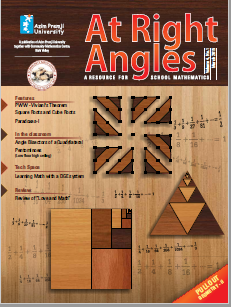
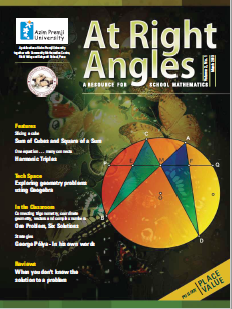
Volume 4 Issue 1: The lead feature in the March 2015 issue of AtRiA is based on the theme Proof Without Words. In the Review section, Mark Kleiner discusses Edward Frenkel’s Love and Math — the Heart of Hidden Reality. Thomas Lingefjard, in his article Learning Math with a DGE system, addresses a pressing need of teachers using technology in the classroom. This issue features a new author Ali Hussen whose article weaves in algebra, geometry and arithmetic. It also introduces a new series on Low Floor High Ceiling activities.The pullout continues on the Teaching of Geometry (part ii).
Links

- Published
- Authors
Links

- Published
- Authors

- Published
- Authors
Abstract
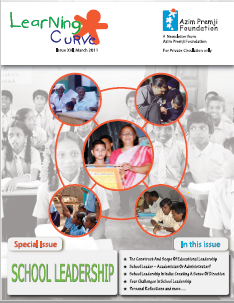
This issue of Learning Curve centres attention on the subject of ‘school leadership’. It defines the construct and scope of educational leadership, ruminates on whether a school leader ought to be an academician or an administrator, reflects on the challenges of school leadership and explores the forms of school leadership in India.
Links

- Published
- Authors
Abstract
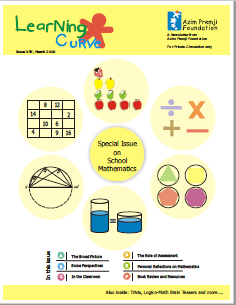
This issue of Learning Curve is cantered on the subject of Mathematics. While one article discusses the very nature of Mathematics, the other traces the history of the subject; similarly while one describes the pedagogy of the subject the other shares insights and the practical perspective of the teacher.
Links

- Published
- Authors
Abstract
In this issue of the Learning Curve, the tricky exercise of measuring learning is addressed by experts in the field and the much neglected area of Mathematics Education Research is discussed for its utility in diagnosing the difficulties students face in assimilating Mathematics.
Links