
Publications & Resources
Our faculty, students and researchers work together everyday to contribute to a better world by grappling with urgent problems we are facing in India. We conduct rigorous work to produce high quality learning resources and publications to contribute to public discourse and social change. Here, we feature a sample from our work for everyone to access. You can explore featured resources, policies, and the latest publications from the University.
To explore all the work of our University, please visit our publications repository.
Article
Connecting families with schools: The bureaucratised relations of ‘accountability’ in Indian elementary schooling
in Taylor & Francis
Article
- Published
- Authors
Abstract
Increasing community and parental connection with schools is a widely advocated means of improving levels of student learning and the quality and accountability of education systems across South Asia. This paper draws on a mixed-methods study of accountability relations in education in the Indian states of Rajasthan and Bihar. It explores two questions: what formal platforms exist to enhance connections between socially disadvantaged families and the schools serving them; and (how) do they influence engagement with student learning? It finds that various platforms have proliferated across public, low-cost private and non-government schools. But, while they promote enrolment attendance and monitoring, a substantive focus on student learning is empirically demonstrated to be missing everywhere. The paper argues that an apparently surprising similarity of (dis)connection is located in system features that are common across school types, locations and social structures. It proposes that this is a ‘field’ in which connection, facilitated by various platforms, is performed according to bureaucratised norms of accountability that even pervade family and community responses. Seeing this as a socially constituted ‘field’ that constrains meaningful discussion of learning across schooling provision for disadvantaged families contribute new insight for accountability-focused reforms in education.
Links
Article
The Social Contract and India’s Right to Education
in International Institute of Social Studies, The Hague; Wiley
Article
- Published
- Authors
Abstract
India’s 2009 Right of Children to Free and Compulsory Education (RTE) Act presents an idealised social contract which assigns roles to multiple actors to uphold a mutual duty, or collective responsibility, to secure children’s access to a quality school education. This article explores how the social contract assumed by the RTE Act misrepresents the conditions required to enact mutual responsibilities as well as actors’ agreement to do so. Qualitative data from Bihar and Rajasthan show how state actors, parents, community groups and teachers negotiate and contest the RTE Act norms. The analysis illuminates the unequal conditions and ever-present politics of accountability relations in education. It problematises the idealisation of the social contract in education reform: it proposes that if the relations of power and domination through which ‘contracts’ are entered into remain unaddressed, then expressions of ‘mutual’ responsibility are unlikely to do other than reproduce injustice. It argues that policy discourses need to recognise and attend to the socially situated contingencies of accountability relations and that doing so would offer an alternative pathway toward addressing structural inequalities and their manifestations in education.
Links
Article
Re-situating the Region: Media Technologies and Media Forms in India
in South Asian Popular Culture

- Published
- Authors
Abstract
There is an air of deceptive obviousness about the idea of the ‘region’. Inheriting a sense of assurance from long-established linguistic, geographical, and historical boundaries and contours, one feels secure in taking a somewhat simplistic cartographic view of the matter even as one acknowledges the overlaps and the blurring margins. But it shouldn’t take long to understand that the very use of the term ‘regional’ may imply that a researcher has probably placed himself/herself squarely at the centre, taking recourse to binary contrasts through a construct such as Bollywood or some other imaginary nub or vantage point from where she surveys the cultural margins, the nooks and the by lanes. What if one reverses this view to see things from within the region aiming one’s sights at the distant cultural firmaments? This is not mere wordplay but only an instance of everyday living! The real purpose here is to underline the plurality of stances, perspectives and viewpoints that may be applied for the study of culture. The ‘regional’ thus may mean not simply a location but also a stance and a perspective to be made explicit and to be acknowledged.
Authors:
Bindu Menon Mannil, Azim Premji University, Bengaluru
Ratnakar Tripathy, Asian Development Research Institute, Patna
Article
Education and good life in twenty-first century global south
in Journal of Human Values, Sage
Article
- Published
- Authors
Abstract
Since the last few decades of the twentieth century, we have been witnessing a major push towards universalization of school education in the countries of the Global South, both from policy advocates and from the grassroots. This verve in societal aspirations and policy action is definitely encouraging. However, this dynamism should also inspire us to rethink and reimagine the aims and practices of education in a rapidly changing context. Education as an organized human enterprise is intimately linked to the broader aims of human wellbeing, good life and justice. The policies and practices of Education for all, therefore, aim to realize these ideals. This special issue of the Journal of Human Values explores the significance of the prevailing conceptualizations of wellbeing, a good life and justice on education theories, policies and practices in the Global South.
Links
Article
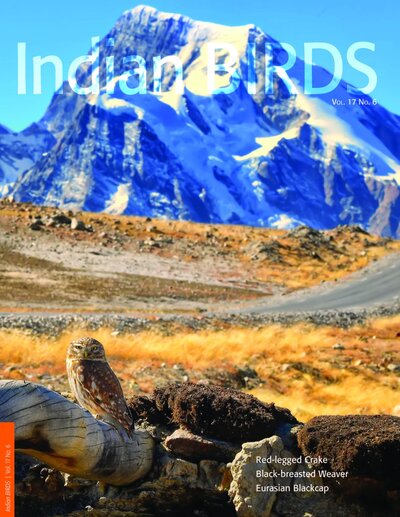
Does the male Indian Robin Copsychus fulicatus share incubation duties?
in Indian BIRDS, New Ornis Foundation

- Published
- Authors
Abstract
During our frequent visits to the countryside of Solapur city, we observed an unusual behaviour in a pair of Indian Robins Copsychus fulicatus. It was a hot summer day in May 2021 and we noticed the pair collecting nest material such as grassroots, twigs, and hair. The nest was situated on a 1.5 m high mound of soil. To avoid disturbing them, we observed them from a distance of c. 9 m, with the help of 10x binoculars and 65x camera. The location of the nest was clearly visible — in a westward-facing hole, 1.4 m above the ground.
Links
Article
Reconceptualising rehabilitation of female survivors of violence: The case of Sampoornata Model of Dance Movement Therapy (DMT) in India
in Women & Therapy
Article
- Published
- Authors
- Rhea Kaikobad
Abstract
This article discusses an intervention for rehabilitation of female survivors of violence that reconceptualises rehabilitation through a feminist lens: the Sampoornata model of Dance Movement Therapy (DMT), which has been created and is being practiced by an NGO called Kolkata Sanved in Kolkata, India. Feminist rehabilitation is seen as a perspective which, in contrast to dominant rehabilitation praxis, recognises that individual experiences of violence are embedded in patriarchal social structures and aims for survivors to internalise a sense of agency by deconstructing internalised patriarchal norms that legitimise violence against women and girls and stigmatisation of survivors. The article highlights how Sampoornata enacts feminist rehabilitation through the medium of the body. Survivors reclaim the body from patriarchal control and reflect on the embodied experience in order to question patriarchal norms, remove self-blame, and negotiate a space for themselves within society.
Links
Article
‘Gaze’ and ‘Bodies’ in popular print: Understanding the changing representation of women in visual culture
in Journal Of Media And Communication


- Published
- Authors
Abstract
The paper attempts to develop arguments around concepts like ‘Gaze’ and the understanding of ‘bodies’ within popular culture. In its discussion on the ‘male gaze’, it raises pertinent questions of ways in which, with the rise of consumerism, the women’s representation, particularly in the popular media, has become more vulnerable. This paper has tried to problematise the existing notion of popular women’s magazines as ‘best companion for women’, as they are fraught with contradictions of what they claim to be and represent. The paper further explores the changing meanings of representation particularly with the advent of globalisation and the rise of the beauty industry.
Links
Article
- Published
- Authors
- School of Policy & Governance
Abstract
A recent writ petition on renaming India as Bharat, which got dismissed by the Supreme Court, is discussed. There are political motives behind naming or renaming a place, but Hindustan, Bharat, and Hind — are all part of the package that is India.

- Published
- Authors
- School of Education
Abstract
An immigrant, who worked in an American machine shop, acquired polite standard spoken English by reading romance novels in an 18-week adult extensive-reading English as a Spoken Language (ESL) class. Full time employment in the machine shop and once-a-week class discussions provided the only places where the student was routinely exposed to spoken English.