
Publications & Resources
Our faculty, students and researchers work together everyday to contribute to a better world by grappling with urgent problems we are facing in India. We conduct rigorous work to produce high quality learning resources and publications to contribute to public discourse and social change. Here, we feature a sample from our work for everyone to access. You can explore featured resources, policies, and the latest publications from the University.
To explore all the work of our University, please visit our publications repository.
CSE Working Paper Series
Rural Transformation in India: What can we learn from village studies?
in Azim Premji University

- Published
- Authors
Abstract
This article examines rural transformation in India through a review of longitudinal village studies conducted over the past three decades. It argues that rural India is not undergoing structural transformation in the classical sense. While labour is steadily moving out of agriculture, this shift has not led to higher productivity in agriculture or the development of a robust rural nonfarm economy. Instead, what unfolds is a process of deagrarianisation, driven by out-migration of male workers to cities where they engage in informal nonfarm employment. This transition is uneven and remains deeply embedded in existing hierarchies of caste, class, and gender, which shape both access to opportunities and outcomes. By identifying common patterns across diverse regional contexts, the article shows how village studies provides a grounded perspective on the nature of rural change.
Author:
C.R. YaduLinks
CSE Working Paper Series
Social norms and women’s employment in India: A district level analysis
in Azim Premji University

- Published
- Authors
Abstract
Reducing gender disparities in workforce participation is an important policy goal in several developing countries. India, in particular, has historically had low levels of women’s workforce participation as compared to men and as compared to peer economies. Prior research has identified both supply and demand-side explanations for low levels of women’s participation in paid work. On the supply side, social norms constraining women’s mobility and autonomy are commonly invoked as one explanation. We test the relevance of such norms in explaining heterogeneity in women’s employment using district-level data from the National Family Health Survey (NFHS) 2015 – 16 and the Sixth Economic Census (2013). Norms indices are constructed using Principal Components Analysis for 640 districts of India. The findings indicate that less restrictive norms related to decision-making, mobility, and asset ownership are positively correlated with higher levels of women’s employment.
Authors:
Subhapriya Chakraborty and Amit Basole
Links
Report
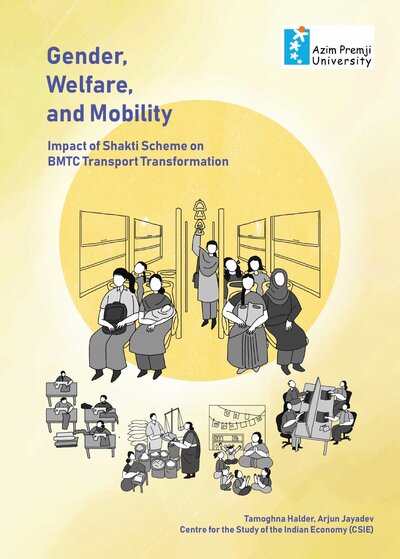
Gender, Welfare, and Mobility: Impact of Shakti Scheme on BMTC Transport Transformation
in Azim Premji University

- Published
- Authors
Abstract
The Shakti scheme, launched by the Government of Karnataka in June 2023, represents one of the most ambitious efforts in India to reimagine welfare by providing free public transport for women. Unlike welfare programmes based on targeted cash transfers, this scheme redefines inclusion through the provision of a universal, non-cash public service mobility. This report is an assessment of the evolution of the scheme with specific regard to the BMTC’s experience. In the period studied– January 2023 to March 2025, covering both pre- and post-implementation phases – the scheme generated a significant surge in bus usage across the state. With more than 2.89 crore trips recorded, a striking transformation in mobility patterns was observed. Importantly, women riders quickly outnumbered men on many of the busiest routes– especially in the Central Business District, reflecting a major shift in access to and usage of public transport. The ridership gains were particularly sharp in the first six months following the scheme’s launch and have since stabilised, indicating a sustained and regular usage pattern among women. The report is divided into three sections. In the first, the researchers discuss state-level free travel schemes. They address certain questions about Karnataka’s experience within wider debates about universalism versus targeting in social policy. In the second, they discuss the report, its methods and findings. In the final section, they discuss some potential paths forward.
Chapter in a Book
Neoliberalism and Women’s Work: A Study of the Informal Economy in India
in Taylor & Francis

- Published
- Authors
Abstract
In this chapter, the researchers critically examine the emancipatory role of neoliberalism with a focus on women’s work in India. They argue that the multi-pronged crisis afflicting the labour market is a fallout of the implementation of the neoliberal project in India that had severely impacted women workers, who typically are one of the oppressed sections in society. They argue that neoliberalism leads to the proliferation of social orthodoxies that promote patriarchal gender contracts whereby men are the primary breadwinners while women are mainly responsible for social reproduction in the ‘domestic’ space.
They highlight that the neoliberal regime in India is associated with declining participation in paid work for women workers, notwithstanding the rapid growth rate of the Gross Domestic Product (GDP) that the economy has been witnessing. This is in the backdrop of India having one of the lowest rates of participation in paid employment of women workers. They claim that women’s work participation in India is affected by the production conditions in Indian agriculture and the burden of unpaid care work. However, increased participation in paid work — the quantitative dimension — does not necessarily lead to women’s empowerment under neoliberalism. This is largely due to the proliferation of the informal sector, which has been the major source of paid work for women workers. The researchers contend that women workers encounter two layers of subordination and control in the labour market that become acute in the informal sector, which is associated with a lack of worker’s rights. They are subordinated, first, by the dominance of capital and, second, by the patriarchal social order. These, in turn, adversely impact the quality and economic value of women’s work. They argue that the degradation of the economic value of women’s work has led to the accentuation of the gender bias that endangers the chances of survival of the girl child in a society characterised by deep-rooted patriarchy.
The contemporary precarity of women’s work — in terms of quantity and quality of work — also reflects the existing social orthodoxies that loom large in the private and public domains in India. Lastly, based on the latest Periodic Labour Force Survey database, they argue that the COVID-19 pandemic has widened the structural inequalities in the economy and added a layer to the existing vulnerabilities of women workers.
Authors: Mampi Bose, Shantanu De Roy
Links
Article
Trajectories of Labour Market Transitions in the Indian Economy
in World Development, Elsevier

- Published
- Authors
Abstract
The Indian economy, despite registering high growth, is characterised by a persistent and vast informal economy. Using it as an illustration, the researchers draw lessons for characterising labour markets in contexts of high informality. They employ a group-based statistical modelling method to identify whether there exist systematic patterns in the high volume of worker transitions across different employment arrangements. Using panel data for eight points between 2017 and 2019, they identify seven dominant labour market trajectories. The trajectory capturing stable formal salaried employment, with highest average earnings, accounts for only 6.7% of the sample. None of the dominant trajectories denote a job ladder from informal to formal work, and the sorting of individuals into informal trajectories is far from voluntary, indicating an existence of formal and informal segmentation. The most populous trajectory, comprising 38.4% of the sample, with second highest average income (although half of that of the formal salaried trajectory), is stable self-employment, followed by the trajectory representing transition within different forms of informal wage work at 27.2%. Most trajectory groups associated with informal wage arrangements have high flux, indicating lack of stability. Furthermore, trajectories associated with informal wage employment have even lower earnings than those with informal self-employment. Far from suggesting a desirability of informal self-employment, this is indicative of a breaking down of the expected voluntary transition from self to wage employment in the transformation process. Additionally, access to trajectories is stratified along various correlates, especially caste. Caste hierarchy operates most starkly at the node of accessing the trajectories, while in terms of penalties or gains in earnings, traditional caste-hierarchy may not always operate uniformly. The findings disrupt the standard expectation in structural transformation models and labour market theories, while highlighting the need to foreground evolving nature of informality in labour market models for developing economies.
Authors: Rosa Abraham, Surbhi Kesar
Links

- Published
- Authors
- School of Arts and Sciences
Abstract
Reflecting a longstanding intellectual heritage in Marxist political economy, contributions to agrarian studies have variously referred to the production, distribution and extraction of value. Despite this central role within the heritage of agrarian studies, the concept of value is often used inconsistently between authors and sometimes deployed without clear elucidation of the underlying theoretical tenets. As such, value often tends to be used more as a metaphor suggestive of conditions of exploitation rather than a detailed conceptual framework. In response, we must ask if there is still a robust case for value analysis forming a foundational pillar of agrarian studies? To address this challenging question, we invited three authors to give their perspective on the value of value for agrarian studies. First and foremost, we asked them to consider what value analysis does that is otherwise missed in critical agrarian studies and how we can mobilise its potential to sharpen analyses. Two further pivotal questions arise, spurred on by recent trends in the literature. First, to what extent do the categories of value enrich or hinder our evolving understanding of the dynamics of social reproduction within agrarian households and communities, including the gendered relations through which agriculture and livelihoods are performed? Similarly, are the largely anthropogenic concepts of value fit for the purpose of explaining environmental change and the more-than-human dynamics through which agricultural landscapes are produced and change over time?
Authors: A Haroon Akram-Lodhi, Srishti Yadav, Alessandra Mezzadri, Marcus Taylor
Article
Methodological Holism in Marx’s Capital Volume 1: The Conceptualisation and Measurement of Individual Units
in Review of Development and Change, Sage

- Published
- Authors
Abstract
This article aims to understand the methodological position that Marx takes in Capital Volume 1 and the implications of that on the individual units in his analysis. With the understanding that Marx adopts a fundamentally holist methodological standpoint, the article outlines how the individuals within classes and the system of capitalist production are measured and contextualised. This question is answered by examining Marx’s Capital Volume 1 as the primary text. Where relevant, the researcher engages with Marx’s intellectual background and tradition. The individual units discussed in this study are the commodity, the worker and the capitalist.
This article examines how the concept of the representative individual emerges through averaging and how this process unfolds in Marx’s Capital, shaped by his methodological approach. The article illustrates the method of averaging in Marx, through his intellectual engagement with Quetelet as it also focuses on Hegel’s influence on Marx’s method and elaborates on the parallels and divergences between them. With the given engagement with Capital and Marx’s intellectual interactions, the researcher arrives at a specific understanding of holism that can be attributed to Marx in Capital Volume 1.
Author: Sushmita Rama Subrahmanyam, Student, MA in Economics (2024−2026)
Links