
Publications & Resources
Our faculty, students and researchers work together everyday to contribute to a better world by grappling with urgent problems we are facing in India. We conduct rigorous work to produce high quality learning resources and publications to contribute to public discourse and social change. Here, we feature a sample from our work for everyone to access. You can explore featured resources, policies, and the latest publications from the University.
To explore all the work of our University, please visit our publications repository.
CSIE Working Paper Series
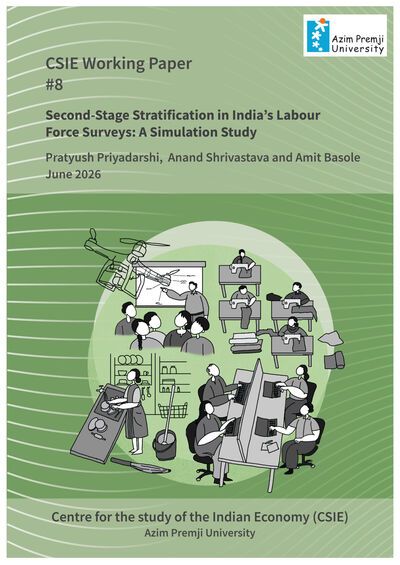
Second-Stage Stratification in India’s Labour Force Surveys: A Simulation Study∗
in Azim Premji University

- Published
- Authors
Abstract
In this paper, we examine the utility of second-stage stratification within the first-stage units (FSUs) of large-scale sample surveys, focusing on India’s official labour force surveys, namely the NSSO Employment-Unemployment Survey 2011-12, the Labour Bureau Employment-Unemployment Survey 2013 – 14, and the Periodic Labour Force Survey 2022 – 23. These three surveys stratify households within the FSU in different ways, and we examine the implications of these choices for the statistical precision of the resulting estimates. Using Monte Carlo simulations on FSUs constructed from PLFS 2022 – 23 unitlevel data, we estimate the variance of each design across three labour market outcomes: labour force participation rate (LFPR), unemployment rate (UR), and labour income. Our primary finding is that the household-level stratification designs employed in these surveys do not necessarily improve precision. For labour force participation and unemployment, simple random sampling outperforms stratification in most FSUs. In general, gains depend critically on the correlation between the stratification variable and the outcome of interest. We propose an alternative education-based scheme that combines lower secondary (10th pass) and graduate attainment. This design raises the median efficiency gain over the PLFS by about 14% for unemployment and 17% for income. We conclude with some reflections on the factors that are relevant to the choice of stratification design.
*We thank Anmol Somanchi and Prof G.C. Manna for helpful discussions. Views are authors’ and do not necessarily represent those of their institutions
Authors:
Pratyush Priyadarshi, Anand Shrivastava, & Amit Basole
Links

- Published
- Authors
Abstract
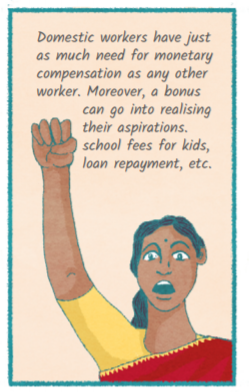
This booklet is based on a two-year study of domestic workers conducted by faculty at Azim Premji University.
Please share it with friends and family so that more people and employers are aware that domestic workers need to be accorded their due rights and be treated with dignity.
The focus of the research is the work and lives of ‘domestic workers’ (henceforth, DW) in Bangalore, especially their struggles to form collectives as part of their attempt to transform their subjectivities from ‘servant’ to ‘worker’, and improve their life and work situations. Domestic work is precarious work constituting a large part of India’s informal economy. It exists within a political economic context signaled by rising incomes of urban middle and upper classes and the existence of a steady supply of working-class women (from mostly stigmatised castes but across all religions) ready for domestic work. It is also enabled by a cultural-ideological context signaled by the preference to engage DWs as a normalised cultural marker for upward mobility. Our research demonstrates the struggles of DWs, the dilemmas and obstacles they negotiate for their empowerment. It focuses on the collective actions of DWs in their workplaces, their families and neighborhoods, and within unions and labour-NGOs engaged in organising DWs for “formalisation” of work, demands for a ‘decent’ wage and work conditions, and innovations in the form and content of their collective rights.