
States account for nearly 90 percent of India’s social sector spending as Centre’s share declines: Study
For the study, Azim Premji University analysed allocations and spending patterns under major schemes, highlights Priyansh Verma in Moneycontrol.
Details
Access the handbook here:
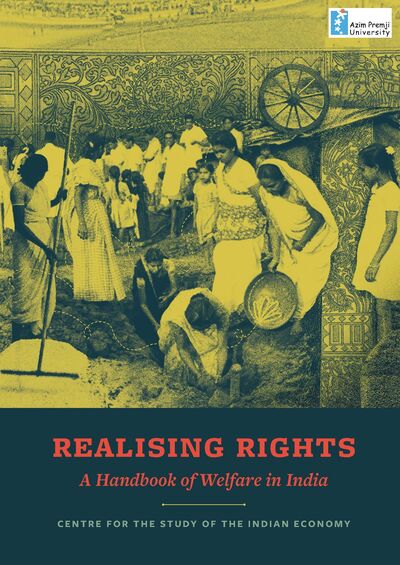
Realising Rights: A Handbook of Welfare in India
in Centre for the Study of the Indian Economy, Azim Premji University

- Published
- Authors
Abstract
This handbook maps the major interventions of the Union government that together constitute India’s welfare regime. India’s welfare architecture affects the lives and livelihoods of hundreds of millions of people. Understanding how these programmes were created, how they have functioned, and the extent to which they achieve their stated objectives is a matter of considerable economic, social, and political importance. This volume seeks to provide a systematic assessment of these interventions and their place within India’s broader development trajectory. The handbook brings together 18 chapters across the major welfare domains and a set of cross-cutting themes. In addition to the macroeconomics of welfare, the domains covered are: maternity entitlements, the Integrated Child Development Services (ICDS), mid-day meals, the Public Distribution System (PDS), rural employment guarantee, social security pensions, school education, health, PM-JAY, the Right to Education Act, PM-KISAN, and state-level unconditional cash transfers. Chapters on social justice, social accountability, decentralisation and digitisation address the cross-cutting dimensions that shape delivery across the entire architecture.
Editors: Bhargav B S, Dipa Sinha, Rajendran Narayanan, Revati Mathai, Vijay Ram S
Support Files:
Links