Never too young to synthesise
Sathish C G speaks about his journey, the “superpower” of chemists, and sharing the excitement of synthetic chemistry with undergraduates at the university.
Details
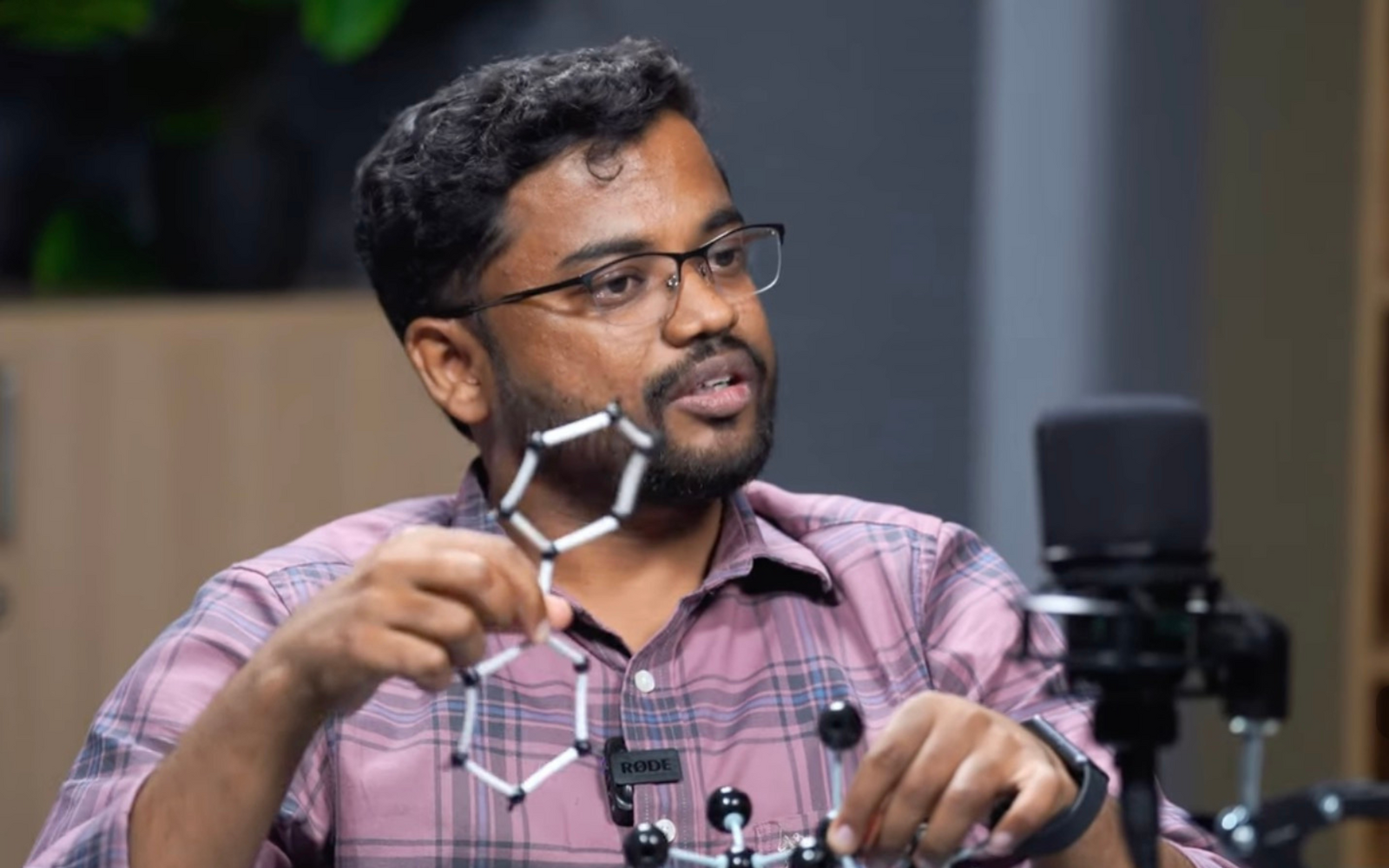
When the news of the 2025 Nobel Prize in Chemistry broke, an unexpected cheer erupted far away from Stockholm, in a college chemistry lab in Bengaluru. Just a week before, Sathish C G had introduced his class to metal organic frameworks (MOFs), a contemporary and versatile class of compounds designed to have large cavities capable of capturing and storing specific substances. The students were about to prepare their first MOFs when it was announced that Susumu Kitagawa, Richard Robson, and Omar M. Yaghi had won the Nobel for discovering these very compounds. For their professor Sathish, the timing felt like a sign that he was on to something good.
Students should get exposed to what is happening in the current scenario
In recent years, synthetic chemists have developed techniques to design and synthesise extremely useful inorganic compounds in the lab. As a PhD student in Germany, Sathish developed light-emitting chemical complexes that could be used to image biological material. MOFs are another class of synthetic compounds which have a range of powerful applications ranging from harvesting water from air, storing toxic gases, and catalysing chemical reactions, to separating proteins, acting as a cargo for biomolecules, and storing hydrogen for clean energy. It is in recognition of this that Kitagawa, Robson and Yaghi won the Nobel last year.
That was also the year Sathish was teaching his course “Inorganic Synthesis”, for the first time. It deals with inorganic compounds, their structures, reaction mechanisms, catalysis and applications. This is not a topic that typically finds a presence in undergraduate syllabi, but having experienced the excitement of synthetic chemistry up close during his PhD, Sathish was determined to share it with his third year students. According to him, “students should get exposed to what is happening in the current scenario”.
Formative years
Sathish’s ideas for chemistry education emerged from his own journey in the field. Growing up in his native village in Chikmagaluru, Karnataka, he did his primary schooling at the local public school where standards of science education were unremarkable. He then shifted to the more prestigious Jawahar Navodaya Vidyalaya located in the same district. These residential schools were set up in the 1980s precisely with the goal to give children from rural areas access to quality education. Here, the teachers opened Sathish’s eyes to what a life in science could look like. By the time he completed secondary education, he chose to pursue mathematics and science, which was unusual at the time for academically brilliant students like himself. “Most of my friends took up engineering or medicine,” he recalled.
During his BSc in Physics, Chemistry and Mathematics at Bangalore University, his interest in chemistry grew, thanks to his college professor as well as an internship he did at Sanjib K. Patra’s lab at IIT Kharagpur. He followed this up with a Masters’ in Chemistry at NITK Surathkal, which included another research internship at Jawaharlal Nehru Centre for Advanced Scientific Research (JNCASR) in Bengaluru. For his PhD, Sathish looked westwards, however this was a prohibitively expensive prospect. To overcome this obstacle, he decided to focus on Europe — particularly, German universities where the science was good and there was no application fee.
Ultimately, Sathish secured a PhD position at the laboratory of Cristian A. Strassert at the University of Münster. Not only was he offered the opportunity to pursue research in his area of interest, synthetic chemistry, all his expenses would be covered by the scholarship he was awarded by the university. In 2020 when the pandemic struck, Sathish was in the final year of his PhD; fortunately, he had completed his research. Stuck at Münster for over a year, he used the time to write up his papers and his thesis. His work became published in top journals and Sathish seemed all set for a promising career in research. However, he was starting to have different ideas. The uncertain state of the world during the pandemic as well as a book he read (Man’s Search for Meaning by Viktor Frankl) prompted him to think deeper about what he wanted to do with his life.
It’s not necessary for everybody to do research, but surely there should be some aspect of hands-on experience within the constraints of our realities?
‘There is always uncertainty’
During these weeks of contemplation, he kept circling back to education — more specifically, undergraduate chemistry education. It struck Sathish how formative his own early brushes with research ended up being — the eye-opening experience at an INSPIRE science camp as a high schooler, and the internship at IIT Kharagpur through the Indian Academy of Sciences during his Bachelor’s. He knew this kind of exposure was extremely rare for students of science in India, but it seemed much more universal for German students. “In Germany, BSc students used to join our research group regularly and spend two or three weeks with us. This was a part of their programme,” he observed. Sathish was aware of the obvious contrast in scale (geographical and population) of Germany and India, yet he found himself unable to accept the current state of affairs in science education in his country. “It’s not necessary for everybody to do research, but surely there should be some aspect of hands-on experience within the constraints of our realities?”
And so, instead of continuing postdoctoral research in the buzzing field of photofunctional complexes and nanohybrids, Sathish began searching for places back home where he could work on chemistry education. This led him to Mumbai’s Homi Bhabha Centre For Science Education (HBCSE), which is dedicated to science and mathematics education. When he informed his advisor at the University of Münster of his plans, the latter was momentarily taken aback but then realised that the promising young chemist was determined. Unconventional decisions were not new to Sathish, after all. “You see, there is always uncertainty, more so during that COVID time. Moreover, I had already taken risks by not taking up engineering or medicine. So I thought, okay, let me do this and see what happens.”
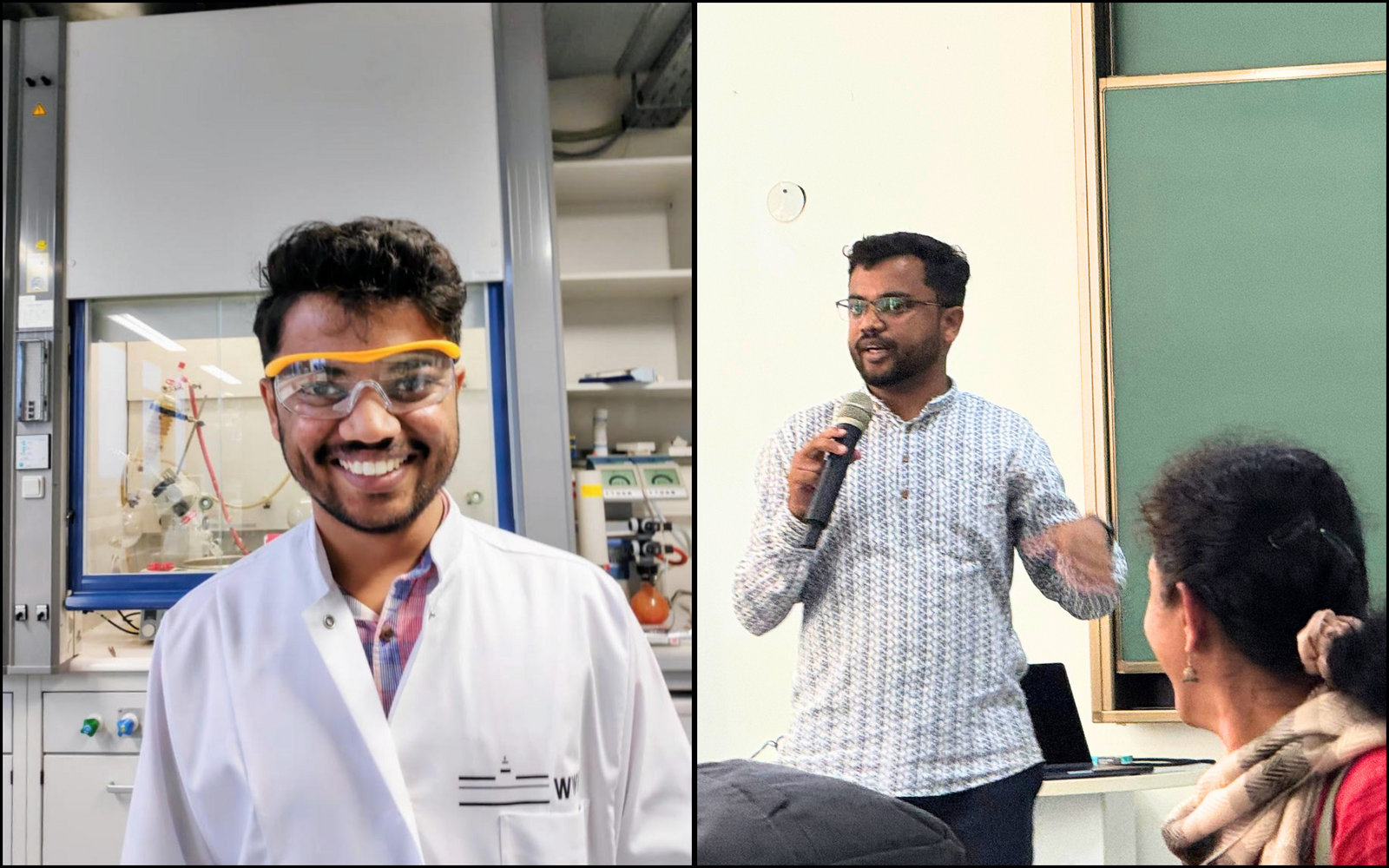
At HBCSE, Sathish realised how different science education was to lab-based research. “When we work with chemicals, we know how they behave. There is some consistency. But this is not so when it comes to working with humans, whether students or teachers. That was eye-opening to me,” he admitted. About two-and-a-half years later, Sathish returned to his home state of Karnataka, this time as an Assistant Professor of chemistry at Azim Premji University, a place he feels was ‘tailor-made’ for because of how seriously pedagogy is taken.
The making of a good chemist
At the university, Sathish is intent on putting into practice all his learnings so far. Guiding him at every step is his firm belief that chemistry is best learnt by doing. “There are skills very particular to a chemist and these can only be obtained by doing, not just by reading,” he emphasised. One of those skills is synthesis.
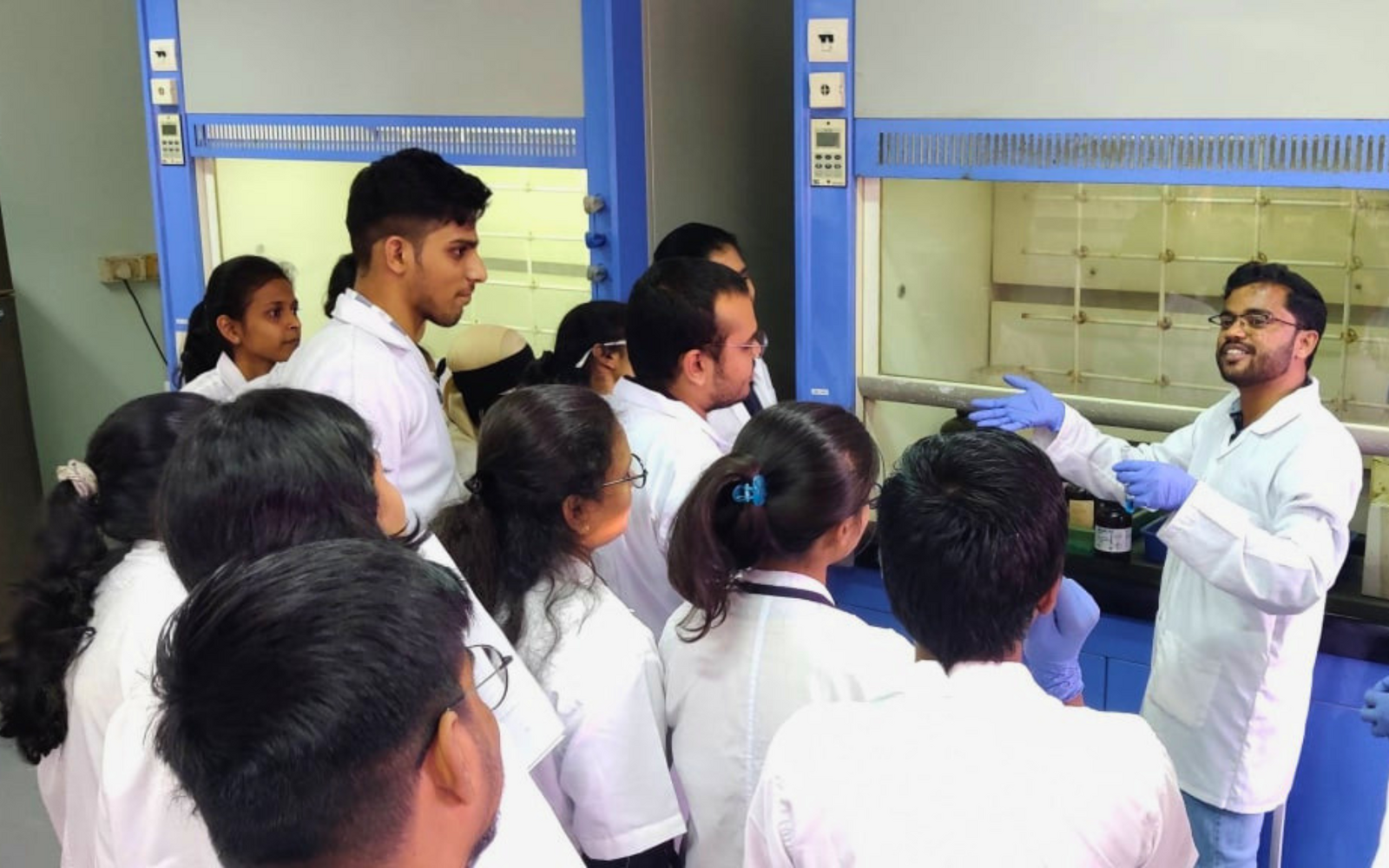
Sathish loves to say this to his students: “Chemists have a superpower: we can create stuff that never existed before on Earth.” He counts himself lucky to be able to go one step further and back his words up with actual demonstration. That’s what this new course he developed is about: creating big, new and useful molecules from smaller, common and inexpensive ones, using techniques that are non-hazardous for the environment. Most recently, his second batch of students synthesised some new complexes and studied the kinetics of the reactions involved using a spectrophotometer, a device that measures the intensity of transmitted radiation at specific wavelengths. He believes that the course (along with other aspects of the university’s chemistry lab) will impart to his students fundamental skills that will be useful to them whether they pursue research or enter the industry.
When we work with chemicals, we know how they behave. There is some consistency. But this is not so when it comes to working with humans, whether students or teachers.
Considering the long way he has come, Sathish is extremely passionate about making quality chemistry education accessible to all. Time and again he is reminded that this is still a distant goal. He recalled a teacher education workshop at the university where after a day of demos, a college teacher participant wistfully commented to Sathish that he was in a chemistry teacher’s “heaven” just because of how much freedom he had to try so many effective teaching methods. “Hopefully, the education system will become robust in the near future. For now, I feel that I should do well by these kids who come to us and pursue a bachelor’s.”
About the Author
Nandita Jayaraj is a Science writer and Communications Consultant at Azim Premji University.