
Publications & Resources
Our faculty, students and researchers work together everyday to contribute to a better world by grappling with urgent problems we are facing in India. We conduct rigorous work to produce high quality learning resources and publications to contribute to public discourse and social change. Here, we feature a sample from our work for everyone to access. You can explore featured resources, policies, and the latest publications from the University.
To explore all the work of our University, please visit our publications repository.
Article
The “Global Learning Crisis”: The Classroom View from Kanchipuram, India
in Comparative Education Review
Article
- Published
- Authors
Abstract
“Global learning crisis” narratives, in focusing on the “proximate determinants” of the crisis, represent a welcome “classroom turn” in international education and development. Extant learning crisis literatures are problematic, however, as their homogenizing gaze distorts how teachers and students co-constitute classrooms as locally meaningful learning spaces. Drawing on anthropological approaches in comparative education, this article addresses the “learning crisis” in a middle-school classroom in a weavers’ neighborhood in Kanchipuram. Constituted in an elaborate “notebook economy,” this classroom was an inventive response that not only accommodated students’ material cultures and social-educational disadvantages but also affected their belonging in a resource-scarce public education system. If the learning it afforded was disdained in “learning crisis” narratives, it was nevertheless relevant for students, readily translated into educationally unintensive assembly-line jobs. In producing contempt for such classrooms, “learning crisis” narratives merely distract from — and thus entrench — the deeply unequal economic and educational development that necessitated the notebook economy in the first place.
Article
Reasonable Accommodation and Interdependence: Revisiting the Dynamics of Disability Inclusion in Higher Education in India
in Journal of Gender Studies

- Published
- Authors
- Meghana Rao
- Shilpaa Anand
Abstract
The principle of reasonable accommodation according to Article 2 of the United Nations Convention on the Rights of Persons with Disabilities (UNCRPD) is defined as ‘necessary and appropriate modification and adjustments not imposing a disproportionate or undue burden, where needed in a particular case, to ensure to persons with disabilities the enjoyment or exercise on an equal basis with others of all human rights and fundamental freedoms’. Exploring the relationship between inclusive policies enacted in institutions of higher education in India, and their impact on those who claim accommodation, we discuss the nature of care that informs and animates such interactions. Drawing on feminist disability studies scholarship on care, particularly, Akemi Nishida’s recommendation that care is inherently collective we analyse two sets of transactions selected for study as enabling care in patronising and charitable manners, while simultaneously ignoring the politics of responding to and providing accommodations. We find that institutional responses to accommodation claims are less reflective of the socio-political and affective aspects integral to the RA principle. Instead, the focus seems to be on providing either technocratic solutions or interpreting RA claims as causing undue burden. By reading the RA principle through the lens of scholarship on interdependence, we aim to broaden the scope of adopting and interpreting the RA principle.
Links
Article
Understanding Graphical Literacy Using School Students’ Comprehension Strategies
in Contemporary Education Dialogue
Article
- Published
- Authors
Abstract
Graphical literacy or graphicacy is a critical component of scientific literacy. Graphs are used to integrate and represent complex sets of information requiring abstraction from perceptual experience. They form essential parts of the Mathematics and Science curriculum across school curricular stages. A key to developing meaningful pedagogic practices to inculcate graphical literacy is in understanding how students perceive and comprehend features of graphs and interpret them. This study attempts to understand how children from the primary, middle and high school years, perceive and interpret information in bar and line graphs. Two hundred and twenty-nine children from four different school contexts in Grades V, VII and IX were administered questionnaires and interviewed based on tasks requiring comprehension of graphs. It was found that children’s understanding of graphs was tied to the curricular progression which was significant at Grades V and IX. Comprehension of bar graphs with nominal data was easier compared to line graphs requiring integration of information from two dimensions and interpreting them. Further, graphs requiring preliminary levels of statistical understanding were easier to comprehend. While prior experience and facility with graphical conventions played a role, interpretation from spatial to symbolic representations posed challenges. Students did not have a clear preferred strategy or a linear comprehension trajectory, but moved back and forth between conventions, clustering of graphical elements and written content in questions, to make meaning. Those who had performed well used various perceptual strategies simultaneously. Further, they were found to employ transformational reasoning based on a sense of ‘how things work’. It was observed that meaningful pedagogic practices at school and informal experiences outside the classroom aid graphical literacy.
Authors
Article
Schooling and Constructions of Citizenship: Some Reflections on Student Agency and Choice
in Contemporary Education Dialogue

- Published
- Authors
Abstract
A national system of education in modern nation-states is usually geared towards nation-building and schools play a significant role in grooming children as future citizens. While the dominant and powerful usually emerge as the ‘ideal citizen’ in the national imagination, the marginalised are constructed as the ‘other’, vilified, and stigmatised. The school, with its overt and hidden curriculum, operates as a major site for the reproduction of dominant ideology while at the same time creating opportunities for exercising human agency. This article, an ethnographic study conducted in a government co-educational school in Delhi, examines how it sought to mould the students into ‘ideal’ citizens and how this was received by them. Belonging to a relatively lower socio-economic background compared to the teaching community, did they give their acquiescence? Or were they able to exercise their agency to challenge the entrenched power structures in society? Were their responses shaped by their specific social locations and the unfolding of ‘cultural politics’? Moreover, when the nature of ‘official knowledge’ itself has undergone radical shifts and the idea of citizenship has been redefined with the introduction of the National Curriculum Framework 2005, were the students able to leverage the epistemological shifts embodied in the textbooks to reimagine and construct ideas of citizenship regarding marginalised communities? These are some questions that the present article seeks to address.
Article
Monolingual Ideologies in Multilingual Classrooms: Exploring Tacit Aspects of the Indian Education System
in Language and Language Teaching

- Published
- Authors
- School of Education
Abstract
Globalisation has resulted in ever increasing linguistic diversities and a worldwide recognition of the need to support linguistic pluralism through education (UNESCO, 2003). Keeping abreast with the global trend, India’s education policy has provided for the cultivation of multilingualism by including at least three languages in the curriculum. However, in reality, India’s education system is guided by monolingual ideologies that disregard multilingual realities and promote a form of “monolingual multilingualism” (Neumann, 2015). This translates into separatist pedagogy and practices that keep languages strictly compartmentalised at schools. Different time slots are allotted to teaching learning of disparate languages. Proficiency in a language is interpreted as the ability to use it without “resorting” to any other language. In effect, monolingual ideologies function to reject translanguaging (Garcia, 2009), or natural language practices of multilinguals, that enter into classrooms. Strategies such as code-switching and translating are invalidated when they occur in spoken or written conversations in classrooms. This article aims to study the monolingual ideologies that permeate the education system to understand their implications for the process of teaching and learning in Indian classrooms.
Article
- Published
- Authors
Abstract
The canvas of science education needs to be viewed in its totality to prevent the confounding of some basic issues and to enable us to evaluate the fads and fashions in educational practice. Policies and processes in education are tacitly shaped by theories in the humanities and social sciences. Inadequate understanding of these theories, or the lack of attention to uncalled-for implications of their practical import, takes education in undesirable directions. To be a good science teacher has never been easy. The teacher is a master of knowledge in science. But that is not all. She is equally committed to the principles governing the practice and communication of science.
Article
Migrant childhoods and temporalities in India: A reflective engagement with dominant discourses
in Journal of Childhood Studies

- Published
- Authors
- School of Education
Abstract
Temporality is recognised as critical to the understanding of childhoods by contemporary scholars of childhood. This paper explores the varying temporalities through which marginal childhoods (and their educational inclusion), particularly those situated in contexts of temporary internal migration, are constructed in the Indian context. Drawing on ethnographic data from the city of Bengaluru, this paper problematises how dominant ideals around migration, childhood, and schooling frame migrant children’s lives through linear temporalities. Furthermore, the paper argues that policy interventions that ostensibly include migrant childhoods do not engage critically with the politics of linear temporality which, in turn, is central to the exclusionary dynamics of migrant children’s schooling. linear temporality; marginal childhoods; educational inclusion; temporality of schooling; migrant childhoods and temporality.
Author: Vijitha Rajan
Links

- Published
- Authors
Abstract
Classroom assessment is the process of documenting the knowledge, skills, attitudes and beliefs of learners. It provides essential feedback to both instructors and students to improve their teaching methods for guiding and motivating students to be actively involved in their learning. Assessment drives learning. Formative assessments enable the instructor to guide the students to learn well. Summative assessments enable the measurement of levels of attainment of course outcomes and act as feedback to course design and curriculum improvement. This article presents the underlying principles of assessment through a discussion of assessment approaches and their purposes, types of assessment items, quality of assessment and summative assessment plans. Quality assessment instruments can be developed through an understanding of the quality attributes of assessment items, the process of designing assessment instruments, designing a variety of assessment items, and devising plans to evaluate them through rubrics. An approach is presented for creating a summative assessment plan that can also lead to the attainment of outcomes as per the requirements of programme accreditation.
Article
- Published
- Authors
- School of Education
Abstract
Multilingual education is an urgent and pressing concern in the Indian educational scenario. While the National Education Policy (2020) acknowledges multilingualism as a resource in educational contexts and reiterates earlier policies calling for mother tongue-based education in elementary classrooms, it does not provide guidance in terms of how to productively accommodate multiple languages in the classroom. Multilingual education will be much stronger if it is based on a strong understanding of multilinguality — the idea that the human mind is fundamentally multilingual in nature. A new, but substantial paradigm of scholarship addressing multilinguality is that of ‘translanguaging’, which views named languages as socio-political constructs and argues that multilinguals have a unified linguistic repertoire that they flexibly, creatively and adaptively draw upon. Accepting the grounding assumptions of translanguaging would has important implications for curriculum, pedagogy and assessment in educational spaces. In this article, we describe and critique the translanguaging perspective, even while acknowledging its positive contributions. We point out, especially its failure to provide guidance in terms of how to productively accommodate translanguaging in classrooms.
Links
Article
Education and good life in twenty-first century global south
in Journal of Human Values, Sage
Article
- Published
- Authors
Abstract
Since the last few decades of the twentieth century, we have been witnessing a major push towards universalization of school education in the countries of the Global South, both from policy advocates and from the grassroots. This verve in societal aspirations and policy action is definitely encouraging. However, this dynamism should also inspire us to rethink and reimagine the aims and practices of education in a rapidly changing context. Education as an organized human enterprise is intimately linked to the broader aims of human wellbeing, good life and justice. The policies and practices of Education for all, therefore, aim to realize these ideals. This special issue of the Journal of Human Values explores the significance of the prevailing conceptualizations of wellbeing, a good life and justice on education theories, policies and practices in the Global South.
Links

- Published
- Authors
- School of Education
Abstract
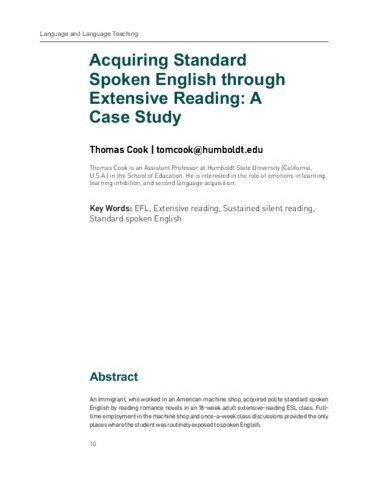
An immigrant, who worked in an American machine shop, acquired polite standard spoken English by reading romance novels in an 18-week adult extensive-reading English as a Spoken Language (ESL) class. Full time employment in the machine shop and once-a-week class discussions provided the only places where the student was routinely exposed to spoken English.